Description
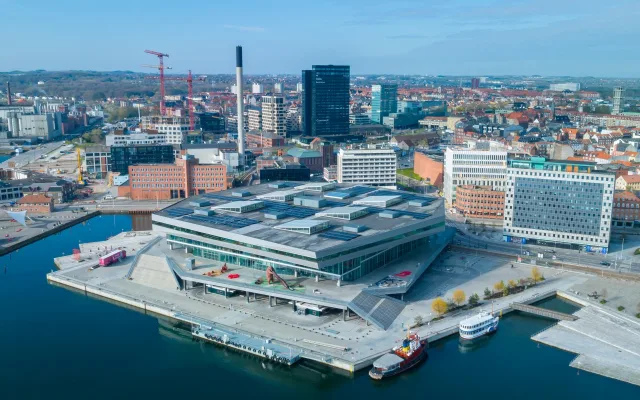
Aarhus is Denmark's second-largest city, known for the ARoS art museum and the open-air history museum Den Gamle By. The city also has a thriving youth culture.
Wiki
Aarhus is a compact harbour city on the eastern coast of Jutland, easy to enjoy over a couple of unhurried days: almost everything in the centre is walkable, and world-class museums sit alongside student bars and waterfront promenades. Denmark's second city feels more relaxed than Copenhagen and noticeably cheaper for accommodation, yet its cultural programme is every bit as rich.
Getting there and getting around
- Flights. Aarhus has its own small airport (Aarhus Airport, AAR) on the outskirts — with limited routes — served by a shuttle bus to the centre. Most travellers fly into Billund Airport (BLL) or even Copenhagen (CPH), both of which have direct trains and buses to Aarhus. The train from Copenhagen takes around 3 hours; book ahead and look for DSB's cheaper orange fares.
- Trains and buses. The main station (Aarhus H) is centrally located, with a shopping centre and bus stops right next to it. Long-distance FlixBus coaches are cheaper than the train if you book in advance.
- Getting around the city. The centre is small: ARoS, the cathedral and the Latin Quarter are all 10–15 minutes on foot from the station. There is a modern tram (Letbane) and bus network; pay by card or through the Midttrafik app. For more distant spots (Moesgaard, Marselisborg forest) a bicycle is ideal — the city is flat and cycling-friendly, with rental shops easy to find.
How long to stay and when to visit
Two days cover the essentials: one day for ARoS, the cathedral and the Latin Quarter, and a second for Den Gamle By plus a trip to Moesgaard or the coast. If you like to take museums slowly, add a third day.
The best time to visit is May to September: long daylight hours, open beaches and café terraces. Summer brings near-midnight light but also higher accommodation prices. Winter comes with early darkness and sea wind, though the museums and hygge-warm cafés are very much in season. Rain is possible any month, so pack a windproof jacket.
What is genuinely worth seeing
- ARoS — head straight for Olafur Eliasson's Your Rainbow Panorama: a circular walkway of coloured glass on the rooftop through which the whole city glows in rainbow hues. The permanent collection and rotating exhibitions inside are strong; allow at least a couple of hours.
- Den Gamle By — far more than a collection of old houses; it reconstructs entire eras, including 1920s and 1970s neighbourhoods alongside the 19th-century quarter, with working shops throughout. A great way to understand Danish daily life without the academic tedium.
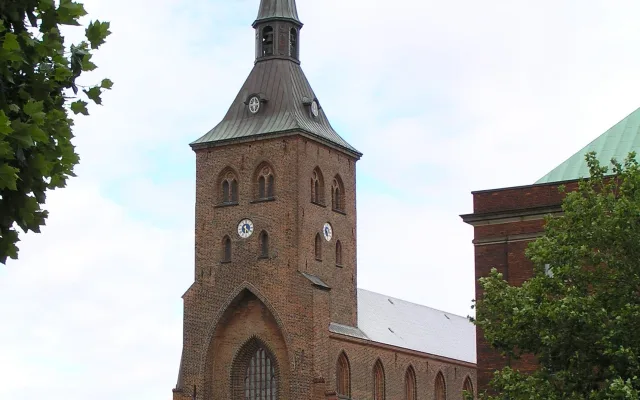
- Aarhus Cathedral (Domkirke) — entry is usually free; worth a visit for its scale and frescoes. The most lively stretch of the pedestrian city is right outside.
- The Latin Quarter — the oldest streets in town, lined with colourful facades. Come not to tick a box but to sit in a café, browse small design shops and vintage stores.
- Moesgaard (MOMU) — a short trip outside the city but well worth it: a striking building with a sloping grass roof you can walk up, and home to the Grauballe Man bog body. Best on a clear day — combine it with a walk in the surroundings.
- Marselisborg — the park around the royal summer residence is open to the public, with deer in the adjoining forest and a stretch of shoreline. A pleasant green break from the museums.
Where to stay
- City centre / near the station — everything walkable, maximum convenience, but pricier and noisier on weekends.
- Latin Quarter and surroundings — atmospheric, café culture on the doorstep, but parking is scarce.
- Frederiksbjerg (south of the station) — a residential neighbourhood with restaurants, quieter and slightly cheaper, about 10 minutes' walk from the centre.
- For budget stays, hostels and guesthouses are a real option; as a university city, Aarhus has a solid range of affordable accommodation, especially outside summer.
Food, prices and how to save money
Denmark is expensive, and Aarhus is no exception — though it is noticeably cheaper than Copenhagen. Dinner at a restaurant with drinks adds up quickly, so the local approach is straightforward:
- Eat a proper lunch and keep dinner lighter — lunch sets offer much better value.
- Look for smørrebrød (open-faced sandwiches) and street food; the city has a strong food scene and covered markets where tasting is cheaper than sitting down in a restaurant.
- Tap water is excellent and free — no need to buy bottled.
- Cafés and bakeries — Danish pastries are filling and good value for breakfast.
- Alcohol is expensive; supermarkets (Netto, Rema 1000, Føtex) are significantly cheaper than bars.
Practicalities and common mistakes
- Cash is rarely needed — cards and phone payments are accepted everywhere, including kiosks.
- Safety. The city is calm even at night; the main risks are fast-moving cyclists (stay off the cycle lanes) and petty theft in the bustle around the station.
- Don't try to fit Moesgaard, Den Gamle By and ARoS into one day — you will be exhausted and remember none of it. Spread them across days.
- Check museum closing days in advance: several close on Mondays outside peak season.
- A bicycle makes a real difference — if you are staying more than two days, renting one saves both time and transport costs.
- The student scene comes alive on Thursdays through Saturdays; if that is the atmosphere you are after, plan your evenings accordingly.