Abu Dhabi
United Arab EmiratesDescription
The capital of the UAE — the Sheikh Zayed Mosque, Ferrari World and the Louvre Abu Dhabi.
Wiki
Abu Dhabi is the capital of the United Arab Emirates and of the emirate of the same name, which takes up over 80% of the country's territory. Built on coastal islands in the Persian Gulf, this city has turned oil wealth into a showcase of architecture, culture and family holidays, while remaining noticeably calmer and more orderly than neighbouring Dubai.
A little history
As recently as the middle of the 20th century, the settlement on the site of today's capital was a fishing and pearling village of mud-brick houses with the fort of the ruling Al Nahyan family. Qasr Al Hosn, the oldest stone structure in the city, has now been restored and works as a museum telling the story of the pre-industrial life of the Bedouin and the pearl divers. The discovery of large oil reserves at the end of the 1950s and the formation of the federation in 1971 under Sheikh Zayed bin Sultan Al Nahyan changed the face of the emirate within a few decades: broad avenues, green boulevards and high-rise quarters rose where there had been sand.
Main sights
- The Sheikh Zayed Grand Mosque — the emblem of the country and one of the largest places of worship in the world, holding tens of thousands of worshippers. The gleaming white marble, the inlay of semi-precious stones, the gilded details, the giant hand-woven carpet and the crystal chandeliers make a powerful impression. Entry is free, but a strict dress code applies; women are given an abaya if needed. It is worth checking the timetable — on Friday mornings access for visitors is restricted.
- The Louvre Abu Dhabi on Saadiyat Island — a museum under a latticed dome that creates a "rain of light", designed by Jean Nouvel. The display is arranged as a dialogue of civilisations: archaeology, painting, sculpture and decorative art from antiquity to the present day, including works brought from the Paris collections.
- Ferrari World on Yas Island — an indoor theme park with some of the fastest roller coasters on the planet (Formula Rossa), simulators and rides for the whole family in the marque's signature red.
- Yas Island — an entertainment cluster where, besides the Ferrari park, there are the Yas Waterworld water park, the Warner Bros World theme park and the Yas Marina Circuit, which hosts the closing round of the Formula 1 season, the Abu Dhabi Grand Prix.
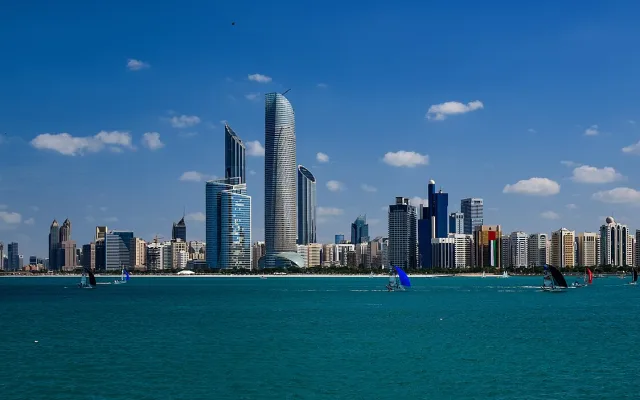
- The Corniche — a landscaped waterfront some eight kilometres long, with cycle paths, beaches, parks and a panorama of the business district.
Districts and the city environment
The historic core, with its markets and the old fort, sits alongside the modern centre around the Etihad Towers skyscrapers and the "leaning" Capital Gate tower. The cultural quarter is concentrated on Saadiyat, where new museums are going up next to the Louvre. Yas Island is responsible for entertainment and sport, while the Masdar City district is conceived as an experimental eco-city with a low carbon footprint. The presidential palace of Qasr Al Watan deserves attention of its own; part of it is open to visitors as a museum of statehood.
Food
The cooking reflects the varied make-up of the population. It is easy to find both Middle Eastern classics — hummus, falafel, shawarma, grilled meat — and Emirati dishes: machboos, a rich rice with lamb, a sweet porridge with fish or chicken, dates and cardamom coffee served by tradition of hospitality. Alongside these, Indian, Pakistani, Filipino and European cuisines are widely represented. Alcohol is sold mainly in licensed restaurants and in bars attached to hotels.
Practicalities
A comfortable itinerary takes about three days: a day for the mosque and the centre, a day for the Saadiyat museums and the waterfront, and one more on Yas Island. The best time to visit is the cool season from November to March; in summer the heat and high humidity are wearing. From Dubai it is roughly an hour and a half to the capital by car or scheduled bus. Getting around the city is easiest by taxi and ride-hailing apps, with public transport provided by buses. It is worth dressing more modestly than at the resorts, out of respect for local custom, and checking current ticket prices and opening hours in advance, since these change from time to time.