AlUla
Saudi ArabiaDescription
Nabataean Hegra in the Saudi desert — rock-cut tombs, Elephant Rock, canyons and a mud-brick old town.
Wiki
AlUla is an oasis town in the north-west of Saudi Arabia, in Medina Province, long closed to foreign travellers and opened to general tourism only at the turn of the 2020s. Set among sheer walls of red sandstone and date palms, it holds the traces of civilisations that traded incense along the ancient caravan road, and it is fairly regarded as the kingdom's greatest archaeological asset.
History and heritage
The AlUla valley has been inhabited for millennia: the Incense Route ran through it, linking southern Arabia with the Mediterranean. The kingdoms of Dadan and Lihyan succeeded one another here, along with Minaean merchants and later the Nabataeans, whose state, with its capital at Petra, reached these lands. The region's peak came around the turn of the era, when the Nabataeans cut monumental tombs into the rock. Later the oasis became an important stop on the hajj route from Damascus to Mecca, as the old caravanserais and a section of the early twentieth-century Hejaz Railway recall.
The main sights
- Hegra (Mada'in Salih) — Saudi Arabia's first UNESCO World Heritage Site. The necropolis holds over a hundred monumental tombs cut into free-standing sandstone outcrops, their façades carved with capitals, rosettes and figures of eagles and sphinxes. The most famous is Qasr al-Farid, the "Lonely Castle", standing by itself with an unfinished façade.
- Elephant Rock (Jabal AlFil) — a huge weathered monolith whose silhouette suggests an elephant with its trunk down. It is at its best in the light of sunset, and viewing areas have been laid out around it.
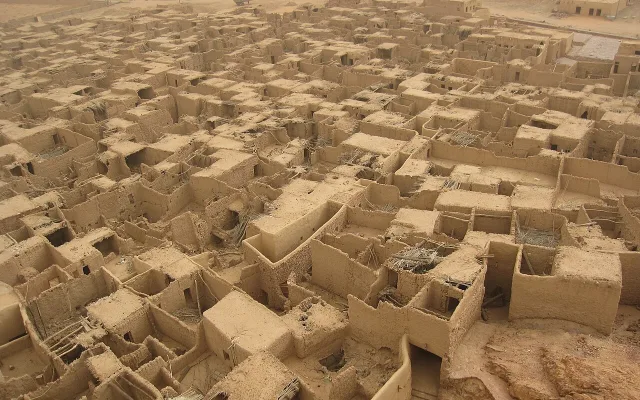
- AlUla Old Town — a maze of mud-brick houses built from roughly the twelfth and thirteenth centuries onwards. Part of it has been restored, with craft workshops and shops along a rebuilt market street.
- Dadan and Jabal Ikmah — the ruins of the capital of the Dadanite and Lihyanite kingdoms, and an "open-air library": a rock canyon carrying hundreds of ancient inscriptions and petroglyphs in several languages.
- Maraya — a concert and exhibition hall clad entirely in mirrored panels that reflect the surrounding desert; it holds the record as the largest mirrored building in the world.
Beyond the monuments, the valley draws people for its landscape: canyons and natural arches, oasis paths through the palm groves, and stargazing in a desert with almost no light pollution.
Food
The cooking follows the traditions of Najd and the Hejaz. The staple is kabsa, fragrant rice with lamb or chicken and spices, along with mandi, meat and rice cooked in an underground oven, and harees, a thick wheat and meat porridge. The particular pride of the district is AlUla dates, reckoned among the best in the country; they are served with cardamom coffee, gahwa, and used in desserts. Restaurants in the resort area also offer modern cooking, and lunch in a town café costs far less than dinner in a hotel restaurant.
Getting there and around
AlUla's regional airport (code ULH) takes domestic flights by the Saudi carriers from Riyadh and Jeddah, plus some international and charter services in high season. The alternative is to fly to Medina and drive, about three to four hours. From the airport a taxi or a hotel transfer is the easiest way into town.
Visits to the monuments run on a system of tourist packages: access to Hegra and several other areas is with guides and on shuttle buses, since driving yourself through the protected zones is restricted. A free hop-on hop-off tourist bus links the key points around the oasis. For trips further afield many people hire a car.
When to go
The comfortable season runs from October to April, with pleasant days and cool evenings. The winter months carry the AlUla Moments cultural season of concerts, exhibitions and sporting events, and that is the peak of visitor numbers. In summer, June to August, the heat reaches extremes and some routes run only in the early morning or close altogether, so it is not the season for working through the ruins and canyons.
How long to plan
About three days is the right amount. The first logically goes to Hegra and the natural landscape, including Elephant Rock; the second to Dadan, the Ikmah canyon and the Old Town; the third to unhurried walks around the oasis, a visit to Maraya and the desert in the evening light.