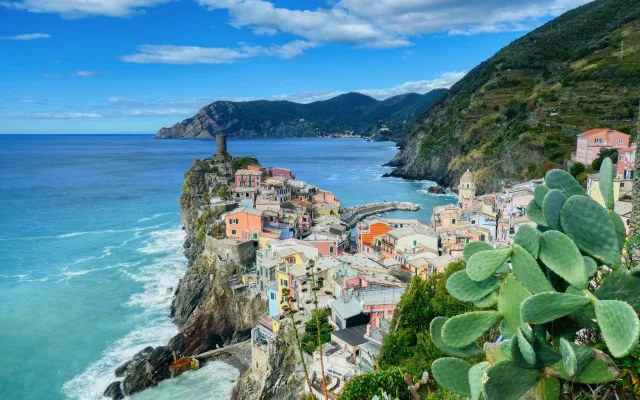
Description
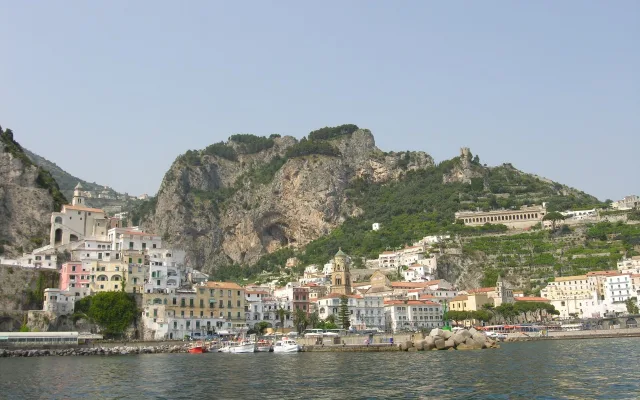
Amalfi is a town on the Italian coast, known for its sheer cliffs, pastel-coloured villages, lemon groves and the clear waters of the Tyrrhenian Sea.
Wiki
Amalfi is a small seaside town in southern Italy that lent its name to one of the most beautiful stretches of the Mediterranean. It sits in a narrow gorge between the sheer cliffs of the Sorrentine Peninsula and the azure waters of the Tyrrhenian Sea, in the province of Salerno in the Campania region. Despite its modest size and population of around five thousand, Amalfi preserves the memory of its days as the capital of a powerful maritime republic, and today is inscribed on the UNESCO World Heritage List together with the entire coastline.
History and heritage
In the 9th–11th centuries Amalfi was an independent maritime power rivalling Venice, Pisa and Genoa. Its merchants traded with Byzantium, the Arab East and North Africa, and local traders are credited with spreading the marine compass across Europe as well as the maritime legal code known as the Tabula Amalfitana. The golden age ended in the 12th century with the Norman conquest and Pisan raids, while a devastating storm in 1343 swallowed much of the lower town. What survives of the former greatness is a tangle of narrow lanes, steep staircases and an eastern flavour in the architecture, where Moorish motifs interweave with Romanesque and Gothic.
Main sights
- Cathedral of Sant'Andrea (Duomo di Sant'Andrea) — the heart of the city, raised above the main square by a broad ceremonial staircase. Its striped façade in the Arab-Norman manner, rebuilt in the 19th century, its Byzantine bronze doors and bell tower set it apart from other churches in the south. The crypt holds the relics of the Apostle Andrew, patron of the city.
- Chiostro del Paradiso (Paradise Cloister) — a 13th-century monastery courtyard adjoining the cathedral, with elegant interlacing arches in the Moorish spirit; it served as a burial place for the town's nobility.
- Paper Museum (Museo della Carta) — housed in a medieval mill where the ancient technique of hand papermaking, which made local workshops famous, is still demonstrated.
- Valle delle Ferriere (Valley of the Ironworks) — a gorge above the town with waterfalls, the ruins of paper factories and rare Mediterranean flora, including relict ferns.
The coast and surroundings
Amalfi makes a convenient base for exploring the coastline. Nearby Ravello, perched on a cliff above the sea, is home to the Villa Rufolo and Villa Cimbrone with their celebrated gardens and terraces, where a music festival takes place every summer. Positano is a vertical village of pastel houses tumbling down to the beach. Walkers are drawn to the Path of the Gods (Sentiero degli Dei), which runs along the mountain ridge from Bomerano (Agerola) to Nocelle: it offers the most breathtaking views of the shore, the lemon terraces and the island of Capri. Capri itself, with its Blue Grotto, is reachable by sea in a day trip.
Food and drink
The local table is built on the gifts of the sea and the famous Amalfi sfusato lemons, whose zest goes into the liqueur limoncello. Worth trying are gnocchi alla sorrentina, risotto al limone, spaghetti alle vongole with clams, fresh buffalo mozzarella and the dessert delizia al limone. White Campanian wines — Greco di Tufo and Fiano — accompany fish dishes. Lunch at a family trattoria runs roughly 25–35 € (about $29–40), dinner with seafood 60–100 € ($69–115) for two, a glass of wine 5–8 € ($6–9). Prices are as of 2026.
Getting there and getting around
The nearest gateway is Naples Airport (NAP), around 60 km away. From Naples, a convenient option is the train to Salerno (about 50 minutes), then onward by SITA bus or ferry. In the warm season the sea route Salerno–Amalfi–Positano–Capri is preferable: ferries spare you the hours-long traffic jams on the narrow coastal corniche. The town itself is navigated entirely on foot — cars have no room here and parking is expensive and limited.
When to visit
The best time is late spring and September, when temperatures reach 22–26 °C, the sea stays warm and the crowds are still manageable. July and August are peak season: hot, crowded and expensive, with hotels fully booked. In late autumn and winter many hotels and restaurants close, but the empty lanes and quiet sea reveal a different, more contemplative side of Amalfi. Three days is enough to see the town itself, visit Ravello and Positano, and walk at least part of the mountain trails.