Description
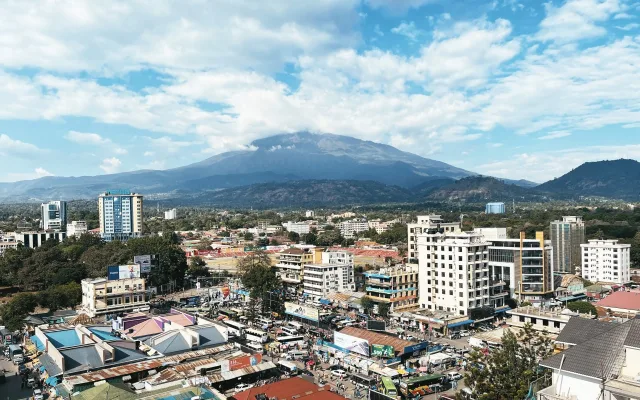
The gateway to the Serengeti and Ngorongoro — the safari organising centre, Mount Meru and coffee plantations.
Wiki
Arusha is not about the town but about what leaves it heading north — all Tanzania's great parks begin here. Most people come for a day or two to put a safari together, buy any missing gear and sleep before an early departure, and in that role the town works very well.
Why come, and how many days
Arusha is a logistics hub, not a destination. The realistic pattern: arrive, spend the night, use a day to prepare the safari (meeting operators, changing money, pharmacy, SIM card), a second night, and a morning departure to the parks. Two days is ample. If the safari is already booked online, one night before and one after is enough — and the "after" is the more useful, because coming off a dusty jeep into a shower and a proper bed is worth a lot.
One thing does justify half a day of its own: Mount Meru (4,566 m). It is the country's second-highest volcano and the best acclimatisation before Kilimanjaro: the climb takes three to four days, the trails are quieter, and in clear weather Kili itself is visible from the summit. Even without climbing, the lower slopes in Arusha National Park offer a walking mini-safari with a ranger — a rare format in Tanzania.
What is actually worth seeing
- Arusha National Park — compact and underrated. The slopes of Meru, flamingos on the Momella lakes, giraffes, buffalo and colobus monkeys. People come for half a day or a day as a rehearsal for the big safari, or when there is no time for the Serengeti.
- Ngorongoro — about three hours away. A caldera with a furious density of wildlife: the Big Five in a single day is realistic. Entry costs more, but the return is better than on many multi-day routes.
- The Serengeti — six to seven hours by road, for the Great Migration (July to October at the Mara river). Because of the distance many take a light aircraft from Arusha airport (ARK).
- Tarangire — closer than the Serengeti, famous for elephants and baobabs, and at its best in the dry season.
- Coffee plantations on the slopes — a tour with tasting and an explanation of the full cycle from bean to cup; an inexpensive and honest alternative if you want something local without a souvenir zoo.
In town, the Maasai market (beadwork, shukas, carving; haggling is obligatory, start at a third of the asking price) and the Cultural Heritage Centre with its gallery of African art take a couple of hours, no more.
Where to stay
Choose by purpose. The centre, around the Clock Tower, is convenient for meeting operators, banks and the market — all on foot. Quieter and greener are the districts to the west and towards Usa River on the airport road, where camps and lodges have gardens and it is easier to set off east towards the parks. Hostels and guest houses in the centre are cheap; the lodges on the edges offer comfort and transfers, but without a car you are tied to the grounds in the evening.
Transport
Kilimanjaro International Airport (JRO) is about an hour away, between Arusha and Moshi; KLM, Qatar, Turkish and Ethiopian fly in. The shared shuttle into town is cheaper than a private taxi but waits until it fills. Arrange the transfer through your hotel in advance — at the terminal exit the prices are higher and the touts many.
Within the town there are dala-dalas (minibuses, pennies, but with no timetable or logic a newcomer can follow) and boda-bodas (motorcycle taxis, 2,600-5,300 TZS / $1-2 across the centre; ask for a helmet, the traffic is chaotic). The centre is compact and walkable, which is enough for a two-day visit. Self-drive safari is barely practised in Tanzania: the parks require a guide, the roads are hard going, and it is cheaper and simpler to go through an operator. Prices are as of 2026.
Dozens of operators — how not to get burned
This is Arusha's main risk. A safari means large sums paid up front, and there is no shortage of fly-by-night firms.
- Look for members of TATO, the tour operators' association, and check reviews on several platforms rather than trusting correspondence alone.
- Do not pay the full amount in cash without a contract; get in writing what is included (park entry, accommodation, water, staff tips).
- Ignore the street touts, the "flycatchers" — they resell you to a real operator at a mark-up.
- A group tour is cheaper than a private one: a three-day group safari runs roughly $600-900, while private trips and premium lodges cost considerably more. Operators quote in US dollars.
Food and money
The local cooking is simple and filling: nyama choma (meat over coals), ugali with stew, chipsi mayai (an omelette with chips). Lunch at a local café is cheap; a tourist restaurant is noticeably dearer but still manageable. Cash in shillings is needed for the market, the boda-bodas and tips; dollars are used for safaris and lodges — bring fresh notes without tears, as old ones may be refused. There are ATMs in the centre, but withdraw a reserve in advance; there are none in the parks.
When to go
The dry season, June to October, is the best time: the animals draw in to water, the roads are passable, and the migration is at the Mara. December to March is the green season: cheaper, with calving among the grazers, but short rains. March to May, the long rains, sees some lodges close and the dirt roads dissolve — though prices are at their lowest and there are almost no visitors.
Common mistakes
- Booking a safari in a panic within an hour of landing — sleep on it and compare a couple of offers.
- Underestimating the altitude: Meru and Ngorongoro are 2,000-4,500 m, cold by evening, and you need a warm layer even in "hot Africa".
- Cutting days in the park to add a night in Arusha — the town is not worth it.