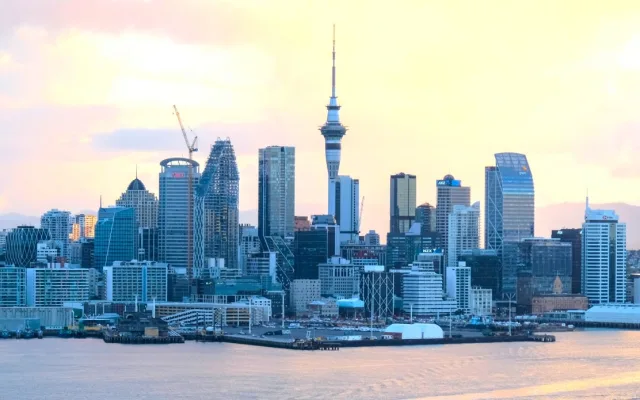
Auckland
New ZealandDescription
New Zealand's largest city — the Rangitoto volcano, the Harbour Bridge and the view from the Sky Tower.
Wiki
The largest city in New Zealand and its economic capital — around 1.7 million people, roughly a third of the country's population in one place. Its nickname is the City of Sails: there are more sailing boats per head here than in any other city in the world. It sits on a narrow isthmus between two harbours, the Manukau and the Waitematā, and is surrounded by 53 extinct volcanoes. It is the ideal starting point for the whole country.
Main sights
- The Sky Tower — 328 m, the tallest tower in the southern hemisphere, with the SkyJump base wire and the SkyWalk around the rim.
- Auckland Harbour Bridge — the city's main bridge, open for a bridge climb and a bungee.
- Mount Eden (Maungawhau) — a 196 m volcanic cone with a crater, and the best viewpoint over the city.
- Devonport — an old naval suburb 12 minutes away by ferry, with beaches and colonial houses.
- One Tree Hill (Maungakiekie) — another large volcanic cone, with a sacred Maori site and an obelisk.
- The Auckland Domain — the oldest city park, and the Auckland War Memorial Museum, the country's principal museum, with a great Maori collection.
- Viaduct Harbour — the restored waterfront of bars and restaurants, the centre of America's Cup activity.
- Waiheke Island — the wine island, 35 minutes by ferry, with 30 wineries.
- Rangitoto Island — the young volcanic island in the harbour, with a walk up to the crater at 260 m.
- The west coast beaches — Piha, Karekare and Muriwai, black sand, 40 minutes away.
- Hobbiton — the Lord of the Rings film set, two hours away at Matamata.
- The Bay of Islands — three hours north, the historic heart of Maori and colonial New Zealand, with the Waitangi Treaty Grounds.
Food and prices
The cooking is modern New Zealand: lamb, seafood, hāngī (Maori food cooked in the ground), the flat white and Marlborough sauvignon blanc. Lunch in a café is NZ$18-28 ($11-16), dinner in a restaurant NZ$40-80 ($24-47). A bottle of sauvignon blanc costs NZ$15-25 ($9-15). A litre of petrol is NZ$2 ($1.20), public transport on the AT HOP card NZ$5-7 ($3-4), and a taxi or Uber NZ$15-30 ($9-18). Prices are as of 2026.
Getting there and getting around
Auckland International Airport (AKL) is the largest in New Zealand, served by Air New Zealand, Qantas, Singapore and Emirates. The SkyDrive bus into the centre costs NZ$15 ($9) and takes 45 minutes; a taxi is NZ$60-70 ($35-41). Around the city there are trains, buses and ferries on one AT HOP network. To Wellington it is an hour by air (NZ$60-200 / $35-118) or eleven hours on the Northern Explorer train.
When to go
December to March, the southern summer, is 18-25°C and ideal. January and February are peak season, with many events including Music in Parks. Winter (June to August) is 8-15°C and rainy. The Pasifika Festival falls in March and the Auckland Lantern Festival in February.