Baku
AzerbaijanDescription
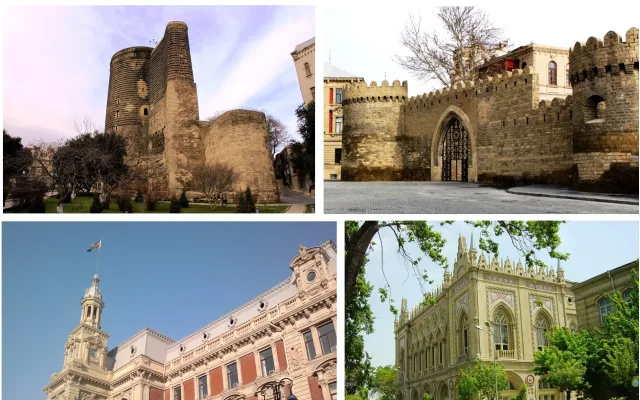
Azerbaijan's capital on the Caspian: the walled old town of Icherisheher, the Maiden Tower and the Flame Towers of the oil era.
Wiki
Baku is the capital and largest city of Azerbaijan, spread like an amphitheatre along the southern shore of the Absheron peninsula on the Caspian Sea. A thousand years of fire worship and medieval caravans sit next to the mirrored towers of the oil age, and it is that contrast which brings travellers here.
History and the shape of the city
A settlement stood on the site long before the common era, and its rise is bound up with oil, which seeped to the surface here and fed the sacred fires of the Zoroastrians. In the Middle Ages Baku was a port and the capital of the Shirvanshah state; later it passed to Persia, and from the early nineteenth century to the Russian Empire. The real explosion came with the oil boom at the turn of the twentieth century: the city acquired oil barons' mansions, theatres and broad European-style avenues. A second transformation began in independent Azerbaijan, when new money produced the Flame Towers and the seafront of glass and steel.
The nickname "city of winds" is well earned: strong currents blow in regularly from both sea and land, bringing coolness in summer and a piercing chill in winter. The Azerbaijani name Bakı is often linked to the Persian bād-kūbe, "pounded by the wind".
Icherisheher and the heart of the old city
The historic core is the walled quarter of Icherisheher, inscribed on the UNESCO World Heritage list together with the Maiden Tower and the Palace of the Shirvanshahs. Inside the walls hides a labyrinth of cobbled alleys with old bathhouses, merchants' caravanserais, minarets and carved portals. It is still a residential district: washing hangs from the wrought-iron balconies and children play in the courtyards.
- The Maiden Tower (Qiz Qalasi) — an enigmatic structure whose exact purpose historians still argue about. The top platform gives a view over the bay and the tiled roofs.
- The Palace of the Shirvanshahs — a fifteenth-century complex with a burial vault, a mosque and the divankhana, now a museum of medieval art and daily life.
- Caravanserais and mosques — the Bukhara and Multani inns recall the city's place on the caravan routes, and the Muhammad Mosque with its "broken" minaret dates from the eleventh century.
Modern architecture
Outside the fortress walls, Baku shows off the ambitions of a new century. The three leaves of the Flame Towers rise over the city and come alive in the evening with lighting that mimics tongues of fire — a direct nod to the fire cult. The Heydar Aliyev Centre by Zaha Hadid is astonishing for its flowing white lines without a single right angle; inside are museums and exhibition spaces. The seafront Boulevard runs for several kilometres along the shore, tying together parks, fountains, a shopping centre shaped like a rolled carpet and a big wheel.
Around the city: fire and stone
The Absheron peninsula holds traces of ancient cults and natural curiosities. Ateshgah is a fire temple with a perpetual flame, where Zoroastrians and Hindu pilgrims once prayed. Not far away the slope of Yanardag burns — a natural gas seep alight for centuries. South of the city is Gobustan, with thousands of prehistoric rock carvings and "singing" stones, and beside it the mud volcano fields for which Azerbaijan is famous.
Food
Azerbaijani cooking is generous and aromatic. The signature dish is saffron plov, served in dozens of variations, alongside thin qutab filled with herbs or meat, dolma in vine leaves, charcoal kebabs and sweet pakhlava. Tea is a ritual of its own: strong tea from a pear-shaped armudu glass with jam and lump sugar. The coffee scene is strong too, with modern roasteries and comfortable cafés in both the old quarters and the new districts.
Lunch in a chaikhana runs about 12–20 manat ($7–12), dinner in a restaurant 34–68 manat ($20–40), a cup of coffee 5–8.5 manat ($3–5). Prices are as of 2026.
Practicalities
Heydar Aliyev International Airport (GYD) is served by AZAL, Turkish Airlines, Lufthansa, Qatar Airways and others. The airport express bus into the centre costs 1.30 manat (about $0.80); a taxi is 25–34 manat ($15–20). Around town there is a three-line metro at 0.50 manat ($0.30) a journey, the Bolt app and local ride-hailing services, and buses. Car hire is roughly 42–68 manat ($25–40) a day, and a taxi out to Gobustan for the day 50–68 manat ($30–40).
The best months are April–June and September–October, when it holds a comfortable 20–28 °C. Summer is hot, though the sea breeze and moderate humidity take the edge off it; winter is cool at 3–10 °C and windy. The Formula 1 round is run on the streets around the Boulevard in September, and accommodation prices rise sharply for those days.
How to plan three days
Three days is enough for the main things. The first is best spent in Icherisheher with the Maiden Tower and the Palace of the Shirvanshahs, and the evening on the Boulevard looking at the lit towers. The second is modern Baku: the Heydar Aliyev Centre, the museums and the panorama from the Highland Park hills. The third is for a trip out of the city — Gobustan, Ateshgah and Yanardag show the "fiery" essence of Azerbaijan that gave the country its poetic name, the Land of Fire.