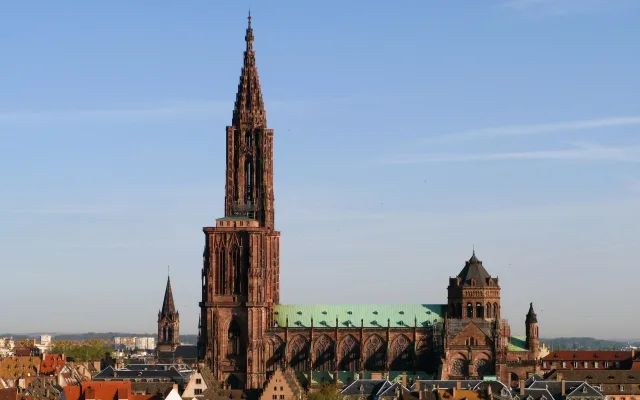
Description
The capital of French winemaking — the Port of the Moon, the Cite du Vin and hundreds of great chateaux.
Wiki
Bordeaux is a major city in south-western France, the administrative centre of the Nouvelle-Aquitaine region, spread along the banks of the Garonne. Its historic core was inscribed on the UNESCO World Heritage list in its entirety under the name "Port of the Moon" — for the distinctive crescent of the river channel and for one of the largest ensembles of 18th-century classical urban architecture in Europe. Above all, Bordeaux is known as the wine capital of the world: it gives its name to an entire wine region, the birthplace of the legendary Pauillac, Saint-Emilion and Pomerol.
History and appearance
Bordeaux was founded in antiquity as the Gallic and later Roman settlement of Burdigala. The wine trade began to flourish in the Middle Ages, when wine was shipped through the port to England — under the Plantagenets, Aquitaine belonged to the English crown for several centuries. The stately look of today's quays took shape in the Enlightenment: the authorities demolished the medieval walls and built a single ensemble of golden mansions in local limestone. For that honey tint to its facades Bordeaux is sometimes called the "little Paris" of the south, though its skyline and atmosphere are quite its own.
Main sights
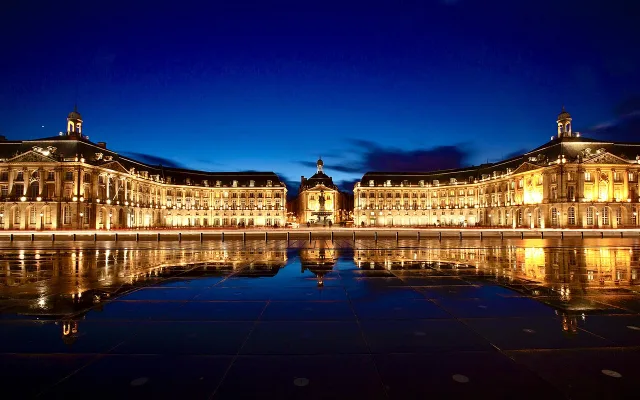
- Place de la Bourse and the Water Mirror — the emblem of the city. Facing the 18th-century palace square lies the Miroir d'Eau: the thinnest film of water on granite slabs turns the quayside into a mirror reflecting the facades, and in summer it gives way to a cloud of cooling mist.
- The Cite du Vin — a futuristic wine museum shaped like a decanter, or a swirl of wine in a glass. The displays are interactive and cover wine-growing cultures across the world; the top floor has a panoramic viewing room with a tasting usually included in the ticket.
- Porte Cailhau and the Grosse Cloche — two surviving city gates of the 15th and 16th centuries; the Grosse Cloche, with its great bell, stands on Rue Saint-James, a short step from Rue Sainte-Catherine.
- The Basilica of Saint-Michel — an example of southern Gothic with a free-standing bell tower, one of the tallest in France, looking out over the roofs of the old town.
- Saint-Andre Cathedral and the Pey-Berland tower — the place where Eleanor of Aquitaine was married; the tower doubles as a viewing point.
- The Esplanade des Quinconces — one of the largest city squares in Europe, with the monument to the Girondins.
- Rue Sainte-Catherine — the longest pedestrian shopping street on the continent, linking the key quarters of the centre.
Quarters
The old centre (Saint-Pierre), with its narrow streets and squares, is made for unhurried walking and evenings out. The Chartrons quarter is historically tied to the wine merchants: here you will find antique shops and the Marche des Chartrons. The right bank of the Garonne, the La Bastide district, is filling up with modern blocks and gardens and offers the best angle on the historic panorama.
Wine and food
The Bordeaux region divides into appellations of the left and right banks. On the left are the Medoc with its prestigious communes (Pauillac, Margaux, Saint-Julien) and the Graves with their famous sand-and-gravel soils; on the right, Saint-Emilion and Pomerol, where merlot dominates. Many chateaux receive visitors for tours and tastings by prior appointment.
The local cooking is rich and filling:
- entrecote a la bordelaise — steak in a sauce of red wine, shallots and bone marrow;
- caneles — small cakes with a crisp caramel crust and a soft vanilla-and-rum centre;
- oysters and seafood from the nearby Arcachon Bay;
- duck dishes, local cheeses and the wild mushrooms of the south-west.
The Marche des Capucins is considered the "belly" of the city — the place to go for fresh oysters and regional delicacies.
Trips out of town
- Arcachon — a resort bay on the Atlantic, with oyster farms and the Dune du Pilat, the tallest sand dune in Europe (over 100 metres). The train takes about an hour.
- Saint-Emilion — a medieval wine town on a hill, with a monolithic church cut into the rock, catacombs and vineyards all around.
- The Medoc wine route — a drive past the great chateaux with stops in Margaux and Pauillac.
Practicalities
TGV trains run from Paris to Bordeaux in about two hours. The modern tram is the easy way to get around: several lines connect Saint-Jean station, the centre and both banks of the river. The historic quarters are compact and made for walking. Around three days is the right length for a trip: enough to see the city and make one or two excursions to the vineyards or the ocean.