Boston
United StatesDescription
America's oldest major city, home to the Freedom Trail, Harvard in Cambridge, lobster rolls at Quincy Market, and the legendary Boston Red Sox.
Wiki
Boston is the capital of Massachusetts and the largest city in New England, set on the Atlantic coast at the mouths of the Charles and Mystic rivers. Founded by English Puritans in 1630, it is one of the oldest cities in the United States and retains a distinctly European atmosphere: narrow cobbled streets, Georgian brick townhouses, and a compact, walkable centre. The city proper has around 700,000 residents; the Greater Boston metropolitan area is home to nearly 5 million.
History and the Revolution
Boston is rightly called the cradle of American independence. It was here that the Boston Massacre took place in 1770, and in 1773 the Boston Tea Party saw colonists dump a cargo of British tea into the harbour in protest against taxation. The War of Independence began in the surrounding area — the first shots were fired at Lexington and Concord, and the Battle of Bunker Hill was one of the earliest major engagements. For generations Boston remained the country's foremost seaport, a centre of abolitionism and learning, and earned itself the title "the Athens of America."
Main Sights
The classic introduction to the city is the Freedom Trail — a roughly four-kilometre route marked by a red line on the pavement. It strings together sixteen historic sites: the old Faneuil Hall, Old North Church (from whose steeple lanterns signalled the British advance), the Granary Burying Ground, and the USS Constitution, an 18th-century frigate still in active commission.
Other highlights:
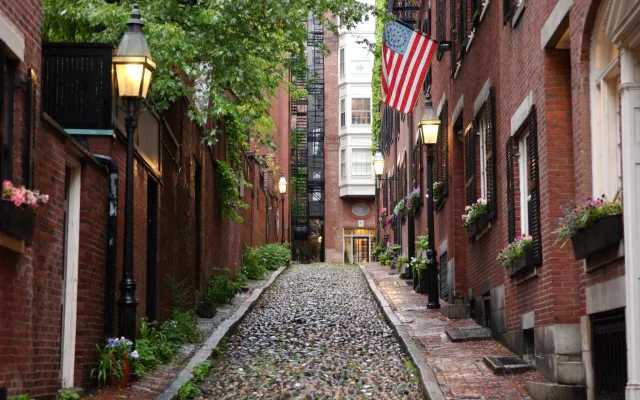
- Beacon Hill — an aristocratic neighbourhood of gas lamps, brick pavements and picturesque Acorn Street, one of the most photographed streets in the country.
- Boston Common and the Public Garden — the oldest public park in the United States (1634) and the adjoining garden with a pond where swan boats have ferried visitors for generations.
- Fenway Park — the oldest active Major League Baseball stadium (1912) and home of the Boston Red Sox; tours run year-round.
- Quincy Market and neighbouring Faneuil Hall — covered market halls with street performers and dozens of stalls serving New England food.
- Back Bay — a turn-of-the-century neighbourhood of elegant brownstones, the boutique-lined Newbury Street, and the Prudential and John Hancock towers.
Harvard, MIT and Cambridge
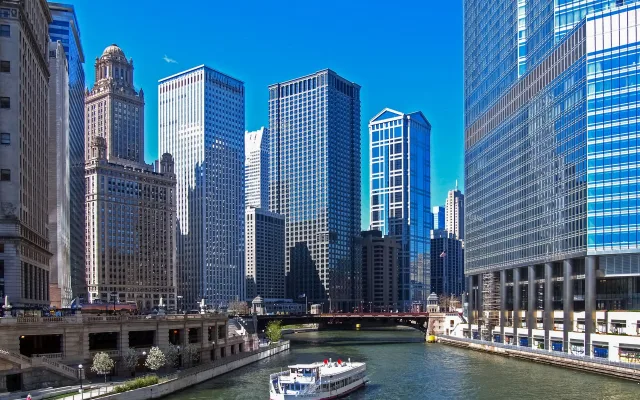
Across the Charles River lies the city of Cambridge, home to two world-renowned universities. Harvard, founded in 1636, is the oldest university in the country; its tree-lined Harvard Yard is open to the public, and nearby are several museums and the landmark Widener Library. The Massachusetts Institute of Technology (MIT) draws visitors with its bold architecture — including Frank Gehry's angular Stata Center. A walk along the Charles River Esplanade connects both banks and offers sweeping views of the downtown skyline.
Food
Boston's food scene is inseparable from the Atlantic. Must-tries include creamy clam chowder, a lobster roll, fresh oysters, pan-fried cod, and fish and chips. The Italian and Irish immigrant heritage is tangible in the North End, celebrated for pasta, pizza and cannoli. A café lunch runs around $18–25, dinner at a restaurant $50–100, and a lobster roll at popular spots such as Neptune Oyster costs around $35. Prices are as of 2026.
Getting Around
The main gateway is Logan International Airport (BOS), connected to the city centre by the Silver Line bus (free as far as Silver Line Way); a taxi costs roughly $30–40. Within Boston the T — the oldest subway system in the United States, with four colour-coded lines supplemented by buses and trams — is the easiest way to get around; fares are paid with a CharlieCard (around $2.40). The Bluebikes cycle-hire scheme is well developed, and the compact centre means most sights are within easy walking distance of each other.
When to Go and a 3-Day Itinerary
The best time to visit is May through October, when temperatures reach 15–28 °C. Fall foliage season (September–October) is particularly spectacular, when New England's maples turn deep red and gold. Winters are cold and snowy — worth factoring in when planning.
Three days is enough to explore the city at a relaxed pace:
- Day 1 — Walk the Freedom Trail from Boston Common to the USS Constitution, lunch at Quincy Market, evening in the North End.
- Day 2 — Beacon Hill, Back Bay and Newbury Street, followed by the museums or the Public Garden.
- Day 3 — Cambridge: Harvard and MIT campuses, a stroll along the Charles River Esplanade, and optionally a game or tour at Fenway Park.