Description
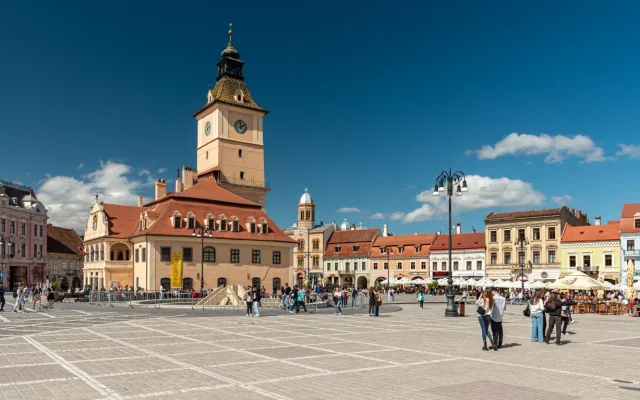
Saxon Transylvanian city at the foot of the Carpathians — gateway to Bran and Peleș castles, with the atmospheric central square of Piața Sfatului.
Wiki
Brașov is one of Romania's most convenient base towns: a compact Saxon centre from which the main castles of Transylvania are easily reached, while the town itself is pleasant enough for an unhurried couple of days. The mountains press right up against the old centre, so even without venturing further afield there is always somewhere to head on foot.
What's Actually Worth Seeing
The heart of the city is Piața Sfatului and the streets around it. All the historic buildings, cafés, and walk-starting points are here. You can cover it in an hour or two, but it's the kind of place that rewards simply sitting.
- The Black Church (Biserica Neagră) — the largest Gothic church between Vienna and Istanbul, named after a 17th-century fire that blackened its walls. Inside: a historic organ and a collection of Oriental carpets. Worth going in — not just a box-ticking exercise.
- Strada Sforii (Rope Street) — one of the narrowest streets in Europe, literally a passageway between buildings. A small thing, but curious and just a couple of minutes from the centre.
- Mount Tâmpa — a cable car runs straight from the city; from the top all of Brașov spreads out below you. If you have the energy, a switchback walking trail also leads up (about an hour). Take the cable car up and walk down, or vice versa.
- Fortified gates and bastions (Ecaterina, Schei) — remnants of Saxon fortifications along the edge of the old town; you'll pass them as you walk around without needing to schedule separate time for them.
The castles are the main reason to come here. Bran ("Dracula's Castle") is atmospheric but small and heavily crowded; its connection to Vlad the Impaler is purely a marketing exercise — it's worth visiting for the building itself and the views, not for any "Dracula history." Peleș in Sinaia is the opposite: a lavish royal palace with richly decorated interiors, and for many visitors more rewarding than Bran. The museum is visited by guided tour only.
How to Plan 2 Days
- Day 1 — Brașov itself: the centre, the Black Church, the cable car up Tâmpa, a walk through the old town and the Șchei quarter.
- Day 2 — a castle excursion. Combining Bran with Râșnov Fortress is realistic (they're on the same road). Peleș and Sinaia lie in the opposite direction and shouldn't be combined with Bran in a single day.
If you have three days, take both Bran + Râșnov and a separate day for Sinaia and Peleș.
Getting There and Getting Around
Brașov-Ghimbav Airport (GHV) opened recently and has limited direct connections. It is often better value to fly into Bucharest (OTP) and continue by train — the mountain scenery along the way is beautiful, and the journey takes roughly 2.5–3 hours. The train is the most relaxed option: no traffic jams on the mountain road, which grinds to a standstill in high season.
The old centre is small enough to cover entirely on foot. Buses to Bran run from the bus station (roughly an hour to an hour and a half) and are the cheapest option. A taxi or transfer there and back costs more but saves time and lets you stop at Râșnov. For Sinaia and Peleș, the train is most convenient — it uses the same line as Bucharest.
Where to Stay
Stay within the old town or close to Piața Sfatului and everything is within walking distance, with the lively evening centre on your doorstep. Accommodation near the train station is cheaper, but you'll have to travel into the centre each day. For a two-day stay there's little point in being far out.
Food and Money
The cuisine is hearty and inexpensive by European standards: sarmale (stuffed cabbage rolls), mici (grilled skinless sausages), mămăligă (cornmeal polenta), ciorbă (sour soup). Look for places with a local tavern feel — they tend to be better and cheaper than the tourist-facing spots on the square itself. Romanian wines are underrated; local Fetească Neagră is a good choice with meat. Keep some cash for buses and small vendors, but cards are accepted almost everywhere.
When to Go and What to Watch Out For
The best time is May to October: warm weather, all trails and cable cars running, castles open. In winter (December–March) people come for skiing at Poiana Brașov, 12 km from town. In summer and at weekends Bran and the centre get very crowded — arrive at the castle when it opens, before the coach parties.
Common mistakes: trying to squeeze Bran and Peleș into one day; visiting the castles in the middle of the day and queuing; underestimating mountain weather — even in summer it is cooler at altitude and rain can set in, so a light jacket is a good idea.