Description
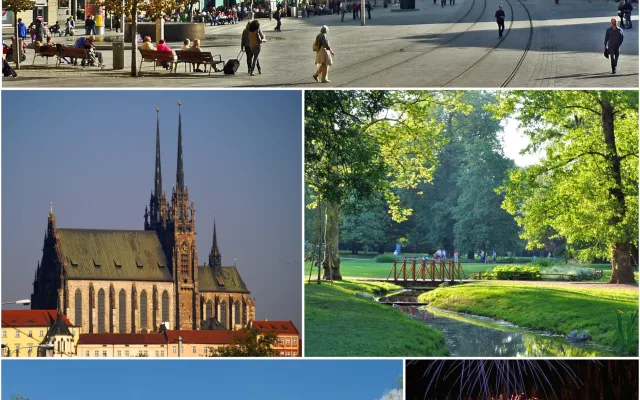
The Czech Republic's second city, home to the UNESCO-listed Villa Tugendhat, the Brno Ossuary, and a thriving student scene.
Wiki
The Czech Republic's second city lives in Prague's shadow — and for independent travellers, that is a genuine advantage: prices are noticeably lower, crowds are thin, and there is enough to fill two packed days. This is where Gregor Mendel worked out the laws of heredity in a monastery garden, and where the Tugendhat family commissioned Mies van der Rohe to build what became an icon of modernism.
What Is Actually Worth Seeing
- Špilberk Castle — a 13th-century fortress on a hill that the Habsburgs turned into the empire's most feared political prison. The interior is optional, but the climb is rewarded by a panoramic viewpoint and a free stroll through the castle park.
- Cathedral of Saints Peter and Paul — neo-Gothic spires dominating the skyline. Its quirk: the bell strikes noon at 11:00. Legend has it that in 1645 the townspeople tricked the besieging Swedes into believing the day was over, forcing them to lift the siege.
- Villa Tugendhat — a UNESCO World Heritage Site, a 1930 masterpiece. The critical detail: tickets must be booked online in advance, often weeks ahead, especially for English-language tours of the residential areas. Walk-in entry is almost impossible — make this your very first booking.
- Capuchin Crypt — naturally mummified monks and 18th-century nobility. Morbid, inexpensive, and quick to visit; a short walk from the station.
- Freedom Square (Náměstí Svobody) — the city's hub, home to the distinctive black "astronomical clock" of unmistakably phallic shape. Every day at 11:00 a glass marble rolls out of it; locals catch one as a souvenir.
- Old Town Hall — the famous "Brno Dragon" hanging under the arch (actually a stuffed crocodile) and the deliberately crooked turret, which the stonemason allegedly built askew after being left unpaid.
If time allows, go underground. Beneath Zelný trh (the Cabbage Market) runs the Labyrinth, a network of medieval cellars and passages. The ossuary is somewhere else entirely: it lies under the Church of St James on Jakubské náměstí, was discovered by chance in 2001, holds the remains of more than 50,000 people, and is the second largest in Europe after the Paris catacombs.
How Many Days and How to Structure Your Visit
Two days is plenty, with room to spare. Day one: the historic centre on foot — the squares, cathedral, Špilberk, and the crypt. Everything is compact; each stop is 10–15 minutes' walk from the next. Day two: Villa Tugendhat (with your pre-booked ticket), the underground, and a leisurely café crawl. The city is very walkable; you will only need the tram to reach the villa or the station.
Getting Around
- Getting here. Brno–Tuřany Airport (BRQ) receives a limited number of Ryanair and Wizz Air flights. It is often cheaper to fly into Prague (PRG) or Vienna (VIE) and travel overland. From Prague, trains take about 2.5 hours (350–600 CZK, $17–29); from Vienna, RegioJet takes roughly 1.5 hours (from 12 EUR, about $14). FlixBus and RegioJet coaches are frequently cheaper than the train.
- Train tickets are cheapest bought online in advance rather than at the counter before departure.
- Within the city. Brno's pride is the DPMB tram network, supplemented by buses and trolleybuses. Tickets are time-based and valid across all modes; a day pass (around 120 CZK, $6) is handy if you plan to move around a lot. Validate your ticket immediately — inspectors are active and fines are steep.
- The main station. Brno hlavní nádraží is still where it has always been, on the edge of the historic centre. Talk of the station "moving" refers to a replacement that will not begin construction until the end of the decade at the earliest. Track work is frequent, though, so check the departure boards for your platform.
Where to Stay
Stay within the central belt between the main station and Freedom Square. Everything is walkable from here, and the bars are nearby for the evening. The city's student character means plenty of hostels and budget guesthouses; accommodation prices are noticeably lower than in Prague. One caveat: the centre is noisy at weekends because of the bar scene — look for a courtyard-facing room or a quieter side street if you are a light sleeper.
Food and Prices
The cuisine is Moravian and hearty: moravský vrabec (roast pork), bread dumplings, goulash. The region's defining drink is not beer but wine: Moravia is wine country, and the local Riesling and Pálava grape variety are worth seeking out.
- Lunch at a hospoda (pub-restaurant): 200–340 CZK ($9–16); dinner at a restaurant: 440–730 CZK ($21–35).
- A glass of Moravian wine: 70–120 CZK ($3–6); local draught beer: 40–50 CZK (about $2).
- Budget tip: eat lunch on weekdays using the denní menu (set lunch of the day) — it costs a fraction of the evening à-la-carte price.
Prices are as of 2026.
Brno has a strong specialty-coffee scene, unusual for a Czech city outside the capital. Cash is still useful in smaller hospody, but cards are accepted almost everywhere.
When to Go
The best window is May to September, with temperatures of 15–28 °C. September has a special draw: the burčák season (young, partially fermented wine) and wine festivals in the villages of South Moravia. In summer the city is quieter than usual — students leave for the holidays, which suits visitors perfectly.
Common Mistakes
- Arriving without a Villa Tugendhat booking and missing it entirely.
- Waiting for noon at 12:00 outside the cathedral — the bell strikes at 11:00.
- Hunting for the ossuary under the Cabbage Market: that is the Labyrinth — the bones are under the Church of St James.
- Treating Brno as a day trip from Prague: the city deserves an overnight stay, and the evening student-bar atmosphere is half its charm.
- Looking for Bohemian beer: you are in wine-country Moravia — switch to local varieties.