Description
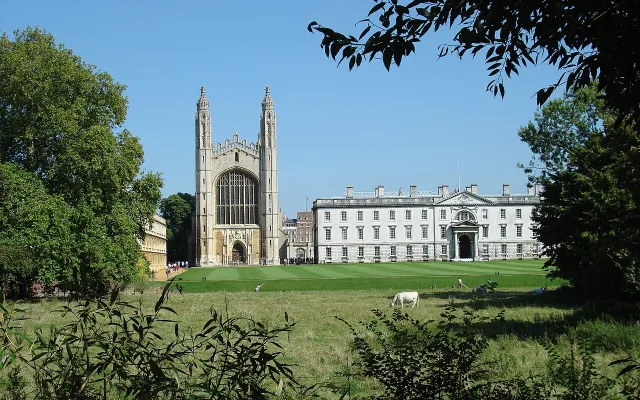
Cambridge is a city in the United Kingdom known for its historic and academic landmarks, such as King's College Chapel and the Mathematical Bridge. Punting on the River Cam is a popular pastime here.
Wiki
Cambridge is a university city in the east of England, in Cambridgeshire, on the River Cam, about 80 km north of London. Known above all for the University of Cambridge, one of the oldest and most prestigious in the world, it remains the perpetual rival of Oxford and one of Britain's great centres of science and learning.
History
A settlement stood on the site of present-day Cambridge as far back as the Roman period: a fortified point guarded the crossing of the Cam. The city's name goes back to the bridge over the River Granta, as the river was once called, later reinterpreted as the bridge over the Cam. Through the Anglo-Saxon period and under the Normans, Cambridge developed as a market town; William the Conqueror raised a castle here, of which only the earthwork of Castle Mound survives.
The turning point came in 1209, when a group of scholars who had left Oxford after a quarrel with the townspeople founded a new university here. The first college, Peterhouse, appeared in 1284. Over the following centuries colleges were created one after another, endowed by kings, bishops and the nobility — and so the unique system of self-governing academic communities took shape that has defined the city ever since.
The University of Cambridge
The university is not a single building but a federation of more than thirty colleges scattered across the centre. Each has its own courts, chapel, hall and gardens. Among the most famous are King's, Trinity (associated with Isaac Newton), St John's, Queens' and Clare.
The great architectural jewel is King's College Chapel, an outstanding monument of late English Perpendicular Gothic. It took almost a century to build, from 1446 to 1515; the interior astonishes with its fan vaulting and 16th-century stained glass. The famous Christmas carol service is broadcast from this chapel around the world.
Cambridge has given science a great many names: Newton, Darwin, Maxwell and Rutherford worked here, and here Watson and Crick worked out the structure of DNA. Dozens of Nobel laureates are associated with the university.
What to see
- The Mathematical Bridge — a wooden footbridge over the Cam at Queens' College. Built on a principle of tangential and radial timbers, it looks like an arch assembled from straight beams. Legend has it that Newton built it without a single nail — a fine story, and untrue.
- The Bridge of Sighs — the covered crossing at St John's College, named after its Venetian namesake.
- The Round Church — one of the few surviving round churches in England, dating from the 12th century.
- The Fitzwilliam Museum — a rich collection of painting, antiquities, ceramics and manuscripts, and one of the oldest public museums in the country.
- The University Botanic Garden, with extensive plant collections and glasshouses.
- The Backs — the picturesque strip of meadow and garden along the river behind the colleges, giving the classic views of their facades.
Punting
Cambridge's calling card is punting, in flat-bottomed boats propelled by pushing a long pole against the riverbed. The route along the Backs passes the most beautiful colleges and goes under the old bridges. You can hire a punt and handle it yourself, or book a chauffeured trip with a guide who tells the stories and legends along the way. It is a slow and very English pastime, and one of the best ways to feel the character of the city.
Atmosphere and food
The centre of Cambridge is compact and almost entirely walkable: narrow cobbled lanes, bookshops, and a market square with a daily market at the very heart of the city. The students keep life young and busy — there is no shortage of cafés, pubs and bookshops. The traditional cooking is English: hearty breakfasts, pies, ale in historic pubs, afternoon tea with scones. There are also plenty of places serving other national cuisines, as you would expect in a university town with an international crowd.
Practical information
Cambridge is easy to visit from London: direct trains take about an hour. Two days are enough to see the main colleges, climb to the viewpoints, take a punt and look into the museums. Bear in mind that access to the colleges may be restricted during examination periods and events, and that some of them charge admission. The city is small, and best seen on foot or by bicycle — Cambridge is rightly considered one of Britain's cycling capitals.