Description
The historic royal capital — the monastery, the museums and the residence of the Njegoš dynasty.
Wiki
Cetinje is the old capital of Montenegro, set at the foot of Mount Lovćen in a scenic valley about 670 metres above sea level. This small town remains the spiritual and historical heart of the country: for centuries decisive matters were settled here, and today it holds the main national museums, the monastery and the former royal residences.
Historical background
The founding of the town is associated with the end of the 15th century, when the ruler Ivan Crnojević moved the centre of the state here to escape Ottoman pressure. In 1484 he laid the foundations of a monastery, around which a settlement gradually took shape. For centuries Cetinje remained a stronghold of Montenegrin independence and a centre of resistance to the Ottoman Empire.
Its particular flowering came in the 19th century, the age of the Petrović-Njegoš dynasty. Under the metropolitan and poet Petar II Petrović Njegoš, and later under Prince (afterwards King) Nikola I, the town turned into a genuine European capital with diplomatic missions, schools and the first state institutions. At the start of the 20th century the embassies of the leading powers worked here, underlining the international standing of the little mountain capital. After the First World War and the union with Serbia, administrative functions gradually passed to Podgorica, but Cetinje kept the honorary status of historical and spiritual capital.
The main sights
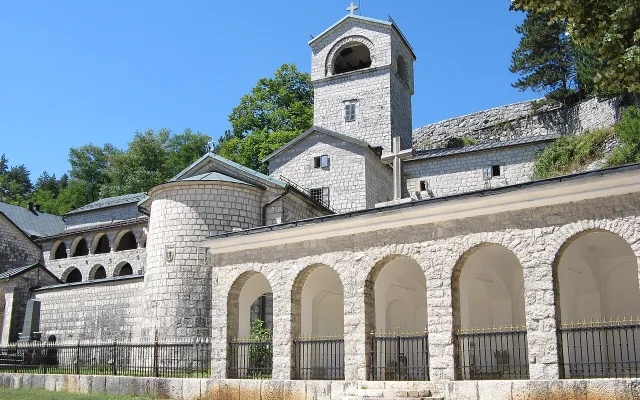
- Cetinje Monastery — the spiritual centre of Montenegro and the residence of the metropolitan. Its treasury holds venerated Orthodox relics, including, by tradition, the right hand of John the Baptist and a fragment of the True Cross.
- The Palace of King Nikola — the former royal residence, now a museum with surviving interiors, furniture, weapons, portraits and personal effects of the ruling family.
- Biljarda — the residence of Prince-Bishop Petar II Njegoš, named after the billiard table brought here. Today it houses a memorial museum devoted to the life and work of the great poet and statesman.
- The National Museum of Montenegro — a complex bringing together historical, artistic and ethnographic sections. In the art collection a special place belongs to the celebrated icon of Our Lady of Philermos.
- The Vlach Church — a small church whose fence, by tradition, is made partly from the barrels of captured Turkish rifles.
- The former embassy buildings — handsome mansions of the Russian, French, British and other diplomatic missions, giving the town centre its particular historical character.
Atmosphere and the townscape
The central part of Cetinje is compact and suited to walking. Low-rise building of the 19th and early 20th centuries, shaded avenues, stone mansions and an unhurried rhythm create the feeling of an open-air museum. Unlike the noisy coast, the atmosphere here is intimate, almost provincial, and the closeness of the mountains is felt in the fresh air and in the panoramas that open from the surrounding heights.
The surrounding area
A few kilometres from the town rises Lovćen National Park, with a mountain massif crowned by the Njegoš Mausoleum on the summit of Jezerski Vrh. A steep road and a staircase lead up to it, and from the viewing platform in clear weather you can see across the country from Lake Skadar to the Adriatic. The mausoleum has become a symbol of national identity and one of the most visited places in the region.
Food
The cooking of Cetinje reflects the traditions of the Montenegrin highlands. Dry-cured Njeguši pršut and sheep's cheeses, produced in the neighbouring mountain villages, are prized here. Rich meat dishes, kajmak (a clotted dairy spread), home-baked bread and local wines are served. Modest family establishments offer the simple but filling cooking typical of the interior of the country.
Practical information
Cetinje is conveniently visited as a day trip. The town is linked by road with Podgorica and the Adriatic coast — the journey from Budva or Kotor takes under an hour by car along scenic mountain hairpins. Seeing the main museums and the monastery fits comfortably into a single day.
The best time to visit is late spring, summer and early autumn, when the weather favours walking and trips into the mountains. Lying away from the sea, the town has cooler and snowier winters than the coast. The compactness of the historic core lets you cover the key places on foot, and Cetinje often becomes a natural addition to a route through Lovćen National Park.