Description
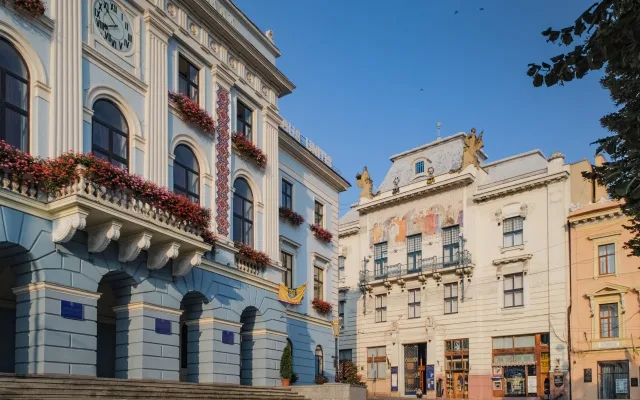
The former capital of Bukovina — Ukraine's "Little Vienna": the UNESCO-listed Metropolitans' Residence, Austrian-era streets and the legacy of six communities.
Wiki
Chernivtsi is the former capital of Bukovina and probably the most Austrian-looking city in Ukraine: around 270,000 people, in the far south-west, 40 km from the Romanian border. Its centre came through the wars of the twentieth century almost untouched, so the late-nineteenth-century streetscape survives as a whole — hence the nickname "Little Vienna". One important note: there is a war on, so check your own government's travel advice, the entry rules and the curfew before planning anything.
What makes the city unusual
Chernivtsi spent centuries at a crossroads: the Principality of Moldavia, then Austrian Bukovina from 1775, Romania between the wars, then the Soviet Union. Ukrainians, Romanians, Jews, Germans, Poles and Armenians lived here side by side, and every community built its own — churches, synagogues, an Armenian cathedral, national houses. Hence the other nickname, "the Jerusalem of Bukovina": before the Second World War Jews made up roughly a third of the population. That layering is the reason to come.
What to see
- The Residence of the Bukovinian and Dalmatian Metropolitans — a UNESCO World Heritage Site since 2011 and the undisputed centrepiece. The huge red-brick complex with its patterned tiled roofs was built between 1864 and 1882 to a design by the Czech architect Josef Hlavka. It now houses Chernivtsi National University: the courtyards are open to all, the state rooms only by guided tour and not always — this is a working university.
- Olha Kobylianska Street — the main pedestrian spine, formerly the Herrengasse. A dense run of historicist and Art Nouveau facades, cafés and bookshops. This is where the Vienna comparison makes sense.
- Theatre Square, with the Olha Kobylianska Theatre of 1905 by the Viennese practice of Fellner and Helmer — the same firm behind theatres in Vienna, Odesa and Zagreb.
- Central (Cathedral) Square and the town hall with its tower — the historic market centre from which the main streets radiate.
- The Armenian Church of Saints Peter and Paul (1875) — another Hlavka building, now in use as an organ hall.
- The former Temple synagogue — the Moorish-style house of prayer of the Reform community, built in the 1870s. The Germans burned it in 1941; in the 1950s the shell was rebuilt as the Chernivtsi cinema. The shape of the dome still gives away what the building was, and it remains the main memorial to a community that is gone.
- The wooden St Nicholas Church (1607) — a rare survival of Moldavian timber building. Next to it stands the other St Nicholas, the 1939 cathedral with corkscrew domes that locals call "the drunken church".
- The Turkish Well — a well from the period when Bukovina belonged to the Principality of Moldavia under Ottoman suzerainty (1538–1775). A small thing, but a characteristic marker.
- The railway station, a late-nineteenth-century Secessionist building, and Shevchenko Park for an unhurried evening.
Nearby
- Khotyn Fortress — about 60 km away, fifteenth-century stone walls above the Dniester, one of the most photogenic castles in Ukraine.
- Kamianets-Podilskyi — roughly 90 km, a fortress on a rock island inside a loop of the Smotrych river.
Food and prices
Bukovinian cooking is Ukrainian with a strong Moldovan-Romanian accent: borsch, holubtsi, varenyky, placinta (a thin pie filled with brynza cheese or cabbage), mititei, sheep's brynza and mamaliga.
- Lunch at a café: 350–670 UAH ($8–15).
- Dinner at a restaurant: 800–1,600 UAH ($18–35).
- A ride on city transport: about 13 UAH ($0.30); a Bolt or Uklon taxi across town: 130–450 UAH ($3–10).
- A litre of petrol: around 58 UAH ($1.30).
Prices are as of 2026.
Getting there and when to go
Chernivtsi Airport (CWC) has been shut since 2022 — Ukrainian airspace is closed. The realistic options are a Ukrainian Railways train from Lviv or Kyiv, including services that run across the Polish border, or a bus from Suceava in Romania, 80 km away and served by a working airport. Trolleybuses, buses and marshrutkas run around town and Bolt and Uklon operate, but the historic centre is a single day on foot.
The best months are May to September, 15–25 °C. In mid-January the villages around the city hold Malanka, a carnival of grotesque masks; the most spectacular is at Vashkivtsi on 14 and 15 January. Winters are cold, −5 to −15 °C.
Common mistakes
- Assuming you can walk into any hall of the Residence: it is a functioning university and access changes with the timetable.
- Confusing the former Temple synagogue with the Knights Templar — "Temple" here means the Reform congregation's house of prayer, nothing to do with the order.
- Trying to fit Khotyn and Kamianets-Podilskyi into the same day as the city itself.
- Travelling without checking the current security situation and the curfew hours.