Description
The northernmost provincial capital of Thailand — the White Temple of Wat Rong Khun and the Golden Triangle.
Wiki
Chiang Rai is the northernmost large town in Thailand and the cultural centre of the Lanna region: around 80,000 people, 800 km from Bangkok, near the borders with Laos and Myanmar. King Mangrai founded it in 1262, and until Chiang Mai appeared in 1296 it was the capital of the Lanna kingdom. There are noticeably fewer tourists here than in Chiang Mai, three hours to the south, but Chiang Rai holds the three most recognisable sights in the north — and the road to the Golden Triangle starts here.
Three temples as art projects
- The White Temple (Wat Rong Khun) is not an ancient monument but a working art project by the artist Chalermchai Kositpipat, begun in 1997 and still unfinished. Everything is white and inlaid with mirror glass; the bridge over the "sea of hands" symbolises the crossing out of the world of suffering, and inside the murals set the Buddha alongside figures from popular culture.
- The Blue Temple (Wat Rong Suea Ten) opened in 2016, built by a pupil of Kositpipat. The interior is entirely cobalt blue and gold, with a white Buddha at the centre — a counterpoint to the White Temple, and less crowded.
- The Black House (Baan Dam) is not a temple but a complex of some forty black buildings assembled over forty years by the artist Thawan Duchanee (1939-2014). Inside are buffalo skulls, hides, bones and horns, and furniture made of bone. It is the dark twin of the White Temple, and the two are best seen on the same day.
What else is in town
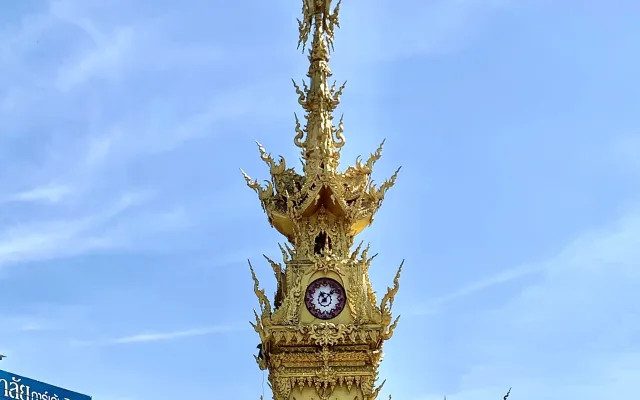
- The Clock Tower — a gilded tower by the same Kositpipat in the centre; every evening at 19:00, 20:00 and 21:00 there is a short light show with music.
- Wat Phra Kaew — the principal historic temple of the town. It was here in 1434 that the Emerald Buddha was discovered in a stupa split open by lightning; the image is now in Bangkok, and the temple holds a copy.
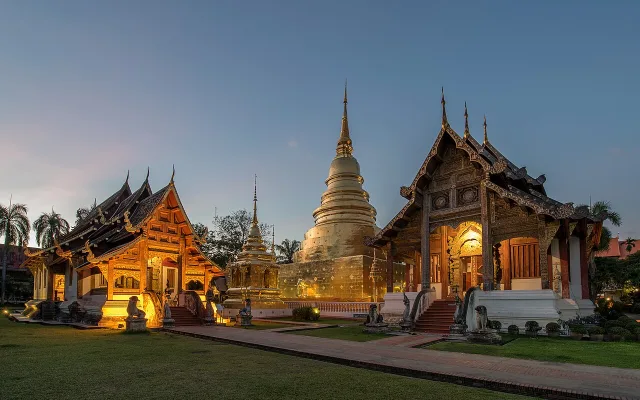
- Wat Phra Singh — the second old temple of the centre, and the origin of one of the north's most venerated Buddha images.
- The Night Bazaar by the bus station — food, crafts and a music stage; open daily.
- The Saturday Walking Street on Thanalai — bigger and livelier than the bazaar, but only on Saturdays.
Trips out
- The Golden Triangle (Sop Ruak), 60 km away — the point where Thailand, Laos and Myanmar meet at the confluence of the Mekong and the Ruak. There is a viewing terrace and the Hall of Opium, a large and surprisingly serious museum on the history of the opium trade.
- Doi Tung — the mountain residence of the Princess Mother, with a botanical garden and plantations raised on former poppy fields.
- The Choui Fong tea plantations — terraces in the hills with cafés and viewpoints, an hour from town.
- Mae Sai — the border town with Myanmar and the northernmost point of Thailand. The crossing opens and closes according to conditions, so check before going.
- Hill tribe villages — Akha, Lisu, Lahu and Karen. Approach these trips with care: some "villages" are set up as a paid exhibit, and visits to Kayan women with neck rings raise their own ethical questions.
Food and prices
Northern cooking differs from Bangkok's: khao soi, the signature dish of the north, is noodles in a coconut-milk curry with crisp noodles on top; sai ua is a herby grilled sausage; nam prik ong is a tomato and pork relish for vegetables; and gaeng hung lay is a pork curry with Burmese roots, without coconut and with ginger. Lunch at a local canteen runs to 130-260 baht ($4-8) and dinner at a restaurant to 330-830 baht ($10-25). A tuk-tuk across town is 66-165 baht ($2-5), and scooter hire 230-400 baht ($7-12) a day.
Transport
Chiang Rai International Airport (CEI) takes AirAsia, Thai Airways and Bangkok Airways; a taxi to the centre is 260-400 baht ($8-12). From Bangkok the flight takes an hour and a half and costs 1,300-3,300 baht ($40-100); the night bus takes 11-12 hours for 830-1,300 baht ($25-40). From Chiang Mai the bus is 3-4 hours for 330-500 baht ($10-15). Around the area people travel by songthaew (pickup trucks with benches), scooter and hire car.
When to go
November to February is dry and cool, 18-28°C, and the best time. March and April bring heat of 35-40°C plus haze from agricultural burning, which can wipe out the mountain views entirely. From May to October there are short heavy downpours. The town sits at about 400 metres, so winter nights are cool, 10-15°C. Loy Krathong falls in November, with thousands of candles floating down the river.