Description
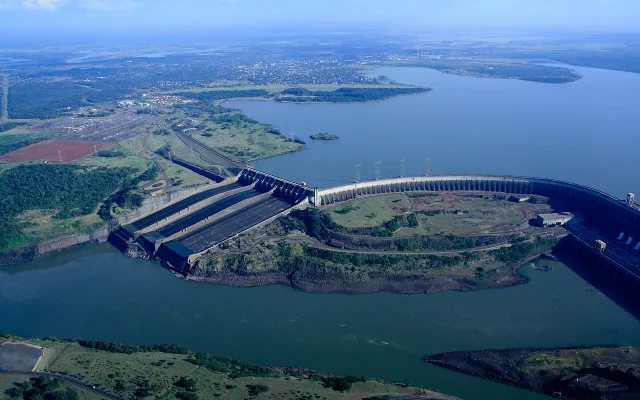
Border city at the triple frontier with Brazil and Argentina — the Itaipu Dam and duty-free trade.
Wiki
Ciudad del Este is Paraguay's second-largest city and the administrative capital of the Alto Paraná department. Sitting on the country's eastern edge, it forms the southeastern corner of the so-called Triple Frontier, where Paraguay, Brazil and Argentina converge, and is known above all for the massive Itaipu hydroelectric dam and its bustling cross-border market.
Geography and location
The city stands on the right bank of the Paraná River, which forms the natural border with the Brazilian state of Paraná. The Friendship Bridge (Puente de la Amistad) spans the river, linking Ciudad del Este with the Brazilian city of Foz do Iguaçu. About ten kilometres downstream lies the confluence of the Paraná and Iguazú rivers, where all three countries meet. This position has made the city a key transport and trade hub in eastern Paraguay.
The climate is humid subtropical: hot, rainy summers from December to February when temperatures often exceed 35 °C, and a relatively mild winter. Heavy rainfall keeps the surrounding countryside green year-round.
History
The city was founded in 1957, initially named Puerto Flor de Lys and soon renamed Puerto Presidente Stroessner after the country's ruler at the time. When the dictatorship fell in 1989 it received its current neutral name, which translates as "Eastern City." Rapid population growth came in the 1970s and 1980s, driven directly by the construction of the Itaipu Dam and the expansion of cross-border trade. Within a few decades a small frontier settlement had grown into a major urban centre with hundreds of thousands of inhabitants.
Itaipu Dam
The area's centrepiece is the Itaipu hydroelectric power station, a joint Paraguayan-Brazilian project on the Paraná River. It is one of the largest power stations in the world by electricity output, supplying a significant share of both countries' consumption. The scale of the structure is extraordinary: the length of the dam and the volume of the reservoir make it an engineering landmark of its era.
The station is open to visitors through organised tours:
- overview tours from viewing platforms looking over the dam face and spillways;
- access to technical areas on selected days;
- an adjacent ecological complex with a nature reserve, museum and trails along the reservoir.
On certain evenings the dam is illuminated in a spectacular light show.
Trade and city life
Ciudad del Este has earned a reputation as one of South America's largest commercial centres. The central streets are densely packed with galleries, shopping arcades and stalls selling electronics, perfume, clothing, watches and souvenirs. The duty-free trading regime draws thousands of shoppers daily from neighbouring Brazil and Argentina. The business district is noisy and crowded, especially on weekdays; it is worth keeping a close eye on personal belongings and checking the quality of purchases carefully.
Beyond commerce, the city is culturally diverse: Lebanese, Chinese, Korean and Brazilian communities are all visible, reflected in the street food and the character of different neighbourhoods.
Food
The cuisine blends Paraguayan tradition with the influence of neighbours and diaspora communities. Local dishes worth trying include those based on corn and cassava — sopa paraguaya (a dense savoury corn cake), chipa (cheese rolls made from cassava flour) and grilled meats in the South American asado tradition. Tereré — cold steeped yerba mate — is drunk everywhere and considered the national drink of Paraguay. Middle Eastern and Asian establishments serve shawarma, noodles and other dishes brought by the trading communities.
What to see in a day
The city typically warrants a single day, which can be combined logically with visits to the region's natural and engineering attractions:
- morning — a tour of the Itaipu Dam and its ecological park;
- afternoon — a walk through the city's commercial centre and a taste of local food;
- if time allows — a trip to the Iguazú Falls (from the Brazilian or Argentine side) or to a nearby Paraguayan nature reserve.
Practical information
Ciudad del Este is a convenient base for a Triple Frontier itinerary. Regular services cross the Friendship Bridge to Foz do Iguaçu, from where the famous waterfalls are easily reached. Guaraní International Airport, just outside the city at Minga Guazú, connects the region with Asunción and a number of international destinations.
The national currency is the Paraguayan guaraní, though Brazilian reais and US dollars are widely accepted in cross-border trade. The official languages are Spanish and Guaraní; Portuguese is also commonly heard in tourist and commercial settings. When planning a visit, check current border-crossing rules and customs import limits in advance, as these change regularly.