Description
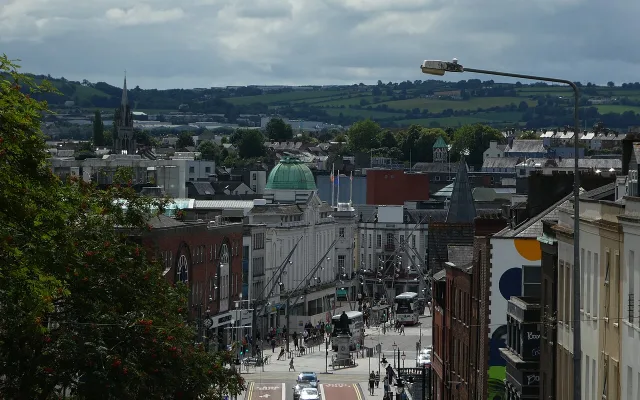
Cork is Ireland's second city, built on an island in the River Lee. Visit the historic English Market and catch live traditional music in the pubs.
Wiki
Cork is Ireland's second city, set on an island at the mouth of the River Lee — compact, walkable, and well suited to independent travellers. It makes an excellent base: a serious food scene, live music in the pubs every evening, and a dozen worthwhile trips within an hour's reach.
What to see in the city
Cork's centre is small — you can cover it on foot in a couple of hours, and the entire historic core fits between the two channels of the River Lee.
- English Market — one of Europe's oldest covered markets, trading since the eighteenth century. People come here to eat and shop, not to browse souvenirs: local cheeses, fish, smoked meats, fresh bread, and farmhouse vegetables. On the upper floor, the Farmgate Café looks down over the market stalls — a good spot for lunch made entirely from what's being sold below. The market opens during the day and is closed on Sundays.
- Cork City Gaol — a nineteenth-century prison in neo-Gothic style on a hill to the northwest. An audio guide and wax figures give a solid sense of life inside; the hilltop also offers a panorama over the city.
- Shandon (St. Anne's Church) — a bell tower with distinctive clocks that show slightly different times on each of its four faces, earning it the nickname "the Four-Faced Liar." Visitors can climb to the top and ring the bells themselves from sheet music — the most memorable hands-on experience in the city.
- University College Cork (UCC) — a handsome neo-Gothic campus with a park and sculptures, free to enter. The Lewis Glucksman Gallery for contemporary art is right alongside.
- The Shandon quarter and the city-centre lanes — brightly painted facades, street art, independent coffee shops, and vintage stores. An aimless wander here is part of the point.
Day trips from Cork
These short excursions are what justify a second night.
- Blarney Castle — about 8 km out, reachable by city bus. The main draw is the Blarney Stone: to kiss it you lie on your back and lean out over the parapet under a steward's supervision. The gardens around the castle are pleasant in their own right.
- Cobh — a harbour town half an hour away by train and the last port of call for the Titanic. The famous row of multicoloured houses above the harbour (the Deck of Cards), a cathedral on the hill, and a well-regarded emigration museum make it an excellent half-day trip.
- Kinsale — a fishing town at the formal start of the Wild Atlantic Way, with Charles Fort and a strong reputation as a food destination. Easiest to reach by bus.
- Cape Clear Island — the southernmost inhabited island in Ireland, an Irish-speaking Gaeltacht area with grey seals and seabirds. This is a full-day outing involving a ferry crossing.
Getting there and getting around
- Cork Airport is a few kilometres south of the city; a bus runs to the centre and taxis are reasonable by Irish standards. There are direct connections to Dublin and various European cities.
- From Dublin — a direct train takes around 2.5 hours; buses are cheaper and a little slower. Kent Station, Cork's railway terminus, is about 15 minutes' walk from the centre.
- Within the city you'll barely need transport: everything central is walkable. City buses are useful for Blarney, the Gaol, and the airport. Bus Éireann services and suburban trains cover Cobh and the Kinsale direction.
Where to stay and how long
Stay in the city-centre island (the area around St. Patrick's Street and the English Market) — everything is within walking distance and you won't need to travel back from a residential neighbourhood in the evening. It tends to be quieter and slightly cheaper on the far side of the river towards Shandon.
Two days is a sensible minimum: one for the city itself and the market, the second for Cobh or Blarney. If Kinsale or Cape Clear Island appeals, allow a third day.
Food, music, and prices
Cork is widely regarded as the food capital of Ireland. Beyond the standard Irish stew, try the local specialities: drisheen (a type of blood sausage) and spiced beef (salt-cured and heavily spiced, especially popular around the holidays). The English Market is the best way to eat locally without spending much.
In the evenings the city lives in its pubs: live traditional sessions play in many venues for free — just walk in and order a pint. Cork is the home of Murphy's stout, the local rival to Guinness; order it rather than the national brand to taste the difference.
Ireland is an expensive country overall: accommodation and alcohol feel noticeably pricier than in continental Europe, and a pint and a pub dinner add up quickly. The usual ways to save are eating through the market and supermarkets, buying train tickets in advance, and leaning into the many free things — the UCC campus, walks along the river, and live music in the pubs cost nothing.
Practical notes
- Cork is a safe city; the usual urban awareness — pockets in crowds, noise around pubs late at night — is all that's needed.
- Weather is changeable in every season: a waterproof layer and clothing you can add or remove matter more than an umbrella. May to September brings the longest days and the most frequent ferry services to the islands.
- Many places close early, and Sunday hours (including the market) are reduced — aim to visit in the first half of the day.
- The typical mistake is to treat Cork as a one-day stopover. The city works best as a base for the surrounding area, so the second night is worth it.