Description
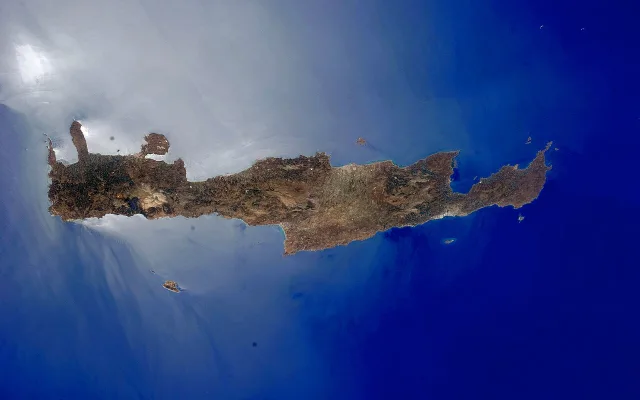
Crete is the largest Greek island, known for the beaches of Elafonissi and for the Samaria gorge.
Wiki
Crete is the largest island in Greece and the fifth largest in the Mediterranean, lying on its southern edge almost equidistant from Europe, Asia and Africa. Minoan civilisation, the oldest in Europe, was born here, and the combination of mountain ranges, palm-fringed beaches and living village traditions makes the island a destination in its own right, worth at least five days.
Geography and the general picture
The island covers about 8,300 sq km and runs more than 250 km from west to east. Mountain massifs stretch along its whole length: the White Mountains (Lefka Ori) in the west, Psiloritis (Ida) in the centre with the highest point at 2,456 m, and Dikti in the east. The northern coast, facing the Aegean, is the more settled: all the large towns and the airports are here. The southern, Libyan shore is drier, emptier and hotter.
Administratively the island divides into four regional units with their centres at Heraklion (the capital and main port), Chania, Rethymno and Agios Nikolaos. Heraklion is the business heart of Crete, Chania is considered the most picturesque town, and the eastern coast with the resorts of Elounda and Agios Nikolaos is the most upmarket.
Minoan heritage and history
Crete is the cradle of one of the first literate cultures in Europe. The Minoans were building labyrinthine palaces as early as the third and second millennia BC, traded across the whole Mediterranean, and perished, probably, after the volcanic eruption on Santorini and the catastrophes that followed. Besides the famous Knossos, palaces have been excavated at Phaistos, Malia and Zakros — their ruins fill out the picture and are usually far less crowded.
Later the island passed through Greek, Roman and Byzantine eras, four centuries of Venetian rule and Ottoman government, from which it was freed only at the beginning of the 20th century. Every era left its mark: Venetian harbours and fortresses, Turkish minarets, Byzantine monasteries such as Arkadi, a symbol of Cretan resistance.
Nature and the outdoors
Besides the Samaria gorge, the island's best-known trek, there are dozens of other canyons to walk — Imbros is easier and shorter, and suits less experienced travellers. The coast is rich in expressive bays: the palm beach of Vai in the east, the Preveli lagoon at a river mouth, and the wild shores of the southern edge. Anyone drawn to the mountains should go up to the Lasithi plateau with its windmills and the Psychro cave, where by legend Zeus was born.
- Knossos — the symbol of the island, the palace reconstructed by Arthur Evans, with its throne room and frescoes.
- Elafonissi and Balos — textbook lagoons with pale pink sand and shallow, transparent water.
- Chania and Rethymno — walks through the narrow streets of the old quarters along the Venetian waterfronts.
Food and produce
Cretan cooking lies at the root of the whole idea of the "Mediterranean diet". The basis of the diet is locally pressed olive oil, wild greens (horta), pulses, goat's cheese and fish. It is worth trying dakos, a barley rusk with grated tomato and mizithra cheese, kalitsounia pastries with a soft cheese filling, snails and young lamb. Among drinks, raki (tsikoudia), a grape spirit, is widespread and is often offered in tavernas at the end of a meal. Cretan thyme honey and mountain herbal teas are popular edible souvenirs.
Practicalities
- Getting there. In season there are direct flights to Heraklion and Chania from many European cities; year-round, connections run via Athens. Overnight ferries sail from the Athenian port of Piraeus (9–12 hours).
- When to go. The swimming season runs roughly from May to October. July and August are hot and crowded; May, June and September are more comfortable for sightseeing and trekking. The Samaria gorge is generally open from April to October.
- Transport. KTEL intercity buses link the larger towns and some of the beaches, but many bays are reachable only by car — hiring one is effectively essential for an independent trip.
- A five-day route. It makes sense to split the time between the west (Chania, Balos, Elafonissi, Samaria) and the centre (Heraklion, Knossos, Rethymno), so as to take in the archaeology, the landscape and the best beaches without long drives every day.