Description
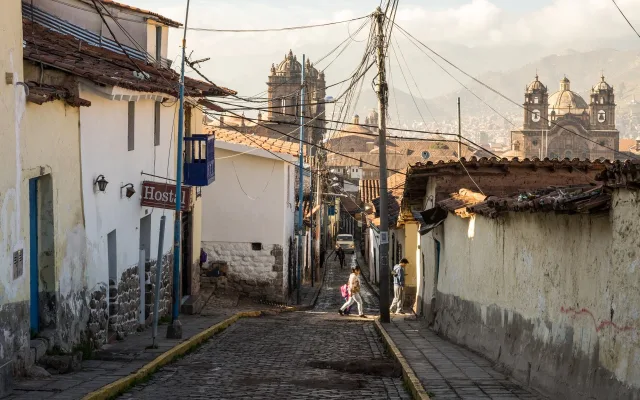
The Incas' navel of the world at 3,400 m — gateway to Machu Picchu, with Inca-built streets, the Sacsayhuamán fortress, and living Andean culture.
Wiki
Cusco is the ancient capital of the Inca Empire — called Qosqo Llaqta, the 'Navel of the World', by the Incas themselves — and the archaeological capital of South America: around 430,000 inhabitants at 3,400 metres in the Peruvian Andes. It is the main gateway to Machu Picchu and the Sacred Valley, and is listed as a UNESCO World Heritage Site. What makes it unique is a literal layering of eras: after the Spanish conquest of 1533, cathedrals and palaces were built directly on Inca foundations, and today the flawless polygonal masonry of the lower courses supports colonial façades with balconies and arches.
History and Heritage
Cusco grew into the capital of Tawantinsuyu — the 'Land of the Four Quarters' — and its layout was said to mirror the outline of a puma, with the Sacsayhuamán fortress as its head. Under the Inca Pachacuti in the 15th century the city reached its peak, becoming the religious, administrative and ceremonial centre from which roads radiated to every province. The Spanish conquest ended that era without erasing it: earthquakes repeatedly brought down colonial buildings, while Inca walls remained intact — a testament to the precision of dry-stone masonry where blocks are fitted without mortar. This continuity is what makes Cusco a living open-air museum.
Main Sights
- Plaza de Armas — the heart of the city, built on the site of the Inca ceremonial square of Aucaypata. It is framed by the Cathedral and the Baroque Iglesia de la Compañía de Jesús (Jesuit church), with arcaded walkways lined with restaurants and balconies running around its perimeter.
- Cusco Cathedral — one of the largest in Latin America, built on the foundations of the Inca Viracocha's palace. Inside are a carved cedar altar and paintings from the Cusco School, including the famous Last Supper depicting a guinea pig on the table.
- Qorikancha (Coricancha) — the 'Golden Courtyard', the Incas' chief Temple of the Sun, whose walls were once covered in gold plates. The Spanish built the Monastery of Santo Domingo on top of it, and the contrast between the two architectures is strikingly clear.
- Sacsayhuamán — a megalithic fortress-sanctuary on the hill above the city, built from stone blocks some of which weigh many tens or hundreds of tonnes. It is the site of the annual Inti Raymi festival — the celebration of the Sun at the winter solstice (24 June).
- Q'enqo, Puca Pucara and Tambomachay — ritual and water complexes on the same hill, usually combined into a single route with Sacsayhuamán.
- San Blas — the artisans' quarter on the hillside, with narrow cobbled lanes, workshops, galleries and viewpoints over the city's tiled rooftops.
- Hatun Rumiyoq Street — home to the famous twelve-angled stone, a showcase of the engineering precision of Inca masonry.
Around Cusco
- Sacred Valley (Valle Sagrado) — the fertile Urubamba river valley with the terraces of Pisac and its market, the salt pans of Maras, the circular terraces of Moray, and the fortress-town of Ollantaytambo.
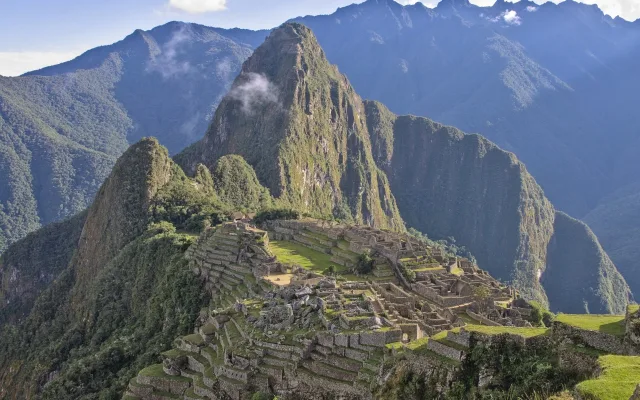
- Machu Picchu — the legendary 'lost city' of the Incas; reached by PeruRail or IncaRail train from Ollantaytambo (or from Cusco with a change), then by bus from the town of Aguas Calientes.
- Inca Trail — the classic four-day trek to Machu Picchu along an ancient paved road; permit numbers are strictly limited, so book well in advance.
- Rainbow Mountain (Vinicunca) — a multicoloured mineral slope at over 5,000 metres, a day trip requiring an early start.
Food
Cusco's Andean cuisine is built around highland produce. Classic dishes include cuy (roast guinea pig), grilled alpaca, lechón and the hearty soup chupe. Side dishes feature dozens of potato varieties and large-kernel corn (choclo) with cheese. To drink: mate de coca (coca-leaf herbal tea), which helps with altitude; the corn beer chicha; and the national cocktail pisco sour. The Mercado San Pedro sells fruit, cheeses, juices and hot food at local prices.
Practical Information
The main challenge in Cusco is altitude. Spend the first day quietly: no alcohol, no heavy exertion, drink plenty of water; coca tea and coca leaves help. The easiest acclimatisation strategy is to fly into Cusco and visit the Sacred Valley — which lies lower — first. Entry to most archaeological sites is covered by the Boleto Turístico (tourist ticket), available in several versions. The dry season (roughly May–September) is best for trekking; the rainy season falls during the southern-hemisphere summer. Four days is enough to see the city, visit the Sacred Valley and spend a full day at Machu Picchu. The currency is the Peruvian sol; cards are widely accepted in the centre, but cash is useful at markets and for taxis.