Description
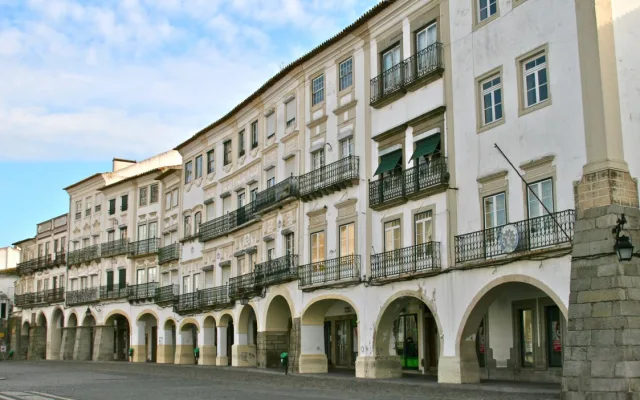
A well-preserved medieval city in the Alentejo with a Roman temple, a chapel of bones, prehistoric megaliths and cork oak countryside all around.
Wiki
Évora is the main historic city of the Alentejo, in southern Portugal: around 50,000 inhabitants, 130 km east of Lisbon, with the whole walled Old Town on the UNESCO World Heritage list since 1986. A Roman temple stands a few steps from a Gothic cathedral, and in the lane behind it hides a chapel lined with human bones. Many people come on a day trip from Lisbon, but staying the night changes the experience: once the coaches leave, the city is yours.
A little history
Under the Romans the city was Liberalitas Iulia, a junction on the road from Lisbon to Mérida. The Moors called it Yeborath. After the reconquest of 1165 Évora became a favourite residence of the Avis kings: through the 15th and 16th centuries the court spent entire seasons here and the city grew rich on it. Then court life moved permanently to Lisbon, major building stopped — and that is precisely why the medieval core has come down to us almost unaltered.
What to see
- The Roman temple — fourteen Corinthian columns of the 1st–2nd century AD on the highest point of the city, the best-preserved Roman monument in Portugal. It is traditionally called the Temple of Diana, but nobody knows who it was dedicated to; most likely the imperial cult, and the name of Diana was invented as late as the 17th century.
- Évora Cathedral (Sé de Évora) — the largest medieval cathedral in the country, begun in 1186. A Romanesque-Gothic bulk with two mismatched towers; a separate ticket gets you onto the roof, with a view over the whole city and down onto the Roman temple.
- The Chapel of Bones (Capela dos Ossos) — attached to the Church of St Francis. In the 16th century Franciscan friars lined its walls and pillars with the bones of some five thousand people, to remind the living of mortality. The inscription over the door reads: "We bones that are here await yours." It is grim, takes twenty minutes, and is worth it.
- The Church of St Francis — worth attention in its own right: Gothic with Manueline detail of the 15th and 16th centuries.
- Praça do Giraldo — the heart of the city, with cafés under the arcades and a fountain of 1571. Under the Inquisition the square served as a place of public execution.
- The University of Évora — the second oldest in the country after Coimbra, founded by the Jesuits in 1559. Eighteenth-century azulejo tiles survive in the courtyards and lecture rooms; admission is inexpensive.
- The Silver Water Aqueduct (Aqueduto da Água de Prata) — 16th century, and unusual in that houses and shops are built into its arches on the edge of town.
Megaliths nearby
- Almendres Cromlech (Cromeleque dos Almendres) — 13 km west, the largest megalithic circle on the Iberian Peninsula: some 95 granite menhirs raised between the sixth and third millennia BC. Considerably older than Stonehenge and, unlike it, free and almost empty. The last kilometre is a dirt track.
- The Almendres Menhir — a free-standing four-metre stone not far from the cromlech.
- Anta Grande do Zambujeiro — the largest dolmen in Portugal, its chamber some five metres high under a protective shelter, 13 km south-west of the city.
Without a car, an organised half-day tour from Évora is the easiest way to reach the megaliths.
Further afield
- Monsaraz — 50 km away, a whitewashed village inside a 13th-century hilltop fortress above the reservoir. The definitive postcard image of the Alentejo.
- Lake Alqueva — the largest artificial lake in Western Europe, surrounded by one of Europe's best dark-sky stargazing areas.
- Alentejo wineries — together with the Douro, this is Portugal's leading wine region. The reds are built on Trincadeira, Aragonez and Alicante Bouschet; many estates receive visitors for tastings by appointment.
Food and prices
Alentejo cooking is plain and very meat-heavy. Look for porco preto, pork from acorn-fed black Iberian pigs; açorda, a bread soup with coriander, garlic and egg; migas, fried breadcrumbs with meat; and the sheep's cheese queijo de Serpa.
- Lunch at a simple restaurant: 12–22 EUR ($14–25).
- Dinner: 25–45 EUR ($29–52).
- A glass of Alentejo wine: 3–5 EUR ($3–6).
- A taxi around town and to the nearer sites: 5–15 EUR ($6–17).
- A litre of petrol: about 1.70 EUR ($2).
Prices are as of 2026.
Getting there and when to go
The nearest airport is Lisbon (LIS), 130 km away. From there a CP train takes about an hour and a half (15–20 EUR, $17–23) and a Rede Expressos coach roughly the same (12–15 EUR, $14–17). Either works for a day trip. Car hire runs 25–35 EUR a day ($29–40) and pays off if you are heading to the megaliths and the wineries. The centre itself is walkable, with everything inside a one-kilometre radius.
The best months are March to May and September to October, 15–25 °C. In summer the Alentejo is the hottest region in Portugal, 32–40 °C, and walking the open streets is hard work. Winter is mild at 8–15 °C but wet. The grape harvest falls in September and October.
Common mistakes
- Arriving in July and going out in the middle of the day: there is almost no shade in Évora.
- Believing the Roman temple was dedicated to Diana — that is a late legend.
- Planning the Almendres cromlech without a car and without a booked tour.
- Leaving on the first evening train: the empty night-time city with the temple floodlit is the best part of the visit.