Description
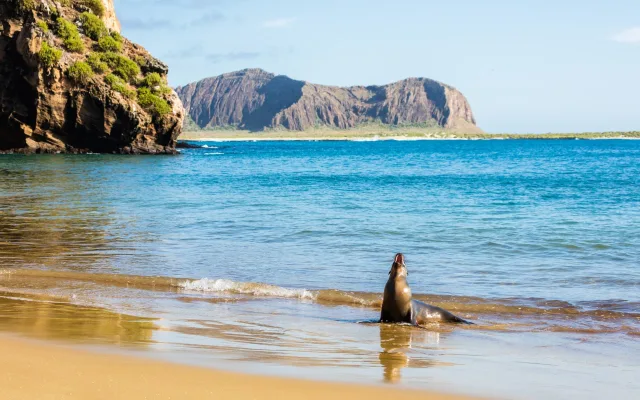
Darwin's living laboratory of evolution: blue-footed boobies, marine iguanas and giant tortoises in an untouched Pacific ecosystem.
Wiki
The Galápagos archipelago is a remarkable chain of volcanic islands in the Pacific Ocean, belonging to Ecuador and lying roughly 1,000 km from the mainland coast. It was here that the young naturalist Charles Darwin, in 1835, gathered the observations that would form the foundation of the theory of evolution. Today the islands remain one of the most carefully protected natural territories on the planet.
Geography and nature
The archipelago consists of 19 major islands and numerous smaller islets and rocks, formed by volcanic activity above a mantle hotspot. Many of the volcanoes are still active, and the landscape ranges from black lava fields to lush humid highlands. The islands straddle the equator, but the cold Humboldt Current keeps the climate milder than one might expect in the tropics and delivers nutrient-rich water that sustains an abundance of marine life.
Isolation and the absence of large predators have produced an extraordinary fauna. Giant land tortoises — whose Spanish name galápago gave the islands their name — marine iguanas (the only lizards that feed in the ocean), Galápagos penguins (which live farther north than any other penguin), blue-footed boobies, frigatebirds, albatrosses and the finches that became symbols of Darwinian science all make their home here. The animals show almost no fear of humans, allowing unusually close observation.
Status and entry rules
97% of the land area falls within the national park, established in 1959; in 1978 the islands became one of the first UNESCO World Heritage Sites. The surrounding waters form a marine reserve. Movement through most natural zones is permitted only along designated trails and in the company of a licensed naturalist guide. A visitor quota system is in place, a park entrance fee and transit card are charged, and strict biosecurity rules are enforced to prevent the introduction of invasive species.
Main islands and highlights
- Santa Cruz — the tourist hub, centred on the town of Puerto Ayora. The Charles Darwin Research Station here runs a tortoise-breeding centre. A 45-minute walk away, Tortuga Bay offers white sand, colonies of marine iguanas and a shallow lagoon where reef sharks and rays are regularly spotted.
- Isabela — the largest island, shaped like a seahorse. A trek to the caldera of the active volcano Sierra Negra (roughly 10 km across) takes several hours. Off the coast lie Las Tintoreras — solidified lava channels with clear pools where white-tipped reef sharks rest.
- San Cristóbal — the administrative capital, with a sea-lion colony right in the town harbour and the crater lake El Junco.
- Bartolomé — the postcard view of the archipelago, dominated by the sharp lava spire of Pinnacle Rock; a good place to spot penguins while snorkelling.
- North Seymour — nesting ground for frigatebirds with their inflated scarlet throat pouches, and for blue-footed boobies.
- Gordon Rocks — a challenging dive site for experienced divers, renowned for schools of hammerhead sharks.
Food and drink
Local food combines Ecuadorian tradition with the riches of the sea. Worth trying are tuna ceviche, the hearty soup encebollado, fresh lobster, and mainland dishes such as bolón de verde, a ball of fried green plantain, rice with seafood, and ripe tropical fruit. Local coffee and dark chocolate are well regarded. A simple meal at a family eatery costs considerably less than dinner at a waterfront restaurant.
Getting there and getting around
The only way to reach the archipelago is by air from Quito or Guayaquil. Two airports serve the islands: Baltra (for Santa Cruz) and San Cristóbal. Fast ferries run between the inhabited islands; a popular way to explore is a multi-day liveaboard cruise, which opens up remote sites that are unreachable on day trips from a land base.
Practical tips
- A trip of around one week is ideal: long enough to combine two or three islands, a cruise segment and land-based activities.
- There is no sharp off-season: December to May is warmer with calmer seas; June to November is cooler but marine wildlife is more active.
- Bring high-SPF sunscreen (reef-safe formulas are strongly preferred), a hat, sturdy shoes for lava trails and snorkelling gear.
- Keep your distance from wildlife, stay on marked paths and never feed the animals — the survival of this fragile ecosystem depends directly on it.