Description
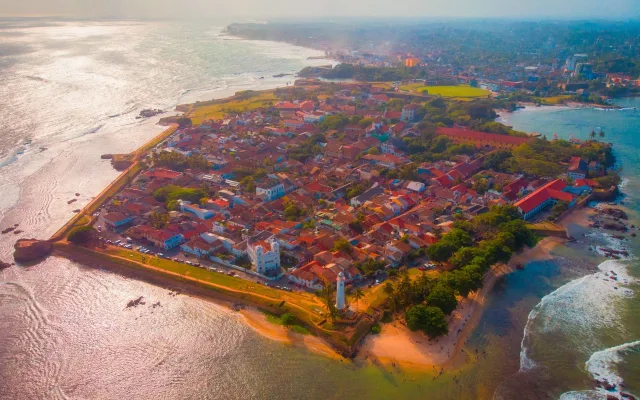
The UNESCO-listed Dutch fort — ramparts above the ocean, colonial streets and the surf coast nearby.
Wiki
Galle is the most picturesque place on Sri Lanka's south coast: the old Dutch fort stands on a headland, the ramparts fall away into the ocean, and inside are quiet colonial streets without cars, cafés and shops. It makes a convenient base for exploring the beach south at an unhurried pace and spending a couple of days between history and water.
Why come, and for how long
Two days is more than enough. The fort itself is compact and can be walked in two or three hours including a circuit of the walls. One day for an unhurried look at the fortress and sunset from a bastion, the second for a trip to the beach at Unawatuna or out to the surf breaks. If you are here for the beaches or a whale safari, Galle works well as a base for the night while you range around by day.
The essential thing is to walk the fort along the ramparts. It is free, takes about an hour and gives the best views: the eastern bastion with the lighthouse, the northern gate with its coats of arms, and the western side facing the sunset. Go towards evening, when the heat drops and locals gather.
Inside the fort
- The walls and bastions — the walk itself matters more than any individual site. Flag Rock bastion in the south-west is the classic place for sunset.
- The lighthouse (1939) — the calling card, standing on the eastern stretch of wall beside the Meeran Jumma mosque.
- The Dutch Reformed Church (1755) — go inside: the floor is laid with old gravestones.
- The National Maritime Museum — housed in a Dutch warehouse by the gate; useful if the history of trade and the monsoon routes interests you.
- Simply wandering the streets — Pedlar Street, Church Street: colonial mansions, boutique hotels, galleries, and shops selling spices and gemstones (haggle, and do not buy stones without knowing the subject — it is easy to overpay).
People live inside the fort, so the atmosphere is alive rather than museum-like. Entry to the fort itself is free; you only pay for the individual museums.
Beaches and surf nearby
- Unawatuna (about 7 km) — a crescent bay with calm swimming and plenty of cafés. The main beach, right at hand.
- Hikkaduwa to the north and Midigama/Weligama to the south — the surf spots. Weligama, with its gently shelving sandy bottom, is the best place for beginners, and it has board hire and schools.
- Mirissa — the base for whale safaris (roughly December to April): blue whales and sperm whales. Go out early in the morning, and choose an operator with a sensible approach to the animals.
- The stilt fishermen near Koggala and Weligama look wonderful in photographs, but these days it is largely staged for money; expect to pay and to bargain.
Getting there and getting around
The international airport is Bandaranaike (CMB) near Colombo, about 130 km north. There are two realistic ways down:
- The expressway (E01) — a fast bus or a transfer or taxi, roughly two hours. The simplest option with luggage.
- The coastal train from Colombo to Galle — slower, but one of the most spectacular railways in the world: the rails run almost along the edge of the ocean. Sit by the windows on the sea side for the views. Tickets are cheap.
Inside the fort everything is on foot. Around the area there are tuk-tuks (agree the price in advance or use the PickMe app to avoid overpaying) and local trains and buses along the coast. Scooter hire is handy for beach trips, but needs experience: the traffic is chaotic, and formally a local permit is required alongside your licence.
Where to stay
- Inside the fort — maximum atmosphere, quiet, everything on foot, but more expensive and with few budget options.
- Outside the walls (the new town) — cheaper and closer to the bus station and the railway, but noisier.
- Unawatuna — if the beach is the priority and you want to visit the fort in passing.
Food and money
Eat local: rice and curry (several kinds at once), hoppers (bowl-shaped rice pancakes, often with an egg), kottu (chopped roti with vegetables and meat), coconut sambol, and the fish curry ambul thiyal. Lunch at a local eating house is very cheap; a restaurant inside the fort with a view costs appreciably more, a mark-up for the location. A king coconut from a cart costs next to nothing and is the best relief from the heat.
As a guide: a tuk-tuk across town runs to about 600-700 rupees ($2), the train from Colombo is inexpensive, local food is cheap, and a restaurant dinner in the fort is several times the price of street food. Cards are accepted in the fort, but keep cash for the markets and the tuk-tuks.
When to go, and what to watch for
The best season in the south is roughly December to April (dry, with a calm sea and the whale season). Summer brings the south-west monsoon with rain and swell.
Practical details:
- The sun is harsh and the fort walls have no shade, so bring water and a hat.
- Swimming: open beaches can have rip currents, so take your lead from locals.
- At mosques and temples, cover shoulders and knees and remove your shoes.
- Keep your distance from "guides" and gem sellers: pushiness and inflated prices are routine, so haggle calmly or walk on.