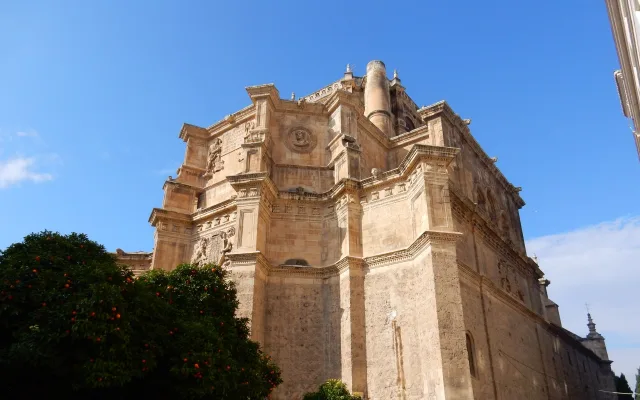
Granada
Description
Granada is a city in Andalusia, known for the Alhambra palace complex, the historic Albaicín quarter, and the Sierra Nevada mountain range.
Wiki
Granada is one of the most remarkable cities in Andalusia, southern Spain, where Moorish heritage stands alongside the Christian architecture of the Reconquista. Nestled at the foot of the Sierra Nevada at the confluence of the Darro and Genil rivers, it is home to around 230,000 people, a venerable university, and an atmosphere celebrated by poets and travellers alike.
History and character
Granada was the last Muslim stronghold on the Iberian Peninsula: in 1492 the Nasrid emirate surrendered to the forces of the Catholic Monarchs Isabella of Castile and Ferdinand of Aragon, bringing centuries of Reconquista to a close. The long period of Arab rule gave rise to a refined urban culture — palaces, bathhouses, gardens and a water-management system whose traces are still visible today. After the emirate fell, the city filled with Renaissance churches and monasteries, and the expulsion of the Moriscos in the 17th century transformed its character for good.
Granada is closely associated with the poet Federico García Lorca, who was born in this region, and with the flowering of flamenco. The university, founded in 1531, gives the city a youthful, lively energy: student neighbourhoods, inexpensive bars and bookshops sit alongside medieval alleyways.
Main sights
- The Alhambra — the Nasrid palace-fortress complex on the Sabika hill, a UNESCO World Heritage Site. Intricate stucco carvings, Arabic inscriptions, the Court of the Lions and halls with honeycomb (muqarnas) vaulting are considered the pinnacle of Islamic architecture in Europe. Tickets that include the Nasrid Palaces are best booked weeks or even months in advance.
- Generalife — the sultans' summer residence and gardens beside the Alhambra: terraces, water channels, rose beds and clipped cypresses conjure an image of earthly paradise.
- Albaicín — the old Moorish quarter on the facing hill, a labyrinth of whitewashed houses, narrow cobbled lanes and the walled garden houses known as cármenes. The Mirador de San Nicolás offers the famous view of the Alhambra backed by snow-capped peaks.
- Sacromonte — the historically Romani neighbourhood of cave dwellings cut into the hillside; this is where the local flamenco-zambra tradition was born, and evening performances still take place in cave venues.
- The Cathedral and the Royal Chapel — a grand Renaissance church and the mausoleum of the Catholic Monarchs, housing their marble tombs and a collection of paintings.
- The Royal Hospital, the Monastery of La Cartuja and the Corral del Carbón — monuments from different eras that round out the picture of the city.
Nature and surroundings
Above Granada rises the Sierra Nevada — Europe's southernmost ski resort, with peaks exceeding 3,000 metres (Mulhacén, at around 3,480 m, is the highest point on the Spanish mainland). In winter people come to ski; in summer, to hike. The drive from the city takes about an hour. Also within easy reach are the whitewashed villages of the Alpujarras and the historic city of Córdoba with its Mezquita.
Food and tapas
Granada's gastronomy blends Andalusian and Arabic influences. The city's defining custom is the free tapa served with every drink ordered — order a few rounds and you can almost make a meal of it. Look out for the tortilla Sacromonte, migas, cured Iberian ham, local broad beans with ham (habas con jamón), Moorish-inspired sweets, and tea in the Albaicín teahouses styled after Moroccan originals. Coffee bars, wine taverns (bodegas) and markets complete the culinary picture.
A rough guide to costs: a drink with its free tapa is €2.50-3.50 (about $3-4), a full lunch €12-18 ($14-21), dinner €20-35 ($23-40). The Alhambra General ticket including the Nasrid Palaces is around €19 ($22) and must be booked online well in advance. Prices are as of 2026.
Practical information
Three days is the ideal amount of time: the first devoted to the Alhambra and Generalife, the second to the Albaicín, Sacromonte and the cathedral area, the third to a trip into the Sierra Nevada or nearby towns.
- Getting there. Granada–Jaén Airport (GRX) handles a limited number of flights. It is often more convenient to fly into Málaga or Seville and continue by bus or train; rail links connect Granada with Madrid and other major cities.
- Getting around. The compact centre is easily walkable, bearing in mind the steep climbs of the Albaicín. Small city minibuses serve the hillside neighbourhoods alongside regular routes.
- When to visit. Spring and autumn are the most comfortable seasons: summers can be hot, while snow lies on the mountains in winter. Even in the warm season, cool mountain air provides a pleasant evening breeze.
Granada leaves the feeling of a city on the boundary between two worlds — Eastern and European — where history can be read in every stone.
Updated