Description
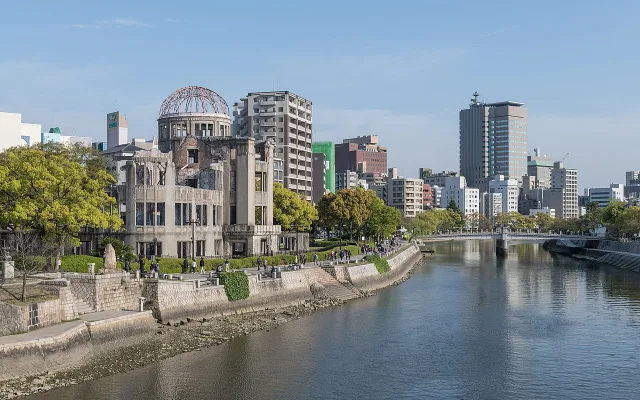
A city reborn after the tragedy of 1945 — home to the Peace Park and the island of Miyajima with its "floating" gate.
Wiki
Hiroshima is a major city in the west of the Japanese island of Honshu, the capital of the prefecture of the same name and the gateway to the Chugoku region. Its name is bound forever to the tragedy of 6 August 1945, yet today it is a lively, green city on the shore of the Seto Inland Sea, and a symbol of peace and human resilience.
History and revival
The city grew up around Hiroshima Castle, founded by the feudal lord Mori Terumoto in 1589 in the delta of the Ota River. The name means literally "broad island" — the historic core stood on one of the river's sandbanks. In the Meiji era Hiroshima became an important military and port centre, which sealed its fate in the Second World War.
The atomic bombing all but erased the built city. On the accepted estimates, around 70,000 people died on the day of the blast and in the hours that followed, and by the end of 1945, counting those who died of burns and radiation, the toll had reached roughly 140,000. Post-war reconstruction was swift: as early as 1949 a law was passed to make Hiroshima a "city of peace". The rebuilt quarters, wide avenues and extensive tram network are the legacy of those years. Some of the surviving trams lived through the blast and still run through the centre, a living monument to the era.
The Peace Park
The Peace Memorial Park (Heiwa Kinen Koen) is laid out on the site of the former busy Nakajima district, which lay close to the hypocentre.
- The Atomic Bomb Dome (Genbaku Dome) — the ruins of the prefectural exhibition hall, the closest building to the hypocentre to remain standing: the bomb detonated in the air some 150 metres away, and the near-vertical shock wave left part of the walls and the steel frame of the dome intact. Its charred skeleton has deliberately been left untouched and is inscribed on the UNESCO World Heritage list.
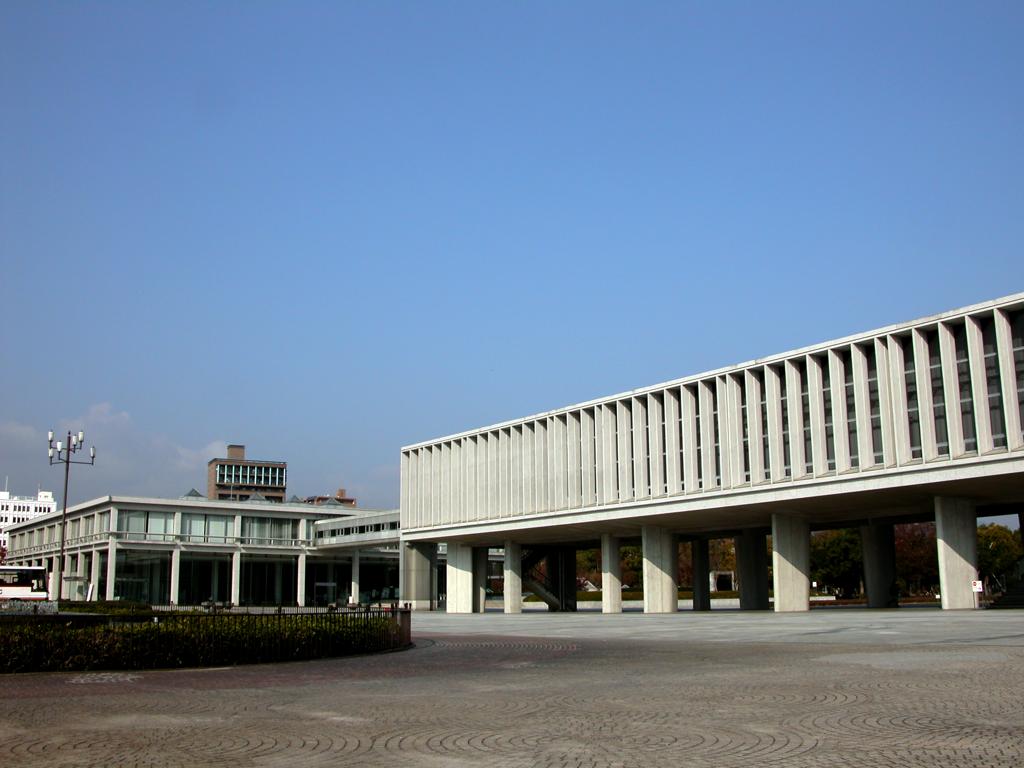
- The Peace Memorial Museum — an exhibition telling the events of 1945 through the personal belongings of the victims, photographs and documents. It is emotionally hard going but important; allow two or three hours.
- The Cenotaph and the Flame of Peace — an arched monument holding the list of victims' names, with a flame that will burn as long as nuclear weapons exist in the world.
- The Children's Peace Monument and Sadako Sasaki — a girl who died in 1955 of leukaemia caused by her exposure to radiation; the tradition of folding a thousand paper cranes as a symbol of hope is linked to her.
Every year on 6 August a memorial ceremony is held here, and in the evening thousands of paper lanterns are floated down the river.
The island of Miyajima
Half an hour to the south-west lies the island of Itsukushima, known as Miyajima, the "shrine island". It is counted among the three most beautiful views in Japan.
- The Torii Gate — a bright vermilion gate that seems to float on the water at high tide. It is a visual symbol of the country and a UNESCO site.
- Itsukushima Shrine — a Shinto shrine on stilts whose galleries appear to drift on the sea when the water is high. The first buildings date to the 6th century; the present form took shape under the patronage of the Taira clan in the 12th.
- Mount Misen — the island's highest point, with viewpoints over the bays of the Inland Sea; walking trails and a ropeway lead up, past ancient Buddhist temples along the way.
- The five-storey pagoda and Senjokaku hall complete the historic ensemble at the foot of the mountain.
Spotted deer wander freely along the lanes and waterfronts; here they are held to be sacred messengers of the gods.
Food
The city's culinary calling card is Hiroshima-style okonomiyaki. Unlike the Osaka version, the ingredients are not mixed but layered: a thin pancake, a great deal of cabbage, yakisoba noodles and an egg. A whole block of restaurants serving it is gathered in the Okonomimura complex. Oysters come from the shores of the Inland Sea — served grilled, deep-fried and raw, and at their best in the cold season. Another local treat is momiji manju, sponge cakes shaped like maple leaves, for which Miyajima is famous.
Practical information
Hiroshima sits on the Sanyo Shinkansen line: high-speed trains reach Tokyo in about four hours and Osaka or Kyoto in an hour and a half. Frequent ferries run to the island from the Miyajima-guchi pier, a crossing of around ten minutes. Within the city itself the tram is the easiest way to travel, its single network linking the station, the centre and the Peace Park; a day pass is 700 yen (about $4.40). The Peace Memorial Museum costs 200 yen ($1.30), the ferry to Miyajima 200 yen each way plus the island visitor levy of 100 yen introduced in 2023, and the Mount Misen ropeway around 2,000 yen return ($13). A plate of okonomiyaki runs 900-1,400 yen ($6-9). Prices are as of 2026.
Two days are enough for the essentials: give the first to the memorials and the centre, and the second entirely to Miyajima. When planning the island visit, check the tide table: high water sets off the "floating" gate to full effect, while low tide lets you walk out to it across the exposed seabed.
Photos