Interlaken
SwitzerlandDescription
Adventure capital of Switzerland, nestled between two lakes: skydiving, hiking to Jungfraujoch, and whitewater rafting in mountain rivers.
Wiki
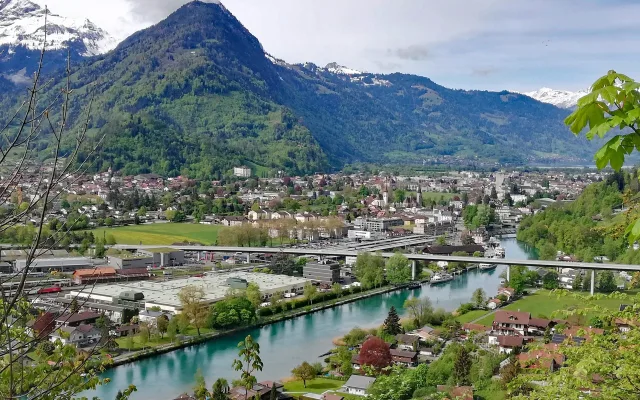
Interlaken is a small resort town in central Switzerland, wedged between Lake Thun and Lake Brienz in the valley of the River Aare. Despite its modest size (around 5,600 residents), it serves as the main gateway to the peaks of the Bernese Oberland and has rightly earned the unofficial title of the country's adrenaline capital.
Geography and general atmosphere
The town's name literally means "between the lakes" (inter lacus). Water defines the landscape here: glacial lakes of brilliant turquoise close off the valley on either side, while to the south the three legendary summits of the Jungfrau, Mönch and Eiger fill the horizon. The heart of Interlaken is the broad meadow of Höhematte, from which the snow-capped Jungfrau is visible on clear days. Along its edge runs the main street, Höheweg, lined with hotels, watch boutiques and café terraces. The town itself stays quiet and unhurried — all the action spills out into the surrounding mountains and rivers.
What to see
- Jungfraujoch, "Top of Europe" — a saddle at 3,454 m housing the highest railway station in Europe. Here you'll find the Sphinx Observatory, the Ice Palace carved into the glacier, and viewing platforms above the Aletsch Glacier — the largest glacier in the Alps. The ascent takes several hours, with changes at Kleine Scheidegg.
- Schilthorn (2,970 m) — a mountain crowned by the revolving restaurant Piz Gloria, familiar from the James Bond film On Her Majesty's Secret Service (1969). A series of cable cars climbs from the village of Stechelberg.
- Harder Kulm (1,322 m) — the closest viewpoint to town, reached in minutes by funicular. A panoramic platform juts out over the cliff, taking in both lakes and the Alpine triangle.
- Lauterbrunnen — a valley of waterfalls 20 minutes away. The symbol of the area is the Staubbach Falls, plunging from a nearly 300-metre wall; the Trümmelbach Falls are hidden inside the rock itself.
- Grindelwald — a large mountain village at the foot of the Eiger's north face. The modern Eiger Express gondola swiftly delivers visitors to trailheads and glaciers.
- Lakes and castles — pleasure steamers cross Lake Thun to the medieval castles of Spiez and Thun, while the Giessbach Falls tumble above Lake Brienz.
Adventure activities
It is the promise of adventure that draws visitors from around the world. Colourful paragliding wings drift almost constantly above the meadow — tandem flights launch from the Beatenberg slope and last 10–20 minutes. Lauterbrunnen is a hub for skydiving and BASE jumping; mountain gorges attract canyoneers descending waterfalls; and the turbulent River Lütschine draws rafters. In winter the surrounding resorts become an extensive ski area with dozens of kilometres of pistes, toboggan runs and snowboard terrain.
Food and drink
The cuisine reflects the traditions of German-speaking Switzerland. Must-tries include cheese fondue and raclette, potato rösti, local sausages and the Bernese classic Berner Platte — a platter of smoked meats and sauerkraut. Dessert often means meringues with Brienz cream, and popular drinks include the white chasselas wine and kirsch, a cherry schnapps. Dining in Switzerland is not cheap: lunch in a cafe runs 25-35 CHF (about $31-43), dinner in a restaurant 50-90 CHF ($62-111), and fondue for two around 60 CHF ($74). A return ticket to the Jungfraujoch from Interlaken costs roughly 240 CHF ($297), or about 190 CHF ($235) with a Swiss Travel Pass; Harder Kulm return is 38 CHF ($47). Prices are as of 2026.
Getting there and getting around
The nearest major airports are Zurich and Geneva, each roughly two to three hours away. Interlaken has two stations — Ost (East) and West — from which mountain railways, buses and cable cars fan out. The transport network is fully integrated and runs to a precise timetable. Swiss Travel Pass holders travel many routes free of charge or at a discount, and the expensive mountain lines such as Jungfraujoch carry a partial reduction.
Practical tips
- When to go. June to September is ideal for hiking and water-based activities; the ski season runs roughly from December to March.
- How long to allow. Three days is enough for one major high-altitude ascent, a walk through the waterfall valley, and a day of adventure sports or lake exploration.
- Things to bear in mind. Mountain weather is unpredictable — pack warm layers even in summer. Book costly ascents in advance and check the visibility forecast so the summit panoramas are not hidden behind cloud.