Description
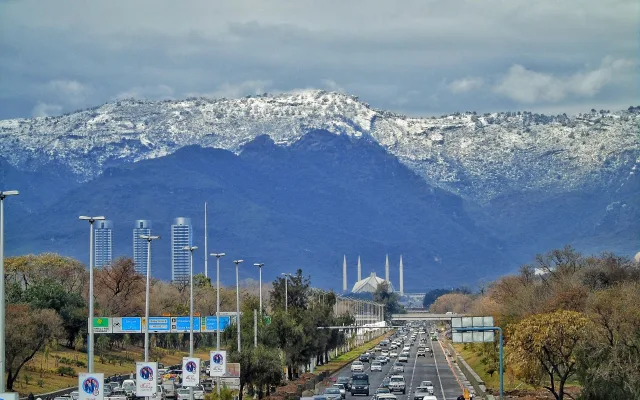
Pakistan's modern capital — the Faisal Mosque, the Margalla Hills and clean, ordered streets.
Wiki
Islamabad is perhaps the least expected capital for anyone who comes to Pakistan looking for chaos: wide avenues, green sectors instead of an old town, and mountains right on the horizon. For the independent traveller it is above all a convenient, safe and legible base — the roads north to Hunza, Skardu and K2 start here.
Is it worth coming, and for how long
Islamabad is not a city of sights on every corner but a place of comfort and recovery between long journeys. Two days is ample: one for the city (the Faisal Mosque, Margalla, the monuments), a second for Taxila or an unhurried walk in the hills. If Islamabad is a staging post on the way north, one full day is realistic.
Keep the essential thing in mind: this is a planned city of numbered sectors (F-6, F-7, G-9 and so on), each like a separate quarter with its own market. The logic is simple, but without a map it is easy to lose yourself among identical junctions on the first day.
Getting there and getting around
- Islamabad International Airport (ISB) is well to the west, closer to Rawalpindi, so it is a fair drive into the centre. There is no city express, and the sensible option is a taxi app.
- Careem and InDrive work well and solve transport entirely. A ride across the city is inexpensive, from the airport noticeably more but still reasonable. Cash or card, with the price shown in advance, which spares you the haggling.
- The Metrobus (bus rapid transit on dedicated lanes) links Islamabad with Rawalpindi and reaches the airport — cheap, but you need a travel token or card and an understanding of the route.
- Walking around the city is barely feasible: the distances are long and everything is built for cars. The pedestrian areas are the parks and Margalla, not the streets.
Rawalpindi, the twin city next door, is where the genuine South Asian character lives: the old bazaars of Raja Bazaar and Saddar, narrow lanes, crowds. If Islamabad feels sterile, go there for half a day for the contrast.
Where to stay
- F-6 and F-7 — the best base: central, safe, close to the markets (Jinnah Super, Kohsar Market), cafés and restaurants. Convenient for both the mosque and the hills.
- F-8, F-10 and G-6 (Melody) — a little cheaper and also convenient.
- Hostels in the Western sense are few; more often it is guest houses and serviced apartments. Book ahead: there really are fewer options than in tourist cities.
What to see, in detail
- The Faisal Mosque — essential. Enormous, without the classic domes, shaped like a tent. Entry is free, shoes come off, and women need a headscarf. The best time is towards sunset, when the lighting comes on and the heat drops.
- The Margalla Hills and the Daman-e-Koh viewpoint — the city seen from above. Higher up there is the Pir Sohawa point. Trail 5 is the popular trekking route, uphill; take water. The monkeys are bold: do not feed them or wave food about.
- The Pakistan Monument on Shakarparian — an "opened flower" of four petals for the provinces, with a viewpoint over the city and a museum alongside.
- Taxila (about 35 km) — the thing worth setting half a day aside for: Buddhist monasteries and stupas, a UNESCO site. Easiest by taxi with the driver waiting; public transport is a chore.
Food and money
The cooking is heavy and meat-based: biryani, nihari, seekh and chapli kebab, karahi, with lassi or doodh patti tea alongside. Street food is cheap, and a restaurant dinner in F-7 is inexpensive by Western standards. As a guide, a simple lunch costs a few dollars, and a decent dinner with a meat main noticeably more but still budget.
- Cash in rupees is needed almost everywhere: markets, street food and small cafés do not take cards. Withdraw at ATMs attached to bank branches.
- Alcohol is effectively unavailable — this is not that city. Do not go looking, and do not make trouble for yourself.
- The savings are obvious: eat where locals eat, use InDrive instead of a hotel transfer, and combine Taxila and the monument in one outing.
Safety and practicalities
- Islamabad itself is among the calmest cities in the country, but check the current situation before travelling, especially if you plan routes north or towards the borders.
- Friday is the day of prayer: some businesses and offices work shortened hours, and the mosques are crowded at midday.
- Dress more modestly than you might be used to: covered shoulders and knees, and for women a scarf to hand is useful.
- Buy a SIM (Jazz, Zong) officially with your passport — data is cheap and fast, and offline maps and taxi apps will not work without it.
- Summer (June to August) is hot and brings the monsoon; spring (March-April) and autumn (October-November) are ideal, warm and clear and comfortable for the hills.