Jeddah
Saudi ArabiaDescription
Saudi Arabia's Red Sea gateway: the UNESCO-listed Al-Balad quarter, a 30 km corniche, the tallest fountain in the world and coral reefs just offshore.
Wiki
Jeddah is Saudi Arabia's second city and its main seaport, spread along the Red Sea coast. For centuries pilgrims bound for Mecca arrived here, and that role as a crossroads gave the city an unusually open character.
The city in outline
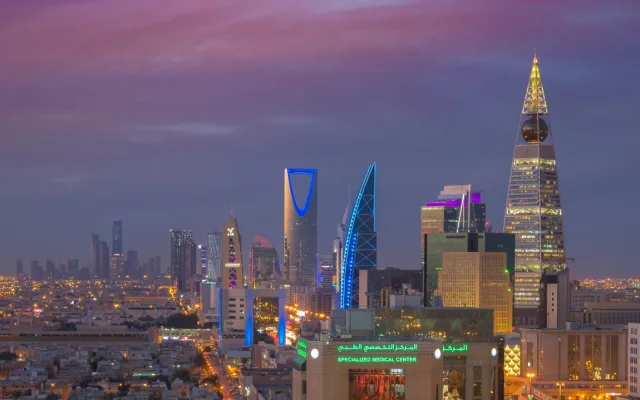
Jeddah lies in the west of the kingdom, in the historic region of the Hijaz, and has around 4.7 million inhabitants. It is the most cosmopolitan and least formal of the big Saudi centres: traders and pilgrims from Africa, India, Southeast Asia and the Levant have been settling here for centuries, and the atmosphere is noticeably freer than in the rest of the country. The dress code is softer, the evenings livelier, and the scene of cafés, galleries and restaurants is one of the most developed in the region. Since the introduction of the online tourist visa in 2019, which takes minutes to obtain, Jeddah has become the natural first stop for anyone opening up Saudi Arabia.
The historic core: Al-Balad
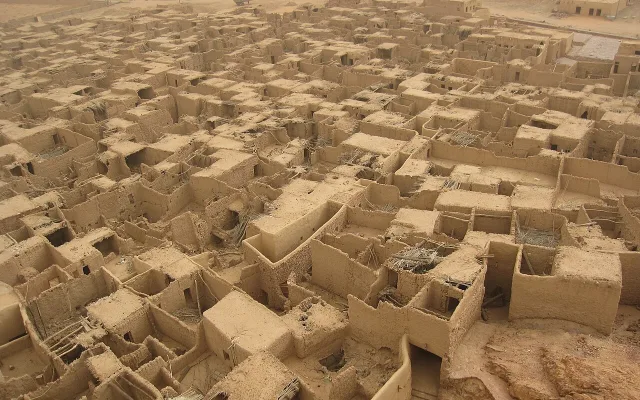
The heart of the city is the old quarter of Al-Balad, inscribed on the UNESCO World Heritage list. Most of what stands today went up in the 19th century, though the settlement itself is far older. Houses were built from coral limestone quarried out of the Red Sea, and their façades carry wooden mashrabiya bay windows — carved, screened balconies that kept the heat out and gave the family privacy. The quarter is in the middle of a large restoration programme: the historic gates, the souks and the caravanserais are being rebuilt, and workshops, bookshops and art spaces are opening inside them.
Key points in Al-Balad:
- Nasseef House — the several-storey mansion of a wealthy merchant family, a textbook piece of Hijazi architecture, now a museum.
- The historic souks — trading lanes that still sell spices, fabric, perfume and gold.
- The old city gates — surviving fragments of the walls that once ringed the port.
The waterfront and the modern landmarks
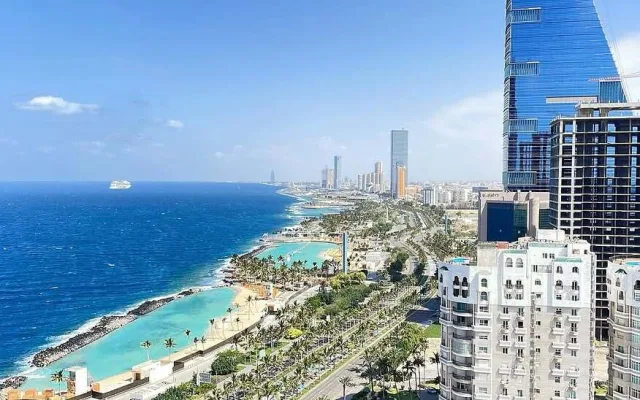
Jeddah's sea frontage is the 30 km Corniche, renewed along its whole length. This is where the city relaxes: footpaths and cycle lanes, playgrounds, beach sections and an open-air sculpture collection whose contributors include Henry Moore and Joan Miró. Above the water rises King Fahd's Fountain, the tallest in the world, throwing a jet more than 300 metres into the air. It is visible from almost anywhere on the Corniche and looks its best lit up after dark.
Another instantly recognisable image is the Floating Mosque (Al-Rahma Mosque): a white building on piles that appears to hover over the water at high tide.
Museums and culture
The fullest picture of Islamic art and daily life is at the Tayebat Museum (the Al-Tayebat International City for Science and Knowledge), a large private collection housed in a complex built in traditional Hijazi style. Inside are manuscripts, ceramics, weapons, coins, jewellery and household objects. Contemporary galleries keep opening across Al-Balad and in the newer districts, which has made Jeddah one of the centres of the kingdom's art life.
The Red Sea
Beyond the city limits the Red Sea reefs begin, with clear water and visibility running to several tens of metres. Diving and snorkelling are popular; the reefs hold plenty of fish, coral and sea turtles. The warm climate makes swimming possible almost year-round, though the summer heat and humidity are heavy going.
Pilgrimage
Jeddah is known as the gateway to Mecca: the bulk of pilgrims performing hajj and umrah pass through its port and through King Abdulaziz International Airport. The holy cities themselves, Mecca and Medina, are closed to non-Muslims, and only Muslims may enter.
Food
Local cooking reflects the city's trading past, combining Saudi and Hijazi traditions with Asian influence. Try kabsa (spiced rice with meat), slow-roasted lamb, stuffed mutabbaq pastry, and the seafood, which is abundant here. Indian, Yemeni and East Asian kitchens are all well represented. Alcohol is banned throughout the country.
Practicalities
- Visa: the electronic tourist visa is issued online.
- Getting around: taxis and the Careem and Uber apps are the easiest way to move; women have been allowed to drive since 2018. Petrol is cheap.
- How long to allow: about three days is enough to work through Al-Balad without rushing, walk the Corniche, see the museums and keep some time for the sea.
- When to go: late autumn to early spring, once the summer heat has broken.