Description
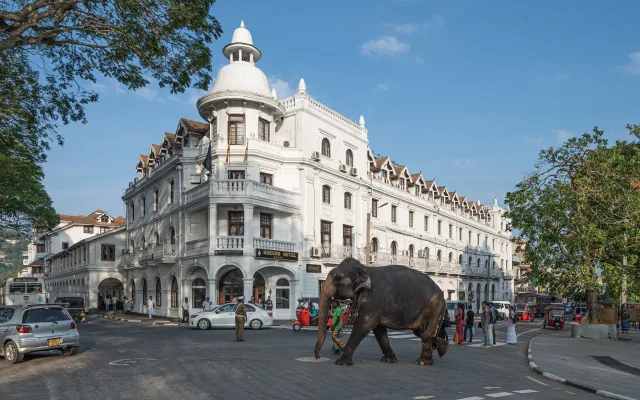
Sri Lanka's cultural capital — the Temple of the Tooth, the Peradeniya botanical garden and Kandyan dance.
Wiki
Kandy is the heart of Sri Lanka's hill country and its spiritual centre: pilgrims come here to the island's principal Buddhist shrine, and backpackers use the town as a convenient base before the famous train ride into the tea mountains. Compact but dense — there is enough here for a couple of days.
Why come, and for how long
Two days is enough to see the essentials without rushing: the Temple of the Tooth, the botanical garden, an evening dance show and a walk around the lake. If you are heading further south into the mountains, Kandy is the logical starting point: the scenic train to Ella and Nuwara Eliya leaves from here, and tickets are best bought in advance.
The town sits in a bowl between hills at about 500 metres, and it is noticeably fresher and damper than the lowlands and the coast. Evenings are cool, so a light jumper is useful.
Getting there and getting around
- From Colombo — the train is the most atmospheric option (about three hours), though the line winds and is not fast. Buses and minibuses run more often and are sometimes quicker.
- From the airport (Negombo/Colombo) — there is no convenient direct service; people normally go via Colombo or take a transfer or taxi.
- Within the town everything central is walkable: it is 15-20 minutes from the station to the lake and the Temple of the Tooth. For longer distances (Peradeniya, Pinnawala) take a tuk-tuk or a local bus. Agree the tuk-tuk fare before getting in; meters are not universal.
What is genuinely worth seeing
The Temple of the Tooth (Sri Dalada Maligawa) is essential. Come for one of the pujas (morning, midday or evening): that is when the inner chamber holding the relic is opened and the drummers play — without it the temple feels far less alive. The dress code is strict: shoulders and knees covered, shoes off at the entrance. Arrive early, as a crowd gathers for the puja.
Kandyan dance — an hour-long evening show with drums, acrobatics and a closing fire-walk. It is a tourist format, but energetic and easy to fit into an evening. There are several venues in the centre, and the programmes are much the same.
Kandy Lake — a calm walk around the perimeter (about 3.5 km) is good at sunset. Not the point of the trip, but a pleasant way to breathe out between temples.
The Peradeniya botanical garden deserves a half-day of its own if you like greenery: a huge site with an avenue of royal palms, a giant banyan and orchid houses. It is about 20 minutes from the centre.
The Bahirawakanda viewpoint (the big white Buddha) — a climb up for the panorama of the town in its bowl of hills. Best in the morning or towards evening.
Outside the town are the wooden Embekke temple, with carved columns of the 14th century, and the Pinnawala elephant orphanage. Read up on the conditions at the latter beforehand: the site has a mixed reputation, and whether to visit is your call.
Where to stay
The most practical areas are around the lake and the central market: everything is walkable and there are plenty of guesthouses. For quiet and views people go to the surrounding hills (the Bahirawakanda area and the slopes above the town), which are cooler and give panoramas, but mean a tuk-tuk down into the centre. Budget options are plentiful, and Kandy is generally cheaper than the beach resorts.
Food and money
The base of the local cooking is rice and curry: rice with a whole set of spiced vegetable and meat curries, the most filling and honestly priced dish there is. Be sure to try kottu (chopped roti with vegetables and egg, made to the clatter of blades) and hoppers, bowl-shaped rice pancakes, especially with an egg. A king coconut (thambili) straight from a cart is refreshing.
As a guide to spending: lunch at a local eating house is cheap, while dinner at a tourist restaurant costs appreciably more. The way to economise is to eat where locals eat and to order rice and curry. Cash is useful — cards are not accepted everywhere, particularly by tuk-tuk drivers and at the market.
Practicalities and common mistakes
- Buy mountain train tickets in advance (especially reserved carriages) — in season they go days ahead. Standing tickets are sold on the day, but several hours standing is hard going.
- Esala Perahera (July-August) is a grand festival with processions of elephants and torchbearers, but the town is overwhelmed and accommodation prices jump. Coming for it means booking far ahead; coming for a quiet Kandy means avoiding those dates.
- The temple scam: "helpers" who lead you to a "free ceremony" or the "right" shop work on commission. You will be let into the shrines without them.
- Weather: rain happens in any season, so an umbrella or a rain jacket is not wasted. The clearest months are roughly January to April.
- Respect local rules: do not turn your back on Buddha statues for a photograph and do not take selfies embracing them — people are genuinely fined for it.