Description
Lithuania's second-largest city — interwar modernist architecture and a medieval Old Town.
Wiki
Kaunas is Lithuania's second-largest city, situated at the confluence of the country's two main rivers — the Nemunas and the Neris. During the interwar decades, when Vilnius was under Polish control, Kaunas served as the provisional capital of the Lithuanian Republic. It is this period that gave the city its distinctive character — a remarkable concentration of modernist architecture that earned interwar Kaunas UNESCO World Heritage status in 2023.
History
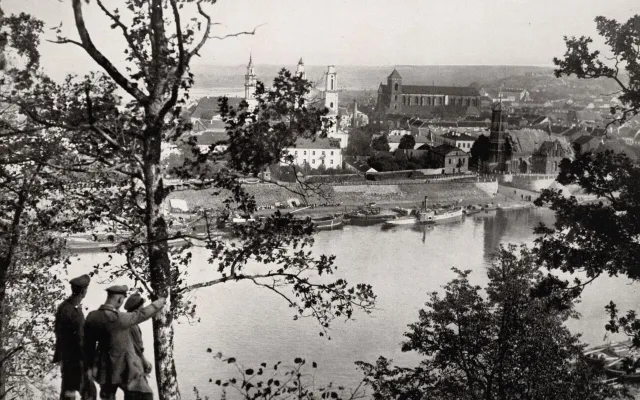
The earliest written records of Kaunas date to the 14th century, when a stone castle was built at the river confluence as a defence against Teutonic Order raids. Kaunas Castle was destroyed and rebuilt several times, remaining a key stronghold of the Grand Duchy of Lithuania. In the 15th and 16th centuries the city grew as a trading hub along the river routes, received Magdeburg rights, and became a centre of crafts; a Hanseatic League trading post operated here.
Kaunas reached its peak between 1919 and 1940, during its years as provisional capital. The city expanded rapidly, with government institutions, a university, banks and residential districts rising in the spirit of contemporary European architecture. During the Second World War Kaunas endured German occupation and the near-total destruction of its Jewish community, once one of the largest in Lithuania. Under Soviet rule the city became a major industrial centre; since independence was restored in 1990 it has developed as a university, cultural and business hub.
Old Town
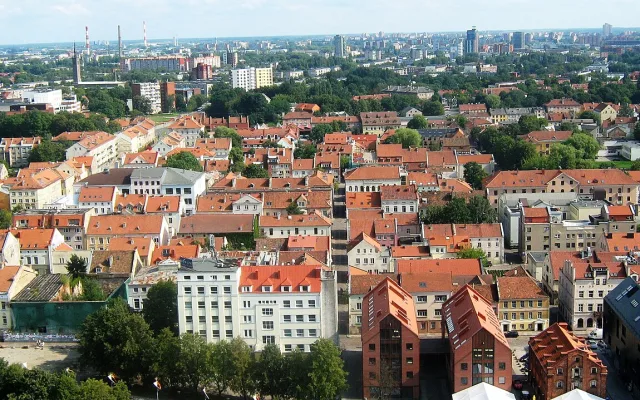
The historic centre (Senamiestis) retains its medieval street plan, with narrow lanes converging on Town Hall Square. The square is dominated by the town hall building with its tall white tower, nicknamed the "White Swan" for its elegant silhouette. Merchant houses, churches and a former Jesuit college surround the square.
- Kaunas Castle — ruins and a restored tower of Lithuania's oldest stone fortress, at the confluence of the rivers.
- Perkūnas House — a late Gothic red-brick building and one of the city's most recognisable landmarks.
- Cathedral Basilica of St Peter and Paul — the largest Gothic basilica-plan church in Lithuania.
- Church of Vytautas the Great — a Gothic church on the riverbank, associated with the Grand Duke.
From Town Hall Square runs Laisvės Alėja (Freedom Avenue) — the main pedestrian thoroughfare, about one and a half kilometres long, lined with linden trees and leading to the newer part of the city.
Modernist Architecture
It is the interwar modernism that makes Kaunas truly distinctive. In the two decades of its capital status, a large number of buildings were constructed in Art Deco, Functionalist and National Romantic styles. Key landmarks include the Church of the Resurrection of Christ, with its white facade and a rooftop viewing platform offering a panorama of the city; the Central Post Office on Freedom Avenue with its characteristically austere facade; and the former ministry buildings, banks and the Vytautas the Great War Museum. Many of these structures are marked by clean geometric forms, ribbon windows and carefully detailed interiors.
Museums and Culture
Kaunas has a rich museum scene.
- Vytautas the Great War Museum and, adjacent to it, the M. K. Čiurlionis National Museum of Art, holding the largest collection of works by composer and painter Mikalojus Konstantinas Čiurlionis.
- Museum of Devils — a one-of-a-kind collection of devil figures and images gathered from around the world.
- IX Fort — a memorial complex on the site of a former fortress used for mass executions during the war.
- Pažaislis Monastery — a Baroque ensemble on the shore of the Kaunas Reservoir, one of the finest in Northern Europe.
The city is known for cultural festivals, street art and murals, and a lively student atmosphere sustained by several universities.
Food
Kaunas offers traditional Lithuanian cuisine: cepelinai (potato dumplings stuffed with meat), šaltibarščiai — a cold bright-pink beetroot soup made with kefir — kugelis (potato pudding), smoked meats and rye bread. Lunch in a cafe runs €10-16 (about $12-18), cepelinai with a beer €12-18 ($14-21), the rooftop viewing platform at the Church of the Resurrection about €3 ($3.50), and a funicular ride €1. Prices are as of 2026. Cafes in the Old Town and along Freedom Avenue serve both local dishes and European food; local bakeries and craft-beer venues are popular, the latter a Lithuanian speciality.
Practical Information
Kaunas is comfortably explored in two days. The first day is best devoted to the Old Town and the castle; the second to Freedom Avenue, the modernist districts and one of the museums, or a trip to Pažaislis Monastery.
- Getting there. The city has an international airport; regular bus and rail services connect Kaunas with Vilnius (roughly one to one and a half hours) and other cities.
- Getting around. The centre is compact and walkable. Buses and trolleybuses run across the city; a historic funicular line links the Old Town with the Žaliakalnis district.
- When to visit. Late spring to early autumn is the most pleasant season, when viewing platforms are open and outdoor terraces are in full swing.
Kaunas combines medieval Gothic, Baroque monasteries and a rare legacy of interwar modernism, making it one of the most architecturally compelling cities in the Baltic region.