Khorog
TajikistanDescription
Khorog is the capital of Tajikistan's Pamirs, on the Panj at the Afghan border, and the main base on the Pamir Highway.
Wiki
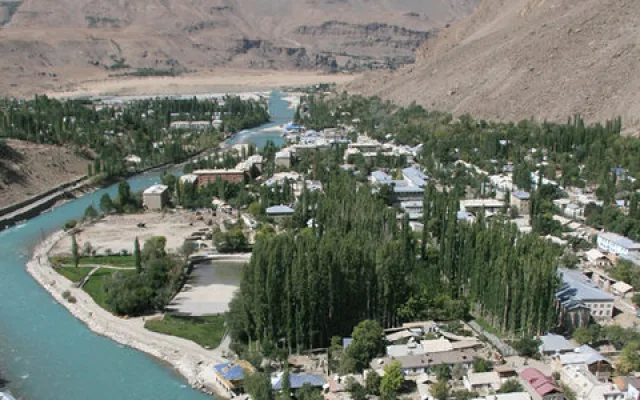
Khorog is the principal town of the Gorno-Badakhshan Autonomous Region and the effective capital of the Tajik Pamirs: some 30,000 people at 2,200 metres, at the mouth of the river Gunt where it joins the Panj. The far bank of the Panj is already Afghanistan, and Afghan villages are visible from the town itself. For the traveller Khorog is above all a base: this is where you finish the paperwork, repair the vehicle, stock up and head on along the Pamir Highway.
The population is largely Pamiri and Ismaili by faith; Pamiris differ from the Sunni Tajiks of the lowlands in language (Shughni, Rushani, Wakhi and others), in daily life and in ritual. Hospitality here is close to obligatory, and turning down tea is difficult.
The Pamir Highway
The M41, about 1,252 kilometres long, links Dushanbe, Khorog and Osh and counts as one of the highest international roads in the world, exceeded only by the Karakoram Highway. Its highest point is the Ak-Baital pass at 4,655 metres. Allow five to ten days for the whole route with stops; Khorog divides it roughly in half and serves as the main place to rest and resupply.
What to see in and around the town
- The Pamir Botanical Garden, at about 2,320 metres, is commonly reckoned the second-highest in the world. The collection has been assembled since the 1940s, and the upper terraces give the best view over the town.
- The Badakhshan regional museum, in the Shotemur house museum — ethnography, the layout of a Pamiri house, and the history of the region.
- The town park and the Gunt embankment, where the whole of Khorog gathers in the evening.
- Garm Chashma — travertine terraces with a hot sulphur spring about 45 km to the south; the water is around 60°C and the pools are separated for men and women.
- The Wakhan valley — the southern branch of the highway runs along the Tajik bank of the Panj, while across the river lies the Afghan Wakhan Corridor. Along the way stand the Yamchun fortress, the Bibi Fatima hot spring, the Buddhist stupa at Vrang and the village of Langar, with thousands of petroglyphs on the slopes above the houses. Beyond that the road climbs the Khargush pass (4,344 m) and rejoins the main highway.
- Ishkashim — the border village where the Wakhan begins. The cross-border market does not always operate; check locally.
- The Bartang valley — the wildest valley in the Pamirs: about 200 kilometres along the river Bartang, on a broken road, past scattered hamlets, ending at Sarez.
- Lake Sarez — the best-known landslide-dammed lake in the Pamirs, formed in 1911 when an earthquake brought the Usoi dam down into the valley. Access is restricted and needs a separate permit.
- Lake Karakul — the largest lake in Tajikistan, some 380 km² at about 3,900 metres, sitting inside an ancient meteorite crater. It lies on the highway north of Murghab, closer to the Kyrgyz border.
Permits and altitude
Entering the region requires a GBAO permit, obtained either with the visa online or separately in Dushanbe; it cannot be sorted out on arrival. Sarez, Zorkul and several border zones need additional permissions. Khorog stands at 2,200 metres and the passes rise to 4,655, so acclimatisation is essential — take the first day at altitude gently and drink plenty.
Food and prices
The cooking is Pamiri and Tajik: qurutob, torn flatbread with soured qurut cheese and the local speciality above all others, along with plov, mantu, shavla and shurbo. In the mountains you mostly eat home cooking in guest houses, and dried mulberries and walnuts come with the tea.
Lunch in a café comes to roughly 35–75 somoni ($4–8), and a night in a guest house with full board 140–230 somoni ($15–25). A taxi around town is 9–28 somoni ($1–3), a litre of petrol about 12 somoni ($1.30) — though in the mountains there may be none at all, so a jerrycan travels with you. A four-wheel drive with a driver for the highway runs to 920–1,385 somoni ($100–150) a day. Cash is essential: the only cash machines are in Khorog and they do not always work. Prices are as of 2026.
Transport and when to go
Khorog's airport is famous for one of the most demanding approaches anywhere, threading between mountainsides; flights from Dushanbe do exist but run irregularly and are frequently cancelled for weather, so they are not something to count on. Overland from Dushanbe it is 14 to 17 hours by car, part of it at 3,500–4,200 metres. From Osh it is two to three days with overnight stops. Within the region a four-wheel drive is not optional: shared taxis are rare and run only on the main routes.
There is one season: June to September, when the passes are open and daytime temperatures hold at 12–25°C. From October to May snow closes the high sections and the highway becomes impassable or dangerous. The main festival of the year is Navruz on 21 March.