Kotor
MontenegroDescription
A medieval Venetian town set in a fjord-like bay, encircled by ancient walls with a scenic climb to the Fortress of St John.
Wiki
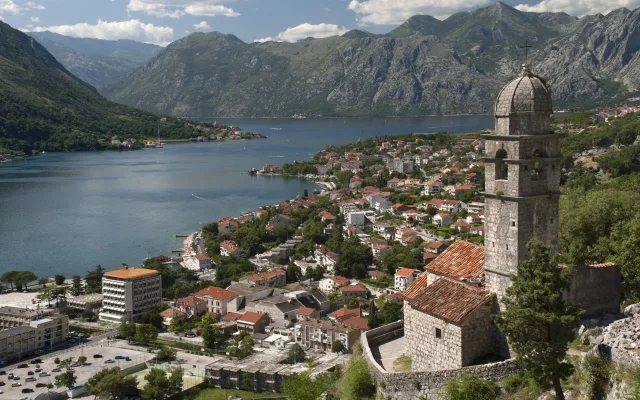
Kotor is the jewel of the Montenegrin coast, tucked at the far end of the Bay of Kotor (Boka Kotorska), where sheer mountains plunge almost vertically into still water. This small city of around 13,000 people preserves a rare, intact medieval character: inside its fortified gates time seems to slow down, and the stone facades, bell towers and cobbled squares are listed as a UNESCO World Heritage Site.
Geography and Nature
The city sits at the foot of the Lovćen massif, at the end of a long winding inlet that is often mistakenly called the only fjord in the Mediterranean — in reality it is a drowned river canyon (ria). The steep slopes create a distinctive microclimate: summers are hot and humid, with brief downpours giving way quickly to sunshine. The fortification walls climb the sheer rock to a height of around 260 metres, while the surrounding peaks rise to 1,200 metres and above. This proximity of mountain and sea defines the whole character of Kotor — compact, vertical, caught between rock and water.
History
A settlement existed here in antiquity (the Roman Acruvium), but the city's present appearance took shape in the Middle Ages. The city flourished most during the rule of the Venetian Republic (1420–1797), which left winged lions of St Mark on the gates and palaces, a Venetian street plan and strong seafaring traditions. Later Kotor passed to Austro-Hungarian rule, survived the Napoleonic era, and endured the devastating earthquake of 1979, after which the historic centre was painstakingly restored. This layered history is written in the architecture: Romanesque churches stand alongside Gothic structures, Baroque palazzi and Austrian fortifications.
What to See
- Old Town (Stari Grad) — a triangle of narrow lanes and squares lined with buildings from the 12th to 18th centuries. The layout was deliberately confusing to disorient attackers; today it is easy and pleasant to get lost in this labyrinth.
- The city walls and the Fortress of St John (San Giovanni) — around 4.5 km of fortifications with a climb of roughly 1,350 steps. The summit offers a panorama of the entire bay; the ascent is most popular at dawn or sunset when the heat has eased.
- Cathedral of St Tryphon — a Catholic cathedral consecrated in 1166, with two distinctive towers and precious relics; dedicated to the city's patron saint.
- Maritime Museum in the Grgurina Palace — a collection of ship models, weapons, captains' portraits and everyday objects that tells the story of Boka's proud seafaring past.
- Church of St Luke, Church of St Nicholas and other Orthodox churches, reflecting the region's mixed religious heritage.
Surroundings
- Perast — a Baroque town 10 km away, once home to renowned sea captains. Opposite it lie two small islands: the natural island of St George and the man-made Our Lady of the Rocks (Gospa od Škrpjela), with a museum and regular boat service.
- Lovćen — a national park on the heights above the city, with the mausoleum of poet and ruler Petar II Petrović-Njegoš.
- Cetinje — the historic capital, with a monastery and museums.
- Budva — a lively resort with beaches, 25 km away, and nearby the iconic island hotel of Sveti Stefan.
- Blue Cave near the entrance to the bay, visited by boat for the play of light on the water.
Food
Kotor's gastronomy blends Montenegrin highland and Adriatic Dalmatian traditions. Worth trying are Njeguši prosciutto and cheese, kajmak, corn cicvara, the meat patty pljeskavica, and on the coast — fresh grilled fish and seafood, squid-ink risotto and pasta. Small family taverns known as konobas offer home cooking and local wines (Vranac, Krstač).
Practical Information
Two days is a sensible allowance for Kotor and its immediate surroundings: the first for the old town and the climb to the fortress, the second for a trip around the bay with a stop in Perast or a drive up into the mountains. In summer the city is crowded with cruise ship passengers, so the narrow streets are best explored early in the morning or in the evening. The nearest airports are Tivat (about 8 km away) and Podgorica; buses run along the coast. Comfortable footwear for cobblestones and steps is essential, and water and a hat are the best protection against the midday heat on the exposed walls.