Description
Japan's ancient capital, with a thousand temples, rock gardens and the geisha quarter of Gion.
Wiki
Kyoto is the ancient capital of Japan, home to the imperial court and the spiritual heart of the country for more than a thousand years. Today it is an open-air museum of a city, where wooden temples, rock gardens, teahouses and geisha quarters sit beside modern districts, preserving the atmosphere of traditional Japan better than any other large city.
History
The city was founded in 794 as Heian-kyo, the "capital of peace and tranquillity", and remained the official capital until 1868, when the court moved to Tokyo after the Meiji Restoration. Over those eleven centuries classical Japanese culture took shape here: the court poetry of the Heian era, the tea ceremony, ikebana, Noh theatre, Zen Buddhism. Kyoto's street plan was modelled on the Chinese capital of Chang'an, a rectangular grid aligned to the points of the compass. The city was largely spared the bombing of the Second World War, so its historic fabric has survived in remarkable condition. Seventeen monuments of old Kyoto are inscribed on the UNESCO World Heritage list.
Main sights
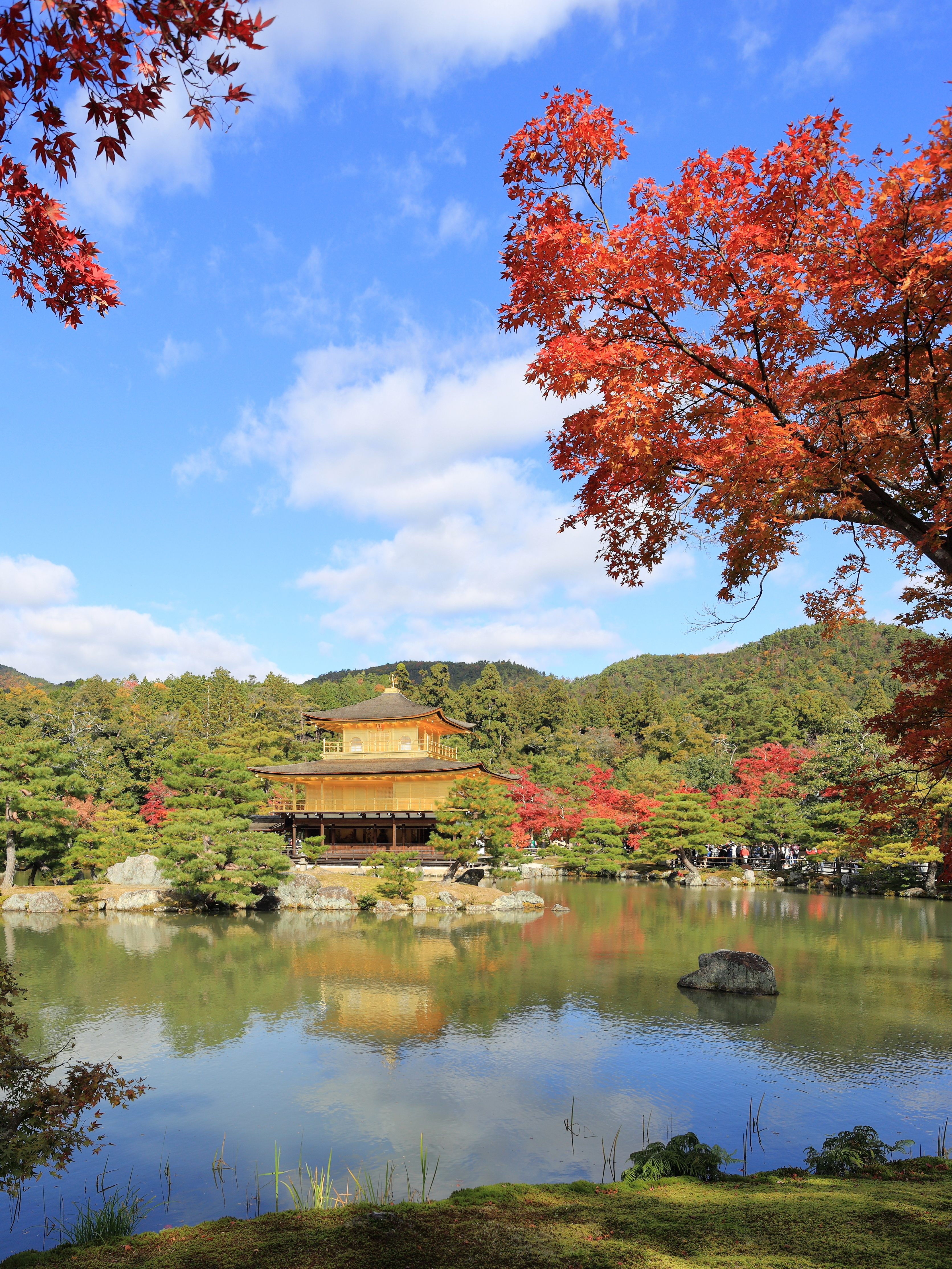
- Kinkaku-ji (the Golden Pavilion) — a Zen Buddhist temple whose upper floors are covered in gold leaf. Its reflection in the mirror pond is one of the most recognisable images of Japan.
- Fushimi Inari Taisha — a Shinto shrine dedicated to the deity of rice. Thousands of vermilion torii gates form tunnels climbing the slope of Mount Inari. Entry is free and the grounds are open around the clock.
- Arashiyama — a scenic western district with a bamboo grove, the Oi River, Tenryu-ji temple and the Iwatayama monkey park on the hilltop.
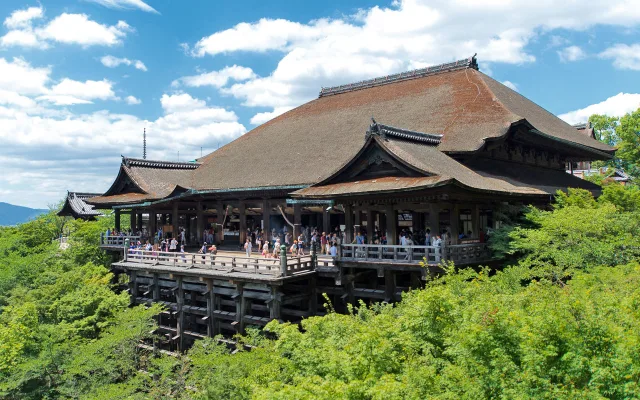
- Kiyomizu-dera — the "pure water" temple on stilts against the slope of Mount Otowa; its wooden terrace looks out over the whole city.
- Gion — the historic quarter of teahouses. In the evening you may see geiko and their maiko apprentices on Hanamikoji street and along the Shirakawa canal.
- Nijo Castle — the castle of the Tokugawa shoguns, famous for its "nightingale" floors, which squeak underfoot and betray an approaching stranger.
- Ginkaku-ji (the Silver Pavilion) and the Philosopher's Path that leads to it along a canal — especially beautiful in spring.
- Ryoan-ji — the definitive karesansui rock garden: fifteen stones on a bed of white gravel, arranged so that never all of them are visible at once.
Food
Kyo-ryori, the local culinary tradition, is considered the most refined in Japan, built on seasonality, delicate presentation and the taste of the ingredients themselves. Try nishin soba (buckwheat noodles with dried herring), yudofu (tofu simmered in hot broth), and bento boxes and multi-course kaiseki sets. Kyoto is the birthplace of matcha green tea, so there is no shortage of desserts made with it: ice cream, waffles, cakes and traditional wagashi sweets. The lively Nishiki Market, nicknamed "Kyoto's kitchen", runs along a narrow covered arcade selling pickles, fresh fish and street snacks. An inexpensive lunch costs from about ¥1,600 ($10) and a cup of coffee around ¥630 ($4). Prices are as of 2026.
A four-day route
- Day 1. Eastern Kyoto: Kiyomizu-dera, the picturesque lanes of Sannen-zaka and Ninnen-zaka, Maruyama Park, Yasaka Shrine and an evening walk through Gion.
- Day 2. The north-west: the Golden Pavilion, the Ryoan-ji rock garden and the Ninna-ji temple complex.
- Day 3. Arashiyama: the bamboo grove, Tenryu-ji temple, the Togetsukyo bridge, the monkey park and the Oi River.
- Day 4. Fushimi Inari early in the morning before the crowds, then Nijo Castle or the Silver Pavilion with the Philosopher's Path.
The city is compact: buses and two metro lines connect the districts, and many routes are an easy walk.
When to go
Beauty peaks in two seasons. Cherry blossom runs from late March into early April, and the crimson of the momiji maples fills the temple gardens in November — these are also the most crowded weeks. Summer is hot and humid, but July brings Gion Matsuri, the biggest festival of the year, with its procession of enormous yama and hoko floats. Winter is mild, with little snow, and ideal for unhurried sightseeing without the queues.
Photos