Description
The gastronomic capital of Latin America, home to the continent's finest restaurants and pre-Columbian huacas embedded within the city's own neighbourhoods.
Wiki
Lima is the largest city and capital of Peru, spread across the desert Pacific coast in the valleys of the Rímac, Chillón and Lurín rivers. It is the country's political, financial and, above all, culinary centre — widely recognised as the gastronomic capital of Latin America.
History and general character
The city was founded by the Spanish conquistador Francisco Pizarro on 18 January 1535 under the name "City of Kings" (Ciudad de los Reyes), and for nearly three centuries served as the capital of the Viceroyalty of Peru — the most important stronghold of the Spanish Crown in South America. From here, vast territories stretching from Panama to Tierra del Fuego were governed; silver from the mines of Potosí was minted here, and one of the continent's first universities — San Marcos (1551) — was established in the city. The historic core was inscribed on the UNESCO World Heritage List in 1988.
Today, Greater Lima is home to around 10–11 million people — roughly a third of the country's entire population. The climate is unusual: despite the city's proximity to the equator, it is cool and nearly rainless, though a thick winter overcast known as garúa settles in from June to September. The best time to visit is the southern summer, December through April, when skies are clear and the ocean warms.
What to see
- Plaza Mayor (Plaza de Armas) — the heart of the colonial city, with the cathedral where Pizarro's remains rest, the Archbishop's Palace and elaborately carved wooden balconies in the Moorish style.
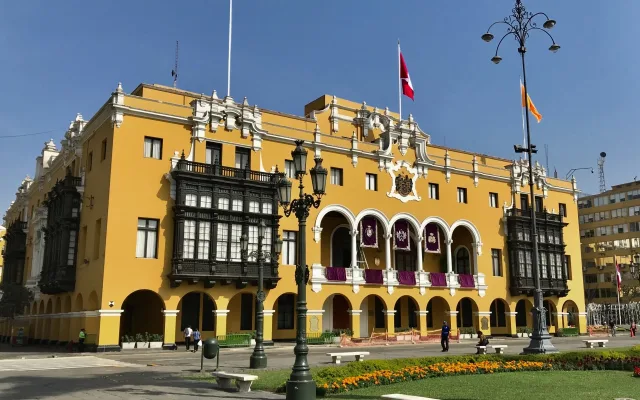
- Government Palace — the presidential residence on the northern side of the square; a changing-of-the-guard ceremony takes place here at noon.
- Monastery of San Francisco — a 17th-century Baroque complex with a library of ancient volumes and famous catacombs housing thousands of human remains.
- Miraflores — a modern seaside district with the well-kept Malecón promenade, the Parque del Amor (Park of Love) featuring a sculpture of a kissing couple and Gaudí-inspired mosaics, and the Larcomar shopping complex perched on the clifftop above the ocean.
- Barranco — a bohemian quarter of artists and musicians, known for its street art, historic mansions, bars and the romantic Puente de los Suspiros (Bridge of Sighs).
- Huaca Pucllana — an adobe pyramid of the Lima culture dating from the 3rd–7th centuries, preserved within the residential blocks of Miraflores; a museum and restaurant operate on site.
- Larco Museum — a private collection of pre-Columbian art housed in an 18th-century mansion, featuring exquisite Moche ceramics and a dedicated gallery of erotic vessels.
- Pachacamac — a vast temple complex 40 km to the south, venerated by pilgrims long before the Inca.
Huacas — pre-Hispanic adobe shrines — are scattered throughout the city: beyond Pucllana, Huaca Huallamarca in the San Isidro district is worth a visit.
Cuisine
It is at the table that Lima reveals itself most fully. Peruvian gastronomy is a fusion of indigenous traditions with Spanish, African, Chinese and Japanese influences. Dishes not to miss:
- ceviche — raw fish "cooked" in lime juice with onion, chilli and corn; the national dish;
- lomo saltado — beef stir-fried with onion, tomatoes and chips in the chifa Chinese-Peruvian style;
- ají de gallina — chicken in a creamy, mildly spicy yellow-pepper sauce;
- tiradito — a ceviche cousin with Japanese inflections, sliced thin;
- anticuchos — beef-heart skewers, a classic street food.
The natural accompaniment is the national cocktail, the pisco sour, made from grape brandy. Lima consistently places several restaurants in the World's 50 Best Restaurants ranking — among them Central, Maido and Astrid y Gastón, which set the benchmark for high-end creative cooking. That said, excellent food is equally available at simple set-lunch diners (menú) or at the Mercado de Surco market.
Planning your visit
Three days is enough to get a solid feel for the city: one day for the colonial centre, one for Miraflores and Barranco with the coastal huacas, and a third for museums and a trip to Pachacamac. From Jorge Chávez International Airport in Callao, the most convenient way to reach the tourist districts is by official taxi or pre-booked transfer. Most visitors choose to stay in Miraflores or San Isidro — safe, walkable neighbourhoods. In the evening, the Magic Water Circuit (Circuito Mágico del Agua) in Parque de la Reserva is well worth seeing — a Guinness World Record-holding fountain complex with a music-and-light show. As in any large city, keep a close eye on your belongings in the centre and on the outskirts, and avoid quiet streets after dark.