Description
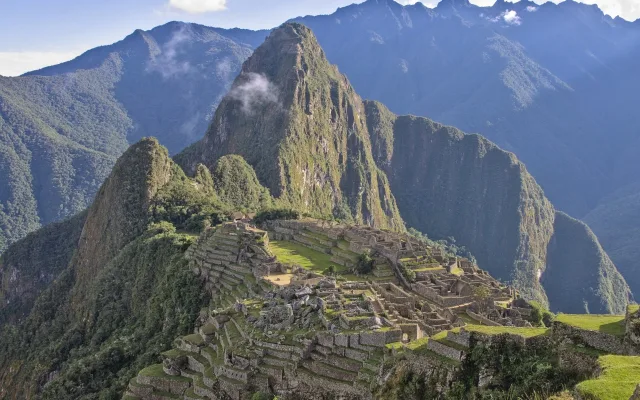
The lost Inca city in the clouds — one of the most iconic sites in the Andes, reachable via the legendary Inca Trail or by train.
Wiki
One of those rare cases where reality lives up to a thousand postcards: the Inca city perched on a saddle between two peaks really does look unreal, especially when the morning mist clears and the terraces emerge from the clouds. But precisely because of that fame, Machu Picchu is a place that demands advance planning — show up without a booking and you may not get in at all.
How a visit works: tickets and limits
The essential thing to understand: you cannot simply turn up. Entry is strictly timed and route-specific.
- Book ahead. In high season (May–September) slots for popular entry times and for Wayna Picchu sell out weeks or even months in advance. The official booking site is the Ministerio de Cultura; agencies are an alternative but charge a premium.
- Three circular routes. Since 2024, when you buy a ticket you choose one of the circuits. The upper circuits give you the classic panoramic "postcard" viewpoint; the lower ones take you closer to the buildings. You cannot backtrack — movement is one-way — so think about what matters more to you: the view from above or the architectural details.
- Combo tickets. Wayna Picchu and Montaña are separate add-ons with limited places. Wayna Picchu is more dramatic, with stairways above sheer drops (not for those with a fear of heights); Montaña is a longer but gentler climb and gives the best wide shot of the citadel.
- Your passport is mandatory — the name on the ticket is checked at the gate. There are no toilets or food inside; both are available only at the entrance.
Getting there
The base for any visit is Cusco, but there is no direct road between Cusco and Machu Picchu.
- Train — the standard approach. From Cusco (Poroy station, which only runs in the dry season, though most travellers start from Ollantaytambo) PeruRail and IncaRail run services to Aguas Calientes. Starting from Ollantaytambo is cheaper: a colectivo or taxi from Cusco takes a couple of hours, the rail leg is shorter, and tickets cost noticeably less than a train from Cusco itself.
- Bus to the top. Shuttles run the switchback road from Aguas Calientes up to the citadel gate (about 25–30 minutes). The alternative is the steep footpath — roughly an hour to an hour and a half of climbing. Buy bus tickets in advance at the booth in the village; queues at dawn are long.
- Trekking routes. The classic Inca Trail and the budget-friendly Salkantay Trek suit those with 4–5 days to spare. The Inca Trail requires a licensed guide and a booking made roughly six months ahead; it closes for maintenance every February. Salkantay has no permit cap, costs less, and can be arranged at fairly short notice in Cusco.
How long to stay and when to go
Two days is enough: arrive in Aguas Calientes, spend the night, enter the citadel on an early slot. Staying in the village overnight is the key to getting in before the wave of day-trip groups from Cusco and before the midday heat.
- Dry season (May–September) — clear skies, but crowds are at their peak and prices are higher.
- November–March — rainy season, fewer visitors; morning cloud can either ruin the view or produce exactly that moody, atmospheric shot.
- Don't fixate solely on sunrise: cloud often blankets everything until 8 or 9 am, while conditions frequently improve by mid-morning.
Acclimatisation and altitude
There is a useful paradox here: the citadel itself sits at 2,430 m — lower than Cusco at 3,400 m. Spend a couple of days in Cusco or the Sacred Valley before visiting Machu Picchu, not afterwards. The valley towns (Ollantaytambo, Urubamba — around 2,800 m) are easier to acclimatise in, and they put you closer to the train.
Money, food and practicalities
- Machu Picchu is expensive by Peruvian standards. The main costs are the train and the entrance fee; there is limited room to cut these, aside from departing from Ollantaytambo and choosing inconvenient early-morning or late-evening trains.
- Food in Aguas Calientes is overpriced — the village has a captive tourist audience. Stock up on water and snacks in Cusco or Ollantaytambo. Large bags and tripods are not permitted inside; rules on backpacks and trekking poles change periodically — poles often require rubber tip covers.
- The thermal baths in the village are modest — a pleasant way to rest your legs after the descent, but not a destination in themselves.
Common mistakes
- Doing it as a day trip from Cusco — exhausting and risky given train schedules.
- Not checking which circuit you bought and missing the viewpoint you actually wanted.
- Booking a Wayna Picchu slot despite a fear of heights — the steps genuinely are narrow and exposed.
- Forgetting your passport or insect repellent: the insects near the river at the bottom bite.
- Expecting to find toilets and lunch inside the site — there are none.