Description
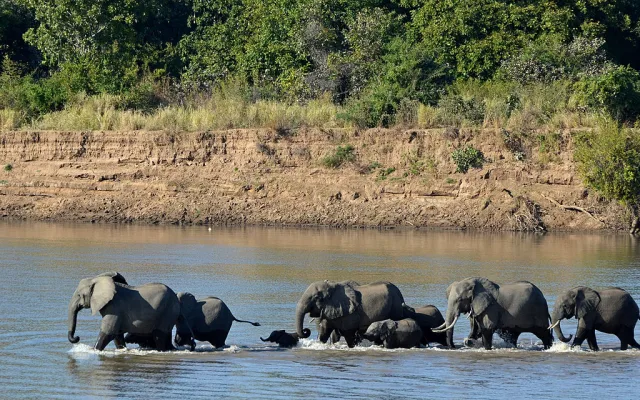
Mfuwe is the settlement at the gateway to South Luangwa National Park in Zambia, birthplace of the African walking safari.
Wiki
Mfuwe is a small settlement in eastern Zambia that serves as the main gateway to South Luangwa National Park, one of the best-known safari regions in Africa. This is where the tarred roads end and the wild valley of the Luangwa River begins, drawing travellers who come for encounters with big animals in their natural environment.
Geography and location
Mfuwe lies in Zambia's Eastern Province, roughly 700 km east of the capital, Lusaka. The settlement spreads out along the eastern boundary of South Luangwa National Park, in the valley of the Luangwa, one of the largest tributaries of the Zambezi. This valley forms the southern end of the Great Rift Valley, which shapes its landforms: broad floodplains, oxbow lakes and reed-grown banks.
The climate is tropical, with sharply defined dry and wet seasons. The dry period (roughly May to October) is considered the best time for watching wildlife: the vegetation thins out and the animals concentrate around the shrinking waterholes. In the rainy season (November–April) the valley turns green, the rivers rise and some of the dirt roads become impassable.
South Luangwa National Park
The main reason for coming to Mfuwe is access to South Luangwa, which covers about 9,000 km². The reserve is renowned for its high density of animals and the variety of its landscapes. It is home to elephants, buffalo, hippos, Thornicroft's giraffe (an endemic subspecies found only in this valley), zebra, kudu, impala and puku. The Luangwa River holds large populations of hippopotamus and Nile crocodile.
Among the predators, the park has lions, leopards, spotted hyenas and African wild dogs. South Luangwa is considered one of the best places in Africa for watching leopards, especially on night drives when these secretive cats come out to hunt.
Birdwatchers value the valley for its wealth of species: several hundred birds have been recorded here, from brilliant bee-eaters and kingfishers to storks, herons and birds of prey.
Walking safaris
South Luangwa entered history as the birthplace of the walking safari. It was here, in the second half of the 20th century, that guides began leading visitors through the bush on foot, accompanied by an armed ranger and an experienced guide. The format gives a different feel for wild nature: you notice tracks, plants, insects and small details that are inaccessible from a vehicle. Walking routes remain the calling card of the region and attract travellers looking for closer contact with the savannah.
History and local life
The Luangwa valley has long been inhabited by peoples who lived by farming, fishing and hunting. These lands were given protected status in the colonial period, and South Luangwa became a full national park in the 1970s. The growth of tourism gradually turned Mfuwe from a remote settlement into a base for the conservation industry.
Today local people's livelihoods are largely bound up with receiving guests and working in the lodges and conservation projects. Initiatives in the surrounding area aim to protect wildlife and involve communities in sustainable tourism. Getting to know village life, crafts and the everyday routine of Zambians can be a rewarding addition to a safari.
Food
The staple of the local table is nshima, a thick porridge of maize flour served with stewed vegetables, beans, fish or meat. Fishing is traditional along the banks of the Luangwa, so river dishes occupy a notable place in the diet. Lodges usually offer guests both Zambian dishes and familiar international cooking.
Practical information
- Getting there. The settlement has Mfuwe Airport, which handles flights from Lusaka and other towns; this is the quickest way into the valley. The alternative is a long road journey from the capital, taking many hours.
- How long to stay. About four days is the ideal allowance: enough for several morning and evening drives, a walking safari and some rest between trips into the bush.
- Accommodation. Lodges and tented camps of varying standards are located near the park, from simple to comfortable.
- Health. The region is endemic for malaria, so arrange prophylaxis and insect repellent in advance. It is advisable to check current vaccination requirements.
- What to bring. Binoculars, neutral-coloured clothing, a hat, sunscreen and comfortable footwear for walking routes will all be useful.
Mfuwe is less a destination in itself than a threshold, beyond which opens one of the most alive and untouched savannahs in Africa, where an encounter with wildlife feels particularly genuine.