Description
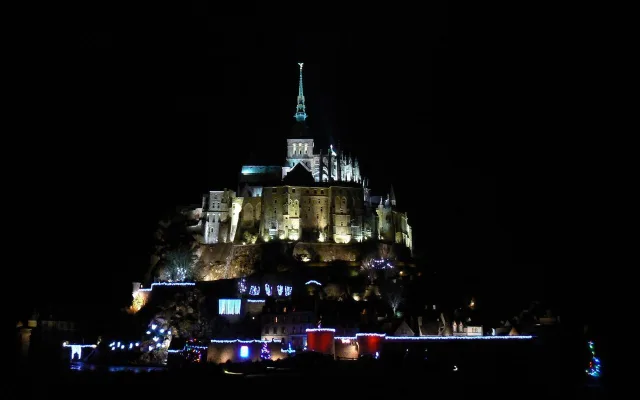
A legendary monastery perched on a rock amid the Norman tides — one of France's most recognisable silhouettes and a UNESCO World Heritage Site.
Wiki
Mont Saint-Michel is a tiny tidal island in Normandy, crowned by a medieval abbey whose sharp silhouette has become one of the most iconic images of France. For centuries pilgrims from across Europe flocked here, calling the mount the "Heavenly Jerusalem"; today it is a UNESCO World Heritage Site (since 1979) and one of the most visited attractions in the country outside Paris.
History and Legend
According to tradition, in 708 the Archangel Michael appeared three times to Aubert, Bishop of the nearby city of Avranches, and commanded him to build a sanctuary on the granite rock then known as Mont Tombe. This marked the beginning of a history that unfolded over a millennium: from a modest chapel to a powerful Benedictine abbey. The peak era came in the 11th–13th centuries, when the Romanesque church at the summit and the monastic complex known as La Merveille ("The Marvel") were built.
During the Hundred Years' War the mount became an impregnable fortress: despite a long siege, the English never managed to take it, which reinforced the island's symbolic importance to the French nation. After the Revolution monastic life faded, and until the second half of the 19th century the abbey served as a prison. It was later declared a historic monument and restored, and a monastic community returned in the 20th century.
The Abbey and Architecture
The island's centrepiece is the abbey itself, rising in terraces up the rock face. The ensemble is crowned by a Gothic basilica whose spire, topped with a gilded statue of the Archangel Michael, reaches about 170 metres above sea level. The engineering skill of the builders is remarkable: the massive structures rest on the rock and a system of crypts that compensate for the uneven terrain.
The La Merveille complex on the north side comprises several levels:
- The Cloister (cloître) — an inner courtyard with a double row of slender columns, seemingly suspended between sky and sea.
- The Refectory (réfectoire) — a spacious hall softly lit by narrow side windows.
- Crypts and halls — powerfully vaulted spaces that support the upper floors.
A visit typically ends with the garden and viewing terraces, which offer a panorama of the vast bay.
The Village and the Grande Rue
At the foot of the mount huddles a tiny settlement with a permanent population of only around fifty people. The single main street — the Grande Rue — climbs in a narrow ribbon from the town gate to the abbey. Along it stand timber-framed houses, souvenir shops, cafés and small themed museums covering the history of the site and local maritime trades. Defensive walls and towers from the 14th–15th centuries encircle the village, and it is possible to walk almost the entire way around the island along the ramparts while taking in changing views over the bay.
Here too stands the celebrated La Mère Poulard, an establishment that has been open since 1888 and made its name with a fluffy omelette beaten by hand and cooked over an open fire.
The Bay and the Tides
The Bay of Mont Saint-Michel is known for some of the most powerful tides in Europe: the difference between high and low water reaches 14 metres, and the tide retreats for kilometres. The water comes in fast, making independent walks across the exposed seabed dangerous because of quicksand and strong currents — crossings of the bay are made only with a licensed guide.
In 2014 the causeway that had been disrupting the natural circulation of water was replaced by a lightweight bridge on piles. As a result, during the largest tides — which occur several times a year — the mount is once again completely surrounded by water and becomes a true island.
Planning Your Visit
One day is enough to tour the abbey, walk the walls and stroll through the village. Cars are left in the mainland car park, from which a free shuttle and a pedestrian path of about two and a half kilometres lead to the island. The nearest major reference points for planning a route are the cities of Rennes and Caen, as well as the Norman and Breton resorts. It is best to arrive early in the morning or towards evening, when the main tour groups have thinned out.
Nearby
- Saint-Malo — a historic corsair port roughly 50 km away, with granite ramparts and a seafaring atmosphere.
- Cancale — a fishing town famed for its oyster beds and views over the bay.
- Avranches — the city where, according to legend, the story of the mount began; medieval manuscripts from the abbey are kept here.
Mont Saint-Michel brings together the natural and the man-made: tides that transform the landscape before your eyes, and the vertical thrust of the abbey reaching towards the sky — a combination that has drawn pilgrims and travellers for centuries.