Description
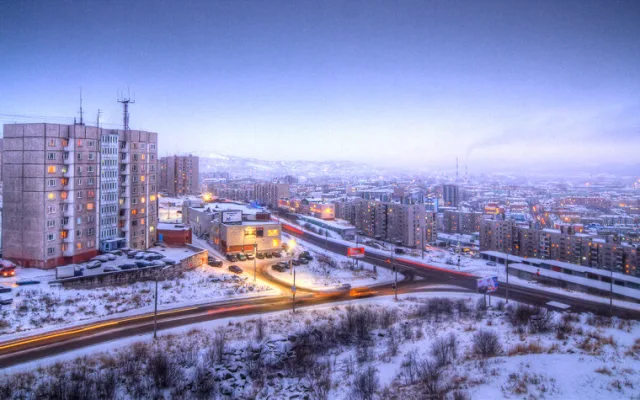
The largest city in the world above the Arctic Circle, on an ice-free inlet off the Barents Sea. Northern lights, the polar day, the nuclear icebreaker Lenin and Arctic cruises.
Wiki
Murmansk is not just a transit point on the way to Teriberka, although many people use it that way. It is a working port city at almost 69 degrees north, where you can climb inside a real nuclear icebreaker, catch the aurora straight from a hill in town, and understand what life above the Arctic Circle looks like without the postcard gloss.
Getting there and getting around
The main ways in are by air and by rail. The airport lies west of the city, with a city bus and taxis running to the centre; the journey takes around half an hour and the bus is substantially cheaper. The bus timetable is not tightly matched to arrivals, so if you land at night, budget for a taxi.
The train from St Petersburg takes over 24 hours, and from Moscow close to two days. It is an option not for saving time but for those to whom the journey itself matters: the last hours of the route run through tundra, lakes and low hills. The railway and bus stations are next to each other, within walking distance of the centre.
Within the city:
- The centre is compact and the key points can be walked, but allow for the terrain — Murmansk is built on hills and the climbs are noticeable.
- Buses and shared minibuses cover the rest; card payment usually works.
- Taxis are inexpensive by capital-city standards, and ordering through an app is the most practical option in winter, when waiting at a stop in the wind is not appealing.
- Renting a car only makes sense for trips out of town (Teriberka, Safonovo, the surrounding lakes). In winter take a car with winter tyres and check whether you are allowed to drive on unsurfaced roads.
What is genuinely worth seeing
The nuclear icebreaker Lenin — the main reason to linger in the city. The world's first surface vessel with a nuclear power plant is permanently moored by the sea terminal and works as a museum: tours are led through the engine room, the wardroom and the bridge. You can only go in with a group at set times, and in high season places are taken in advance — check the schedule on the day you arrive, or better the day before.
The Alyosha memorial — a giant soldier on Zeleny Mys hill. People go up not so much for the monument as for the outlook: the whole Kola Bay, the port, the cranes, the hills on the far shore. The best viewpoint in the city, and free. The walk up is feasible but steep; in winter the paths are slippery.
The seaport and the bay. An ice-free port is not an abstraction: even in February the water is open, ships are working and fishing trawlers are moored up. A walk along the bay gives you more understanding of the city than any museum.
The regional museum — for anyone interested in the Arctic, the opening up of the North, Sami culture and the nature of the Kola Peninsula. Compact and to the point.
The naval museum and the submarine K-21 in Severomorsk — for those interested in the fleet. But Severomorsk is a closed town requiring a permit, which is arranged in advance and is not granted to everyone. Plan this separately and well ahead, or do not count on it at all.
How many days, and when to go
A day and a half to two days is enough for Murmansk itself. The real point of the trip is to use the city as a base: Teriberka on the Barents Sea with its "ship graveyard" (3–4 hours each way, with the road closing in a blizzard), snowmobile safaris, husky farms and reindeer camps. That makes 4–5 days a sensible format.
Winter (December–March) is the northern lights season. The polar night lasts roughly from early December to mid-January: the sun does not rise at all, but there is no complete darkness — the days are long, thick twilight. The aurora is hunted outside the city, driving away from the light pollution, and only in clear weather — cloud cancels everything.
Summer (June–July) brings the polar day, when the sun does not set. A different city: green hills, water, mosquitoes in the tundra. There is no aurora — it is physically impossible.
The shoulder seasons are a compromise: late August and September give dark nights, tundra that is still passable, and the first chances of the aurora.
Where to stay
Stay in the centre — the area of Lenina Avenue, Pyat Uglov ("Five Corners") and around the square. From there it is walkable to the icebreaker, the station and the cafés, and the excursion groups set off from there too. Hotels in the outlying residential districts are cheaper, but in winter every extra journey in the dark and the cold costs you energy. The choice is small: a few hotels, apartments and hostels. In the high winter season book ahead — demand from tourists hunting the aurora is real.
Money, food, saving
Murmansk is more expensive than the average Russian provincial city: the northern logistics mean everything is brought in. The exception is fish and seafood. Cod, halibut, wolffish, scallops and crab are what make a restaurant meal here worthwhile. Sea urchin and crab are served in specialist places and are no longer budget fare. Reindeer meat appears on menus as a local item and is worth trying.
Where to save:
- Canteens and chain cafés for ordinary lunches, with a restaurant used selectively, for the fish.
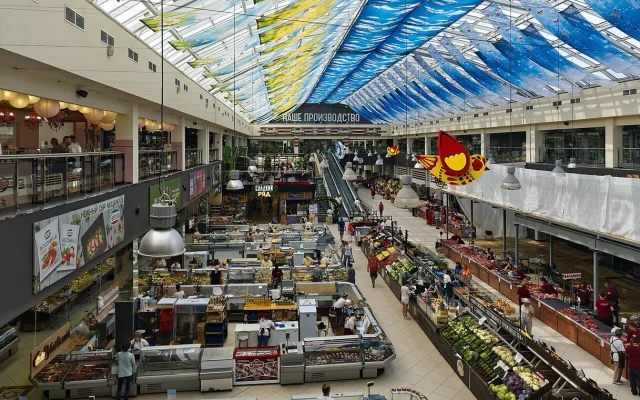
- The fish market or the shops by the port instead of restaurant mark-up, if your accommodation has a kitchen.
- Public transport instead of taxis during the day.
- Group tours to Teriberka are cheaper than private ones, but for the aurora a private guide delivers more — a guide chases the breaks in the cloud, whereas a coach follows its route.
Important things to bear in mind
- Clothing decides everything. The wind off the bay makes −15 °C feel sharper than −25 °C in central Russia. You need a windproof layer, thermal underwear, a hat that covers the ears, mittens and shoes with a ridged sole. Ordinary city boots are dangerous on ice.
- The weather breaks plans. The road to Teriberka is closed in blizzards, sometimes for a day or two. Do not schedule it for the last day before your flight.
- The aurora is not guaranteed. No tour honestly promises a result. Three or four nights in reserve give reasonable chances; one night is a lottery.
- Devices freeze. A phone dies within minutes in the cold — keep it in an inside pocket and bring a power bank.
- Safety. The city is calm and the crime risk is no higher than usual. The main dangers are ice underfoot, icicles and sheets of ice falling from roofs in spring, and hypothermia if you underestimate the wind.
A typical mistake is to come for two days "to see the aurora and Teriberka" and leave with nothing because of a blizzard. A second is to treat the city as a stage set: Murmansk is more interesting if you look at it as a working Arctic port rather than as a place to change trains.