Description
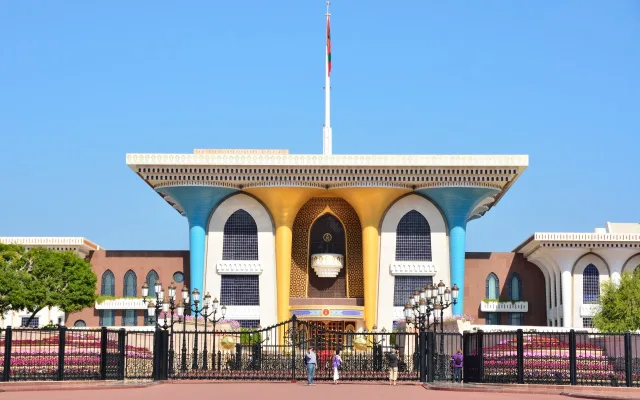
The capital of Oman — the Sultan Qaboos Grand Mosque, Al Alam Palace and the Mutrah souq.
Wiki
The capital of the Sultanate of Oman — around 1.4 million people, and one of the most authentic Arab capitals on the Gulf. Unlike Dubai and Doha, Oman has kept a low-rise white city built in what locals call Omani style: nothing above ten storeys in the centre, mosques in traditional architecture, and a general conservative elegance. It is the safest country in the region and one of the best places in the Middle East for travellers of every kind.
Main sights
- The Sultan Qaboos Grand Mosque — the country's principal mosque, open to non-Muslims in the mornings. It holds one of the largest carpets in the world (4,200 m²) and an enormous crystal chandelier.
- The Royal Opera House Muscat — the Gulf's first opera house, opened in 2011, with an excellent programme.
- The Mutrah Corniche — a seafront promenade along the old town, looking out over the harbour.
- Mutrah Souq — the country's main traditional market, selling frankincense, silver and Omani daggers (khanjars).
- Al Jalali and Al Mirani forts — 16th-century Portuguese forts on either side of Muscat bay. Usually only Al Jalali opens, and not always.
- Al Alam Palace — the sultan's ceremonial palace, seen from outside.
- Bait Al Zubair Museum — a private museum of Omani culture in a restored mansion.
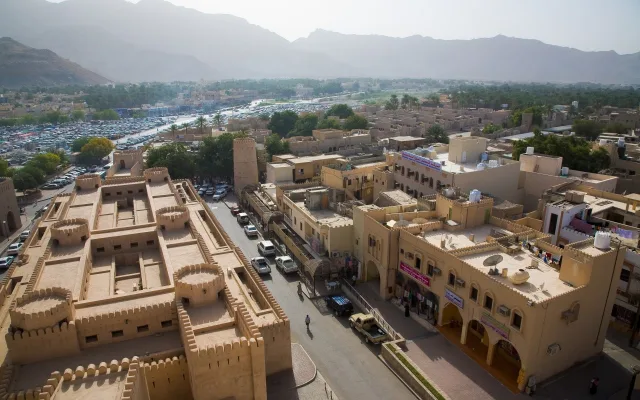
- Nizwa — the ancient capital 165 km away, with the country's greatest fort and a Friday livestock market.
- Wadi Shab — the most beautiful wadi in Oman, two hours away: a walk in and a swim in natural pools.
- The Sharqiya Sands (Wahiba) — desert two and a half hours out, with Bedouin camps.
Food and prices
The cooking is Omani: shuwa (lamb baked in the ground for 24 hours, for special occasions), mishkak (grilled skewers), majboos (rice with mutton) and Omani halwa. Lunch at a local place is 3-6 OMR ($8-15), dinner in a restaurant 10-19 OMR ($25-50). Fresh Omani mangoes in season are 1-2 OMR ($3-5) a kilo. A litre of petrol costs 0.230 OMR ($0.60), a taxi across town 2-6 OMR ($5-15), car hire 12-19 OMR ($30-50) a day — essential for trips out of the city. Prices are as of 2026.
Getting there
Muscat International Airport (MCT) is served by Oman Air, the national carrier, along with Emirates, Qatar, Etihad and Lufthansa. A taxi or Mwasalat transfer into the centre is 5-7 OMR ($12-18), the bus 0.800 OMR ($2). Around town you take taxis or hire a car. From Dubai it is an hour by air ($50-100) or six hours by bus ($35-45). Oman issues eVisas online, usually within two or three days, and waives them for some nationalities — check what applies to your passport.
When to go
November to March, at 22-30°C, is ideal, with December to February the peak. Summer (May-September) is an extreme 38-45°C — but Salalah, 1,100 km to the south, is the one place on the Arabian Peninsula that catches the summer monsoon (the khareef), when everything turns green. Turtle season at Ras Al Hadd runs from June to September.