Ohrid
North MacedoniaDescription
The Orthodox Jerusalem of the Balkans on the shores of crystal-clear Lake Ohrid — a tectonic marvel and UNESCO double World Heritage Site.
Wiki
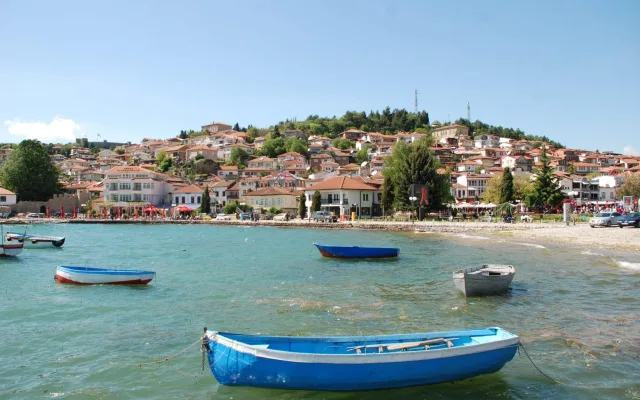
One of the oldest cities in Europe and the foremost spiritual and cultural jewel of North Macedonia — a city of around 42,000 people on the shore of the lake of the same name, the oldest lake in Europe (4–5 million years old). A UNESCO double World Heritage Site (cultural and natural, inscribed 1979/1980). In the Middle Ages Ohrid was the most important centre of Slavic literacy — Saints Clement and Naum carried on the work of Cyril and Methodius and founded the Ohrid Literary School here. The city's nickname "the Jerusalem of the Balkans" comes from its 365 churches within a 5 km radius — one for every day of the year.
Main sights
- Church of St John at Kaneo (Sveti Jovan Kaneo) — the most photographed church in the Balkans, perched on a cliff above the lake, 13th century.
- Samuel's Fortress (Samoilova Tvrdina) — the 10th-century citadel of Tsar Samuel, a symbol of Macedonian statehood.
- Ohrid Old Town — cobbled lanes climbing a hillside, lined with 19th-century houses in the traditional style.
- Ancient Theatre — the only surviving Hellenistic theatre in North Macedonia (2nd century BC).
- Saint Sophia (Sveti Sofija) — an 11th-century cathedral, former seat of the Archbishopric of Ohrid.
- Saints Clement and Panteleimon (Sveti Kliment Ohridski) — a reconstructed 9th-century church and the tomb of Saint Clement, the foremost educator of the Slavs.
- Plaošnik — an archaeological site featuring an early Christian basilica and reconstruction.
- Monastery of Saint Naum (Sveti Naum Monastery) — the principal pilgrimage site, 30 km along the lake shore near the Albanian border. 10th century; contains the tomb of Saint Naum.
- Lake Ohrid — the deepest lake in the Balkans (288 m), home to endemic species including Ohrid trout, with beaches along its shores.
- Bay of Bones — a reconstructed prehistoric pile-dwelling settlement.
- Bitola — the neighbouring city an hour's drive away, the second-largest city in the country.
- Saint Erasmus — an ancient rock-cut church along the road to Saint Naum.
Food and prices
The cuisine is Macedonian: tavče gravče (the national dish — beans slow-cooked in a clay pot), Ohrid trout (a protected designation of origin, endemic to the lake), ajvar, mučkalica, Šopska salad. Lunch at a kafana (traditional tavern) costs 8–15 EUR (about $9–17); dinner at a restaurant 18–35 EUR ($21–40). A glass of Tikveš or Bovin wine is 3–5 EUR ($3–6). A litre of petrol is around 1.40 EUR ($1.60), a taxi across town 4–10 EUR ($5–12), a boat to Saint Naum 15–20 EUR ($17–23) return. Prices are as of 2026.
Getting there and around
Ohrid Airport – St Paul the Apostle (OHD) is served by Wizz Air and charter flights. Flying into Skopje (SKP, 170 km away) is often more convenient — the bus takes 3–4 hours and costs 12–18 EUR ($14–21). The Old Town is compact and best explored on foot; taxis cover the rest of the city. To Saint Naum: by boat (1 hour, 15 EUR / $17) or by taxi/minibus (45 minutes).
When to go
May to September: temperatures of 18–28 °C, with warm lake water from June onwards (the lake warms slowly). July and August are peak season. May and September are the best compromise. The Ohrid Summer Festival (July–August) brings major classical concerts to the ancient theatre. Winter (December–March) is cold (−5 to +5 °C) and many tourist sites are closed.