Description
A Venetian gem on the Adriatic coast — Tartini Square, narrow lanes and sunsets.
Wiki
Piran is a small seaside town in south-western Slovenia, set on a narrow cape of the Istrian peninsula projecting into the Adriatic. Centuries under the rule of the Venetian Republic left an Italian character in its appearance: tightly packed stone houses, Gothic facades, bell towers and a labyrinth of paved lanes running down to the water.
Overview
Piran (Slovene: Piran, Italian: Pirano) forms part of Slovene Istria and belongs to the coastal region, where the national border comes right up to Croatia and Italy. The town is officially bilingual: Italian is heard alongside Slovene, and signs in the streets and in public offices are given in both languages. The population is a few thousand, and most residents live in the compact historic core, which is surrounded by sea on three sides.
The town probably owes its name to the Greek word pyr (fire) — in antiquity a signal beacon may have burned at the tip of the cape for seafarers. The mild Mediterranean climate, with hot dry summers and warm damp winters, makes the surrounding area suitable for a seaside holiday through virtually the whole warm season.
History
The first settlements on the cape go back to antiquity, but the town's flowering is bound up with the age of Venice. From the end of the 13th century until the fall of the republic in 1797, Piran was under the rule of the Serenissima, which shaped its architecture, its economy and its way of life. Its prosperity rested on the production of sea salt, on fishing and on maritime trade. After the Napoleonic wars the territory passed to Austria and formed part of the Austrian Littoral; in the 20th century it went through a period under Italy, then became part of Yugoslavia, and since 1991 has been part of independent Slovenia.
This long border history has produced a layered identity in which Slavic, Romance and Central European traits are interwoven.
What to see
- Tartini Square — a spacious oval square at the heart of the town, paved in pale stone and serving as its main public space. At its centre stands a monument to a native of Piran, the violinist and composer Giuseppe Tartini.
- St George's Church — the parish church on high ground above the town, whose free-standing bell tower recalls the famous campanile in St Mark's Square in Venice. The viewing platform gives a panorama of tiled roofs, the harbour and the bay.
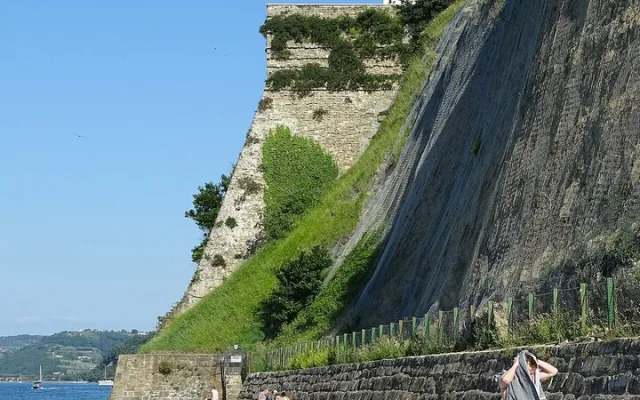
- The town walls — surviving defensive fortifications on the hill behind the town. Walking along them and climbing the towers gives one of the best vantage points over the whole peninsula.
- The seafront and the old harbour — a line of houses at the water's edge, fishing boats and restaurants; a good place to watch the sunsets for which the town is known.
- The narrow lanes of the historic centre — the district around May 1st Square, with its stone arches, external staircases and old wells, conveys the atmosphere of a medieval coastal settlement.
The surrounding area
A few kilometres away is Portorož, a resort zone with beaches and a tradition of health tourism. Nearby lie the Sečovlje salt pans, an extensive nature park where salt is still produced by the old method and where numerous bird species live. It is also worth looking into neighbouring Koper, the administrative centre of the Slovene Littoral, with a Venetian heritage of its own.
Food
The cooking of Piran is Mediterranean, with a strong Istrian and Italian influence. It is based on the produce of the sea: fresh fish, squid and mussels, along with dishes made with locally produced olive oil. Risotto, pasta, the cured ham pršut and truffles, in which the Istrian soil is rich, are all popular. The region's white and red wines are served, including the Malvazija and Refošk varieties. A meal often ends with a cup of strong coffee on a terrace overlooking the sea.
Practical information
Piran is best explored on foot — the historic centre is closed to through traffic, and cars are left in car parks at the entrance, from where a shuttle service runs to Tartini Square. Two days are enough to walk the lanes at an unhurried pace, climb up to St George's Church and the town walls, spend time on the seafront and make a trip to the salt pans or Portorož.
You can arrive by car or bus from Ljubljana and other towns in the country, and from neighbouring Trieste and Croatian Istria; in the warm season there is a coastal boat service. The best time to visit is late spring and early autumn, when the sea is still warm and there are fewer visitors than at the height of summer.