Prague
Czech RepublicDescription
Fairy-tale "Golden Prague" — Charles Bridge, Prague Castle and the best beer in the world.
Wiki
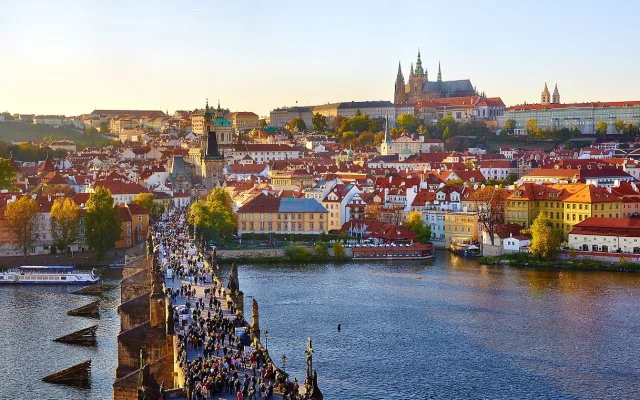
Prague is the capital of the Czech Republic and one of the most completely preserved medieval cities in Europe, spread along the banks of the Vltava. It earned the nicknames "Golden Prague" and "the city of a hundred spires" thanks to its panorama of tiled roofs, church towers and gilded domes; around eight million travellers come here each year, making the Czech capital one of the most visited destinations on the continent.
A little history
The first fortifications on these hills appeared in the 9th century, and the city's flowering came in the 14th, under the emperor Charles IV, when Prague became the effective capital of the Holy Roman Empire. It was then that Charles Bridge, St Vitus Cathedral and Charles University — the oldest in Central Europe (1348) — were founded. Later the city lived through the Hussite wars, the baroque rebuilding of the Habsburg era, the national revival of the 19th century and the Velvet Revolution of 1989. What makes Prague unique is that its historic centre came through the world wars almost unscathed, so that layers of Gothic, Renaissance, baroque, art nouveau and cubism sit on neighbouring streets. The historic centre is on the UNESCO World Heritage list.
Main sights
- Prague Castle (Pražský hrad) — the largest castle complex in the world by area and the seat of Czech rulers for more than a thousand years. Inside are the Gothic St Vitus Cathedral with stained glass by Alphonse Mucha, the Old Royal Palace, the basilica of St George and the picturesque Golden Lane with its tiny craftsmen's houses.
- Charles Bridge — a 14th-century Gothic stone bridge with thirty baroque statues of saints. By day it becomes a busy pedestrian artery with musicians and artists; to catch the crossing empty, come at dawn.
- The Old Town Square — the heart of the Old Town, with the famous Astronomical Clock (the Orloj) and its hourly procession of apostles, the twin-towered Týn Church and the brightly coloured facades of merchant houses.
- The Jewish Quarter (Josefov) — an ensemble of six synagogues, a town hall and the Old Jewish Cemetery with its densely crowded gravestones, one of the most completely preserved in Europe.
- Vyšehrad — an ancient fortress on a rock above the Vltava, with a rotunda, the neo-Gothic church of Saints Peter and Paul and a cemetery where Dvořák, Smetana and Čapek are buried. It offers one of the best views of the river.
The picture is completed by Wenceslas Square and its boulevard, the "Dancing House" and Petřín hill with its lookout tower resembling the Eiffel.
Beer and food
The Czech Republic holds the world record for beer consumption per head — about 143 litres a year — and beer culture here is raised to the rank of national tradition. The classics are the pale lager Pilsner Urquell, the dark Kozel and the family-run Bernard. For atmosphere, head to the historic beer halls, among them the legendary U Fleku, brewing dark beer since 1499, and the Pivovarský klub. A half-litre costs noticeably less than in most western European capitals.
Czech cooking is filling and meat-heavy: roast pork knuckle (vepro koleno), braised beef svickova in a cream sauce, goulash with knedliky — steamed bread dumplings. For something sweet there is trdelnik and palacinky, and with beer, fried cheese (smazeny syr).
Districts
- Staré Město (the Old Town) — the tourist core, with cobbled lanes and the main monuments.
- Mala Strana — the baroque quarter below the castle walls, with palaces, gardens and welcoming side streets.
- Nove Mesto — the business and shopping part around Wenceslas Square.
- Žižkov — a bohemian district with inexpensive bars and the television tower with its crawling baby figures.
- Vinohrady — a comfortable residential quarter with the restaurants and cafes that Praguers themselves use.
Practicalities
It is easy to arrive by train or by plane: the direct train from Berlin takes about 4.5 hours. Public transport combines a three-line metro (A, B, C) with trams and buses on a single ticket — the network covers the whole centre and runs late, with night trams after that. From Václav Havel airport, buses connect to the metro, and taxis are available; for journeys it is more reliable to order a car through an app. The currency is the Czech koruna, so change money at reputable offices rather than with touts on the street.
Prague is compact, and most of the key places in the centre can be reached on foot. Three days are enough to take in the Castle and Mala Strana at a gentle pace, walk across Charles Bridge to the Old Town Square and Josefov, climb up to Vyšehrad and keep an evening for a beer hall. For the ratio of impressions to cost, the Czech capital remains one of the most affordable large cities in Central Europe.
Photos