Description
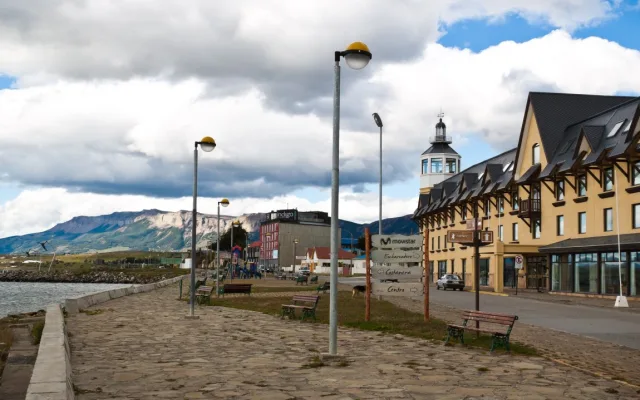
Gateway for trekking in Torres del Paine: Patagonian fjords, Serrano Glacier, guanacos and breathtaking sunsets over the Strait of Magellan.
Wiki
The main gateway to Torres del Paine National Park — South America's greatest natural wonder — Puerto Natales is a town of around 20,000 people in Chile's Magallanes Region, on the shores of Última Esperanza Bay, close to the Argentine border. Founded in the late 19th century as a sheep-farming colony by Scottish and Italian settlers, it is now the main base for treks and expeditions to Torres del Paine (the Paine Towers), Perito Moreno (on the Argentine side) and Antarctica.
Main Sights
- Torres del Paine National Park — South America's defining natural icon. 1,814 km², three famous granite towers rising to 2,850 m, Glacier Grey, glacial lakes, guanacos and pumas. UNESCO Biosphere Reserve.
- W-Trek (4–5 days) — the park's most popular route, 80 km in the shape of a W, with refugios for overnight stays.
- O-Circuit (8–10 days) — a full loop around the Torres massif; longer, quieter and more demanding than the W.
- Las Torres Base Trek — the most iconic day hike, 18 km return, 7–9 hours, to a turquoise lake at the foot of the three towers.
- Glacier Grey (Glaciar Grey) — catamaran across Lago Grey to the foot of a 30-metre ice wall; 55,000–82,400 CLP ($60–90).
- Cueva del Milodón (Mylodon Cave) — a cave containing the remains of a giant ground sloth (mylodon) that lived here around 12,000 years ago, 24 km from Puerto Natales.
- Última Esperanza (Last Hope) Sound — the fjord that gives the province its name, the setting for classic expedition voyages.
- Bernardo O'Higgins National Park — Chile's largest national park (35,000 km²), accessible only by boat.
- Mirador Cerro Dorotea — a viewpoint above the town and fjord, about 3 hours' climb.
- Puerto Natales Municipal Museum — ethnography of the sheep-farming era and the Tehuelche people.
- Puerto Bories — a restored historic sheep-processing complex, now a luxury hotel and museum.
- Perito Moreno and El Chaltén — on the Argentine side, 4–5 hours by bus across the border.
Food and Prices
The cuisine is Patagonian and Chilean: lamb roasted on a spit (cordero al palo, the regional speciality), centolla (southern king crab), curanto and pisco sour. Lunch at a café costs 13,700–22,900 CLP ($15–25); dinner at a restaurant 27,500–55,000 CLP ($30–60). A bottle of Chilean carménère runs 13,700–27,500 CLP ($15–30). A litre of petrol is around 1,100 CLP ($1.20), a city taxi 4,600–11,000 CLP ($5–12) and a shuttle to Torres del Paine 9,200–18,300 CLP ($10–20) for the 90 km trip. Prices are as of 2026.
Getting There
Teniente Julio Gallardo Airport (PNT) has LATAM flights from Santiago and Puerto Montt. More connections are available at Punta Arenas (PUQ, 250 km away), which is served by more airlines and has onward bus services. From Punta Arenas the bus takes 3 hours and costs 13,700–22,900 CLP ($15–25). From Argentine El Calafate, buses cross the border in 5–7 hours for 22,900–36,600 CLP ($25–40). Shuttle services run the 90 km to the park.
When to Go
November to March (southern summer) brings temperatures of 5–20 °C and long days (up to 17 hours of daylight in December). November and March are the sweet spot: fewer crowds and a good chance of spotting a puma. High season is December–February — book refugios at least 6 months ahead. Winter (June–August) drops to 0 to −10 °C; many refugios close, but the experience is special for well-prepared trekkers. Patagonian wind is the biggest hazard: gusts can reach 100 km/h.