Description
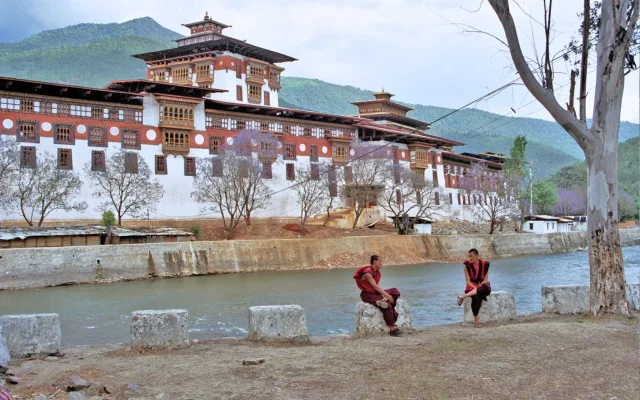
Bhutan's former winter capital — a 17th-century dzong on the spit between the Pho Chhu and the Mo Chhu, in the warmest of the tourist valleys.
Wiki
Punakha is the warmest and greenest of Bhutan's tourist valleys: while Thimphu is chilly, here rice, oranges and bananas ripen, and the country's principal fortress stands on the spit between two rivers like a ship on the water. For the independent traveller it is the obligatory third point after Paro and Thimphu — everyone passes through, few linger, and that is a mistake.
Why come
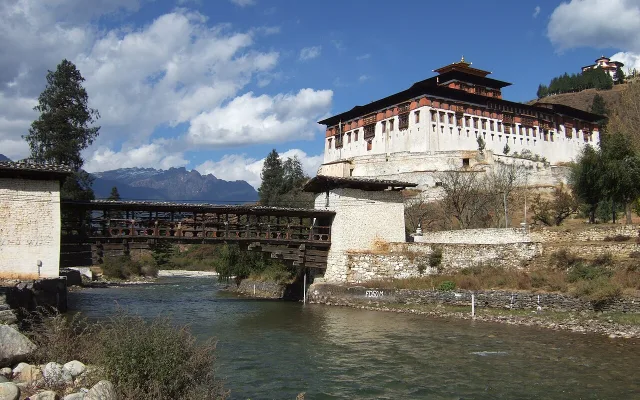
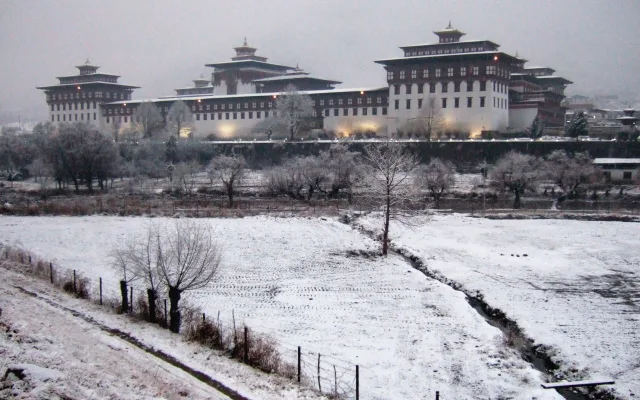
The key reason is Punakha Dzong (Pungtang Dewa Chenbi Phodrang, the "Palace of Great Happiness"), built in 1637. It is the second-oldest and second-largest dzong in Bhutan and, by common consent, the most beautiful: white walls on the promontory between the Pho Chhu and the Mo Chhu, jacarandas in flower in spring, and richly painted inner courtyards. It is the winter residence of the Je Khenpo, the country's chief abbot, so monastic life here is particularly alive in the cold months. Unlike many dzongs, visitors are admitted to the temple section — allow time for an unhurried walk through the courtyards rather than a photograph from outside.
The valley around is more than the fortress:
- The Punakha suspension bridge over the Pho Chhu — one of the longest in the country at around 160 m, swaying and hung with prayer flags. Free, with a good view along the valley.
- Chimi Lhakhang — the "fertility temple", founded in memory of Drukpa Kunley, the "Divine Madman". You walk to it across rice fields from the car park, about twenty minutes — and the walk is pleasanter than the temple. The houses in the surrounding villages are painted with phallic symbols, and souvenirs on the same theme are sold there.
- Khamsum Yulley Namgyal Chorten — a stupa on a hill above the valley; the climb goes up through terraces, with a panorama at the top. Less publicised than the dzong and correspondingly calmer.
Rafting the Mo Chhu
The main activity is rafting the Mo Chhu. The run is calm, the rapids of a low grade and suitable for beginners, and it finishes at the walls of Punakha Dzong — the view of the fortress from the water is worth it in itself. The neighbouring Pho Chhu is harder and longer. Trips are arranged through local operators; in the dry seasons of autumn and spring there is more water and better views. If you are choosing between the two rivers without experience, take the Mo Chhu.
Getting there and getting around
Punakha is linked to the rest of the country by the single road from Thimphu (about 75 km, two and a half to three hours) over the Dochu La pass at 3,100 m. The pass is not merely transit but a stop: 108 chortens along the ridge, and in clear weather — more often in the morning and in winter — a panorama of the snow peaks of the eastern Himalaya. Ask your driver to stop for twenty minutes here.
Visitors do not normally have their own car in Bhutan: the country operates on a system with a guide and driver, and transport is built into the itinerary. Distances within the valley are short but the sights are scattered — without a vehicle you will not get between the dzong, the bridge and Chimi Lhakhang. The core around the fortress is walkable.
How many days, and when
Two days is enough: on the first, the drive from Thimphu with a stop at Dochu La, then the dzong and the bridge towards evening; on the second, rafting in the morning and a walk to Chimi Lhakhang or the chorten. For a slower pace, add a night and a trip to the Phobjikha/Gangtey valley, about three hours away, where black-necked cranes arrive in winter.
The best seasons are October and November (clear, dry, with the mountains visible) and March and April (warm, with the jacarandas in flower by the dzong). The five-day Punakha Tshechu festival, with masked ritual dances inside the fortress, falls in February or March; if your dates coincide it is a powerful spectacle, but accommodation goes early. Summer is the rainy season and the mountains are hidden.
Practicalities, food and money
- Where to stay. Hotels are spread along the valley slopes rather than in a compact centre — check with your operator how close they are to the dzong and whether there is a valley view, or you risk staying far from everything.
- Altitude. At 1,200 m the breathing is easy and no acclimatisation is needed, though a quick ascent to Dochu La at 3,100 m can leave you slightly short of breath.
- Food. The warmth of the valley gives local rice, including red rice, and fruit; the national ema datshi (chilli with cheese) is genuinely hot here — ask for it "less spicy" if you are not ready.
- Budget. There is little to economise on separately in Punakha: food, transport and the guide are usually already part of the tour. Real on-the-spot costs are souvenirs, tips and rafting as an extra.
Common mistakes
- Skipping Dochu La to save an hour — you lose the finest panorama of the trip.
- Allowing a single day: the drive eats half of it, leaving no time for the dzong and the rafting.
- Coming in the rainy season and expecting a Himalayan view — there will not be one.
- Dressing too lightly: the valley is warm, but the pass and the early morning are noticeably colder, so bring a layer.