Description
A modern architectural landmark with Cube Houses, Markthal, and the largest port in Europe.
Wiki
Rotterdam is the second-largest city in the Netherlands after Amsterdam, located in the province of South Holland in the delta of the Rhine and Meuse rivers. Almost completely destroyed by German bombing in May 1940, the city chose not to rebuild its old urban fabric and instead became a laboratory for contemporary architecture. Today it is one of Europe's foremost urban attractions: bold skyscrapers, experimental residential districts, and the continent's largest seaport, linking Europe to world markets.
Getting to Rotterdam
The nearest major hub is Amsterdam Airport Schiphol, from which direct trains reach Rotterdam in roughly 25–40 minutes. Intercity and Thalys high-speed trains connect the city with Amsterdam, The Hague, Utrecht, Brussels, and Paris. Rotterdam Centraal station, with its distinctive pointed stainless-steel roof, is an architectural attraction in its own right. Getting around the city is easy by metro, tram, or bicycle — cycle lanes are everywhere.
Top Sights
Cube Houses
The Kubuswoningen are Rotterdam's most recognisable landmark. The complex of yellow cubes, each tilted at 45 degrees and mounted on hexagonal posts, was designed by architect Piet Blom in the 1980s. One of the houses is open as the Kijk-Kubus museum, where visitors can see what daily life looks like inside such unusual geometry.
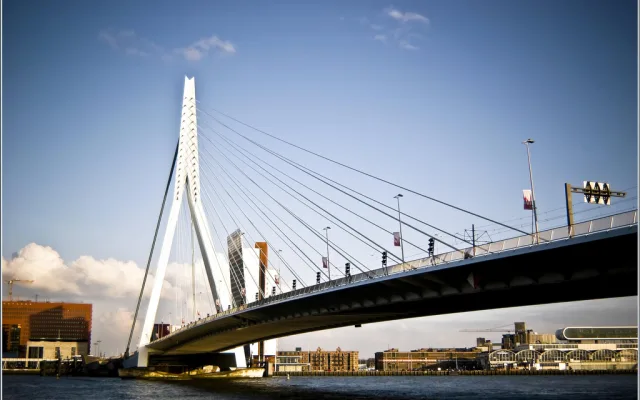
Erasmus Bridge
This cable-stayed bridge across the Nieuwe Maas, around 800 metres long and opened in 1996, is nicknamed "the Swan" for the distinctive silhouette of its pylon. It connects the city centre to the south bank and has become a symbol of the reborn city.
Markthal
The Markthal is a vast horseshoe-shaped arch with residential apartments above a covered food market. Its vaulted ceiling is decorated with an enormous, vivid mural called "Horn of Plenty." Stalls sell cheese, spices, fresh fish, fruit, and street food.
Oude Haven and the Maritime Museum
Oude Haven is the historic harbour, home to vintage vessels and one of the few places where the atmosphere of the pre-war city survives. Nearby, the Maritime Museum chronicles Rotterdam's seafaring and port history.
St Lawrence Church
The Grote of Sint-Laurenskerk is the only surviving medieval building in the city centre — a Gothic church from the 15th–16th centuries, restored after the war.
Euromast
The Euromast, around 185 metres tall, offers panoramic views of the city and port from its observation deck; the more daring can abseil down from the top.
De Rotterdam
The "vertical city" designed by Rem Koolhaas — three staggered towers housing offices, apartments, and a hotel on the bank of the Maas.
Parks and Green Spaces
Het Park
Het Park, at the foot of the Euromast, is a pleasant English landscape park with ponds and shaded paths — a relaxing spot for a stroll.
Kralingse Plas
Kralingse Plas is a large lake with woodland on the eastern edge of the city, popular with locals for rowing, picnics, and jogging; historic windmills stand along the shore.
Museums
Museum Boijmans Van Beuningen
One of the oldest and most richly stocked art museums in the country, with a collection spanning Old Masters to Surrealists. Nearby stands the striking mirrored Depot Boijmans Van Beuningen, a publicly accessible art storage facility.
Kunsthal
The Kunsthal, designed by Koolhaas, is an exhibition hall with no permanent collection, hosting a rotating programme of contemporary art and design shows.
Two Days in Rotterdam
Spend the first day exploring the centre: Cube Houses, Markthal, Oude Haven, and the Erasmus Bridge. Dedicate the second day to the museums, a trip up the Euromast, and a walk around the historic Delfshaven quarter, from which 17th-century settlers set sail. Rotterdam is compact and most sights are well connected by public transport.