Description
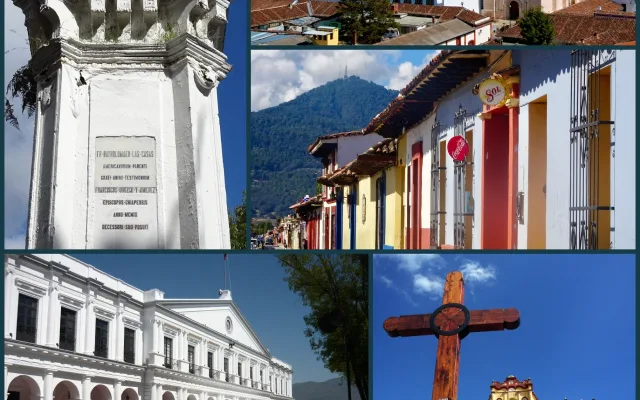
A colonial mountain city in the state of Chiapas with living Maya communities, misty forests, and the Agua Azul waterfalls nearby.
Wiki
A "Pueblo Mágico" (Magic Town) and the cultural heart of the Mexican state of Chiapas — around 220,000 inhabitants at 2,200 m in the Sierra Madre mountains. One of the most atmospheric colonial cities in Latin America. The best base for understanding indigenous Mexico: the city is surrounded by dozens of villages belonging to the Tzotzil and Tzeltal Maya peoples, each with its own language, dress, and traditions (a syncretism of Catholicism and local religion). Also a hub for trips to Palenque, the Sumidero Canyon, and the Montebello Lakes.
Main Sights
- Zócalo (Plaza 31 de Marzo) — the main square with the cathedral and municipal palace.
- Cathedral of San Cristóbal (Catedral de San Cristóbal) — the city's main church, with a yellow Baroque façade.
- Templo de Santo Domingo — the most beautiful church in the city (1547), with a gilded interior. In front of it is the main craft market.
- Andador Eclesiástico (Real de Guadalupe and Madero) — the main pedestrian streets lined with bars and restaurants.
- Templo y Cerro de Guadalupe — on the eastern hill, the best viewpoint over the city.
- Templo y Cerro de San Cristóbal — on the western hill, another viewpoint.
- San Juan Chamula — a Tzotzil village 10 km away, home to one of the most unusual churches in Latin America: Christianity blended with shamanism (no pews, the floor strewn with pine needles, candles, bottles of cola used to induce belching and expel spirits, chickens for sacrifice). Photography is strictly forbidden.
- Zinacantán — another Tzotzil village, known for its red-and-pink traditional costumes and weaving.
- San Lorenzo Zinacantán — a village with a traditional church.
- Sumidero Canyon (Cañón del Sumidero) — a gorge up to 1,000 m deep; boat tour along the Grijalva River, 1,030–1,545 MXN ($60–90), 1.5 hours from San Cristóbal.
- Palenque — a UNESCO World Heritage Site, an ancient Maya city 5 hours away; usually an overnight trip.
- Montebello Lakes (Lagunas de Montebello) — 59 multi-coloured lakes near the Guatemalan border.
- El Chiflón (Cascadas El Chiflón) — a series of turquoise waterfalls, 2 hours away.
Food and Prices
The local cuisine is Chiapaneco: tamales chiapanecos (with meat and chilli), pozol (a corn-and-cacao drink), pan compuesto, queso de bola, sopa de pan. There is a strong mezcal scene (mezcal and pacharán). Lunch at a café costs 103–206 MXN ($6–12), dinner at a restaurant 260–600 MXN ($15–35). Mezcal is 70–120 MXN ($4–7) a glass. A litre of fuel costs around 21 MXN ($1.20), a city taxi 70–140 MXN ($4–8), and a colectivo to nearby villages 17–34 MXN ($1–2). Prices are as of 2026.
Getting There and Around
San Cristóbal has no airport; the nearest is Tuxtla Gutiérrez (TGZ), 80 km away. From Tuxtla, the OCC bus takes 1.5 hours (140–205 MXN / $8–12); a taxi costs 1,030–1,370 MXN ($60–80). Tours to Palenque (5 hours each way) usually involve an overnight stay. The city centre is compact and easy to walk; taxis and colectivos serve the surrounding villages.
When to Go
November to April is the dry season, with temperatures of 8–22°C (the altitude keeps things cool — nights can be cold). The main events are Día de Muertos (1–2 November) and Carnival (two days before Lent). The rainy season (May–October) brings short, heavy downpours, though mornings are usually clear. At 2,200 m, always pack a warm layer.