Description
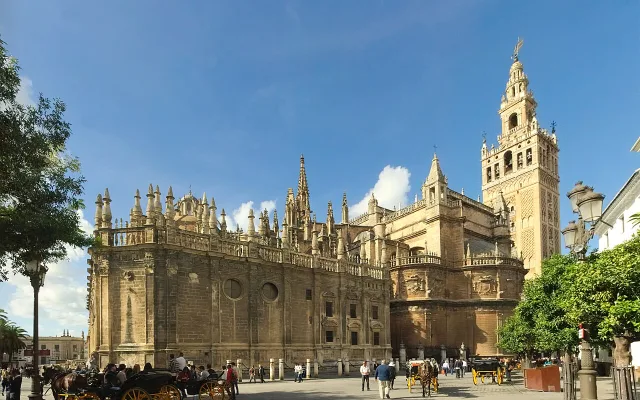
Seville is a city in Andalusia known as the home of flamenco. Its sights include the Alcazar and the Giralda.
Wiki
Seville is the capital of Andalusia and the fourth-largest city in Spain, spread along the banks of the Guadalquivir. This southern centre is famous for its Moorish inheritance, for the passion of flamenco, for the scent of orange trees in blossom and for a sultry temperament that can be felt on every street.
A little history
Founded by the Phoenicians and then the Romans (as ancient Hispalis), Seville flourished under the Arabs, who ruled it for several centuries under the name Ishbiliya. It is from that era that the city inherited its elegant courtyards, its minarets and its horseshoe arches. After the Reconquest in 1248 the city passed to the Castilian crown, and in the age of exploration it became Spain's chief maritime gateway: expeditions to the New World were fitted out here, and all the colonial gold and silver passed through the local port. That wealth shaped the sumptuous look of the historic centre.
Main sights
- The Alcazar — a royal palace in the Mudejar style, built between the 14th and 16th centuries on the foundations of an Arab fortress. It is one of the finest examples of Islamic architecture in Europe, with lacework carving, tilework and gardens. The palace served as a set for "Game of Thrones" and is on the UNESCO list. Tickets about €14.50; it is best to book ahead.
- The cathedral — the third-largest Christian church in the world, raised on the site of the main mosque. Inside is the tomb of Christopher Columbus. A UNESCO site; tickets around €11.
- The Giralda — the cathedral's 97-metre bell tower, once a minaret. Instead of stairs, gentle ramps lead to the top, and from the viewing platform a panorama of tiled roofs opens up.
- Barrio Santa Cruz — the former Jewish quarter, a maze of narrow lanes with whitewashed facades, wrought-iron balconies and shaded patios.
- The Plaza de Espana in the Maria Luisa park — a grand semicircular ensemble with a canal, little bridges and ceramic alcoves dedicated to the Spanish provinces. Built for the exposition of 1929.
- The Metropol Parasol (known locally as "the mushrooms") — a huge modern timber structure with a viewing walkway, in deliberate contrast with the historic buildings around it.
- The Torre del Oro — a 13th-century defensive tower on the waterfront, a reminder of the city's illustrious maritime past.
Quarters and atmosphere
Besides Santa Cruz, it is worth walking through the Triana quarter on the far bank of the Guadalquivir — the cradle of ceramics, bullfighting and gypsy flamenco. Bohemian Alameda de Hercules draws young people and night owls, while the shopping street of Sierpes is good for unhurried browsing and for getting a feel of the local rhythm.
Flamenco
Seville is rightly considered the heart of flamenco — it sounds more authentic and more alive here than in the capital. The most atmospheric performances take place in small tablao venues: Casa de la Memoria, El Arenal, and the legendary La Carboneria, where informal evening sessions can still be caught. The Flamenco Dance Museum helps make sense of the history of the genre.
Food
The city's cooking is built around tapas, small portions ordered as you move from bar to bar. Be sure to try:
- salmorejo — a thick cold tomato cream with ham and egg;
- gazpacho — a refreshing vegetable soup, a lifesaver in the heat;
- pescaito frito — crisp fried fish and seafood;
- Iberian ham and the local olives.
It all goes down with chilled sherry from the neighbouring region or a light beer. An average lunch in a simple place costs from about €11.
When to come
Spring and autumn are best. April brings two vivid events: Semana Santa (Holy Week) with its solemn religious processions, and the Feria de Abril, a colourful popular fair with costumes, horses and sevillanas dancing. Summer is exhausting: the temperature often climbs to 40–45 °C, so July and August are better avoided, or sightseeing planned for the morning and the evening.
Practicalities
Three days are enough to see the essentials without rushing. Devote the first day to the Alcazar, the cathedral and the Giralda, the second to walks through Santa Cruz, the Maria Luisa park and the Plaza de Espana, the third to Triana, the riverside and an evening of flamenco. The historic centre is compact and pedestrian-friendly; trams and buses also run through the city, and cycle paths follow the river. Seville is connected by AVE high-speed trains to Madrid (about 2.5 hours) and Cordoba, which makes it a convenient base for exploring Andalusia.