 Города и дороги
Description
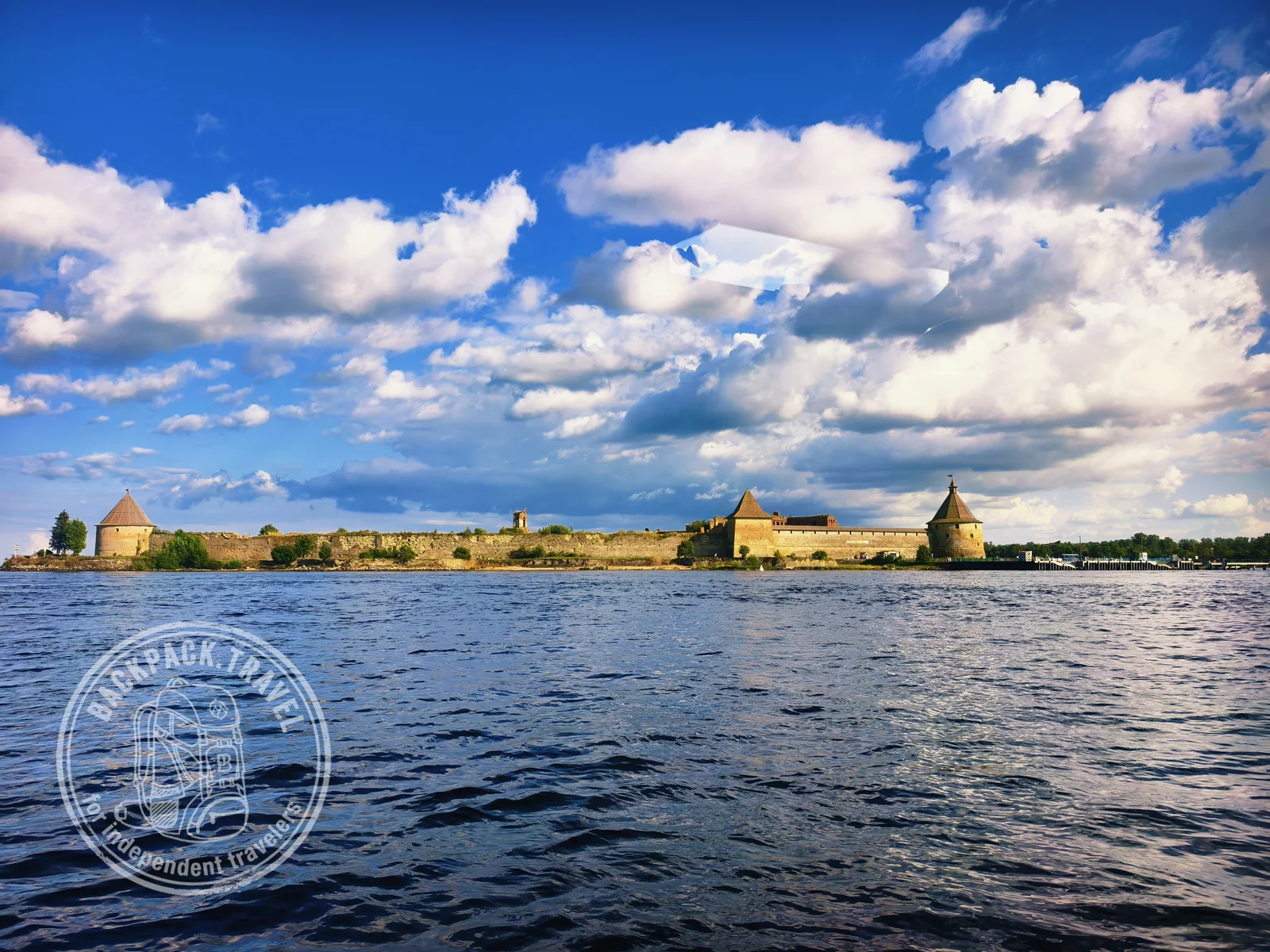
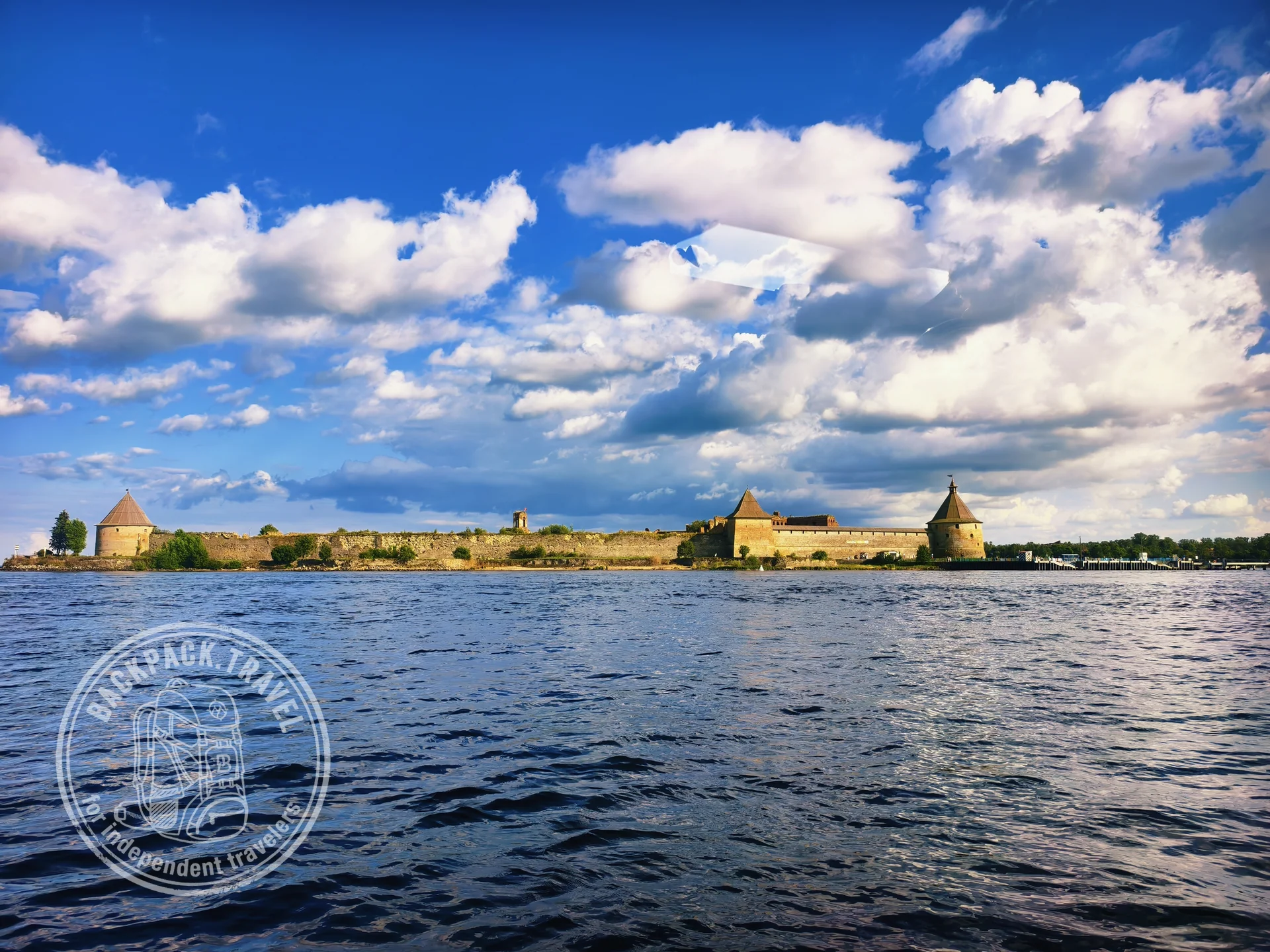
A small town where the Neva leaves Lake Ladoga, with boats out to the Oreshek fortress, an island stronghold that held its ground both in the Great Northern War and in 1941–1943.
Wiki
Shlisselburg is a small town in the Kirovsky district of Leningrad Region, with about 14 thousand residents, roughly 50 km east of St Petersburg. It stands where the Neva flows out of Lake Ladoga, and the whole point of the trip is the island in the middle of that outflow with the Oreshek fortress on it.
The Oreshek fortress
The fortress was founded in 1323 by the Novgorod prince Yuri Danilovich, and in the same year the Treaty of Nöteborg was signed here, the first agreement between Novgorod and Sweden. In 1352 the defenses were rebuilt in stone, and between 1514 and 1525, under Vasily III, the fortress took its present outline: walls about 740 meters long, ten towers and a separate citadel behind a harbor channel.
In 1612, after a nine-month siege, it was taken by the Swedes and renamed Nöteborg. Peter I won it back in an assault on 11 (22) October 1702 that lasted thirteen hours. Peter gave the fortress the name Shlisselburg, the "key town", and ordered the key presented to him to be fixed to the Sovereign's Tower.
For almost two centuries after that the fortress served as a prison.
- The old prison, the "Secret House", was built in 1798 inside the citadel with ten solitary cells, and the Decembrists were held here. In 1764 the guards killed Ivan VI Antonovich, the emperor who had been deposed as an infant, when Lieutenant Mirovich tried to free him.
- The new prison appeared in the 1880s with forty cells, and prisoners were held here from 1884 to 1906: fifteen were executed and as many died of disease. In 1887 Alexander Ulyanov was executed here over the plot against Alexander III.
Both prisons are open as museum displays, and this is the strongest part of the visit.
The defense of 1941–1943
From 8 September 1941 to 18 January 1943, for 498 days, the fortress was held by a garrison of two hundred and fifty to three hundred men, NKVD troops and sailors from a coastal battery. The German positions stood on the left bank, some two hundred meters away. The enemy never crossed to the right bank, never closed the blockade ring from the east and never managed to cut the Ladoga stretch of the Road of Life.
The fortress was almost completely destroyed. The ruins of the Cathedral of St John were conserved as the core of the 1985 memorial with its sculptural group "The Oath". Six of the ten towers survive, and the Golovin Tower has a viewing platform from which you can see both Ladoga and the source of the Neva.
How to get to the island
Only by water and only in season. The fortress is open roughly from the beginning of May to the end of October and closed in winter. Boats run from the pier in Shlisselburg itself and from Morozova settlement opposite, and the crossing takes ten to fifteen minutes.
- The crossing is paid for separately from the entry ticket, and different operators set their own fares.
- In a strong wind the sailings are canceled. This is not a formality, because in bad weather you may not get to the island at all. Keep a fallback plan for the day.
- The opening hours and the boat schedule change from month to month, so check before you set out.
Buses run from St Petersburg: route 575 from Ulitsa Dybenko metro station, taking about 40 to 60 minutes, and route 440 from Rybatskoye. The other option is the suburban train from the Finlyandsky station to Petrokrepost and the crossing from the right bank.
The source of the Neva, the canals and the town
The Neva flows out of the Shlisselburg Bay of Lake Ladoga opposite the fortress, and its entire length is 74 km. The embankments by the source are good for a short walk.
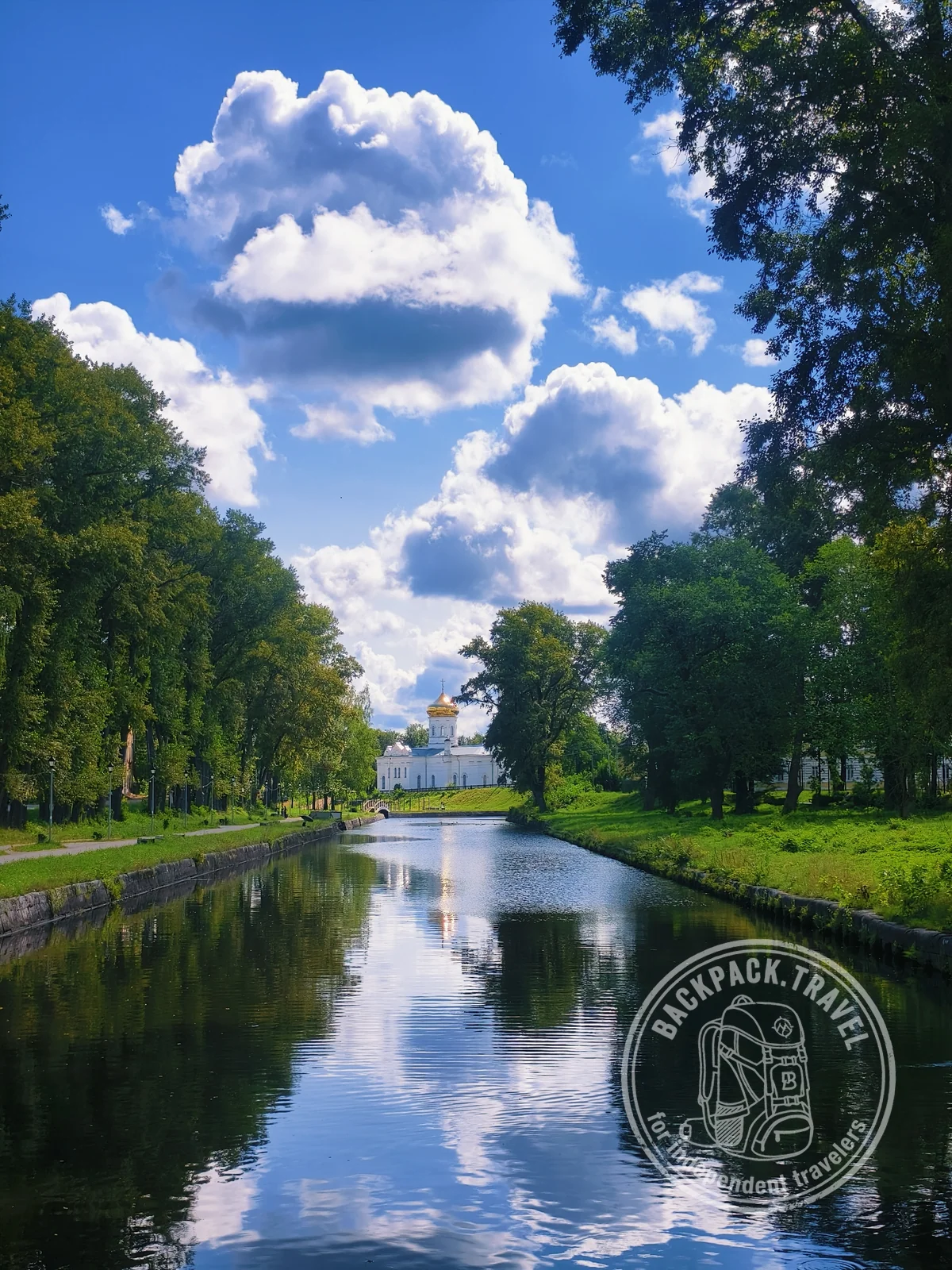
The Old Ladoga Canal was built between 1719 and 1730: Ladoga is prone to storms and sailing vessels were lost by the hundred, so a route was dug around the lake from the Volkhov to the Neva, close to 120 kilometers long. Skornyakov-Pisarev began the works and Münnich finished them. By the middle of the 19th century the canal had silted up, and in 1861–1866 the lock-free New Ladoga Canal was dug alongside it. The old one is overgrown and no longer navigable, but the most spectacular part of it survives in Shlisselburg: granite locks of the first half of the 19th century, including a four-chamber one, and the Petrovsky bascule bridge.
By the pier stands a monument to Peter I by Mark Antokolsky: the model dates from 1872, but it was erected in 1957, and it was the first monument to a tsar put up in the USSR after the revolution.
How much time to allow
Half a day is enough if you are coming specifically for the island, counting the journey, the crossing and an hour and a half to two hours in the fortress itself. The optimum is to take a full day from St Petersburg, which adds a walk along the canals and the embankment to the fortress. There is no reason to stay overnight, since the town itself is covered in an hour or an hour and a half.
There is little shade on the island and almost nowhere to shelter from rain and wind, so dress with something in reserve even on a warm day.
Who won't enjoy it: in winter and early spring there is no point coming, because the main sight is closed and what you get is an ordinary small town with a canal. Anyone expecting a castle with interiors will find Oreshek the wrong place, since it is ruins and bare walls, and the impression rests on the history and the setting rather than on beauty. And if the wind gets up, resign yourself to it in advance, because no amount of persistence will bring the boat back.