Stellenbosch
South AfricaDescription
South Africa's wine capital in the Cape winelands — Cape Dutch architecture, tastings at hundreds of estates and university charm.
Wiki
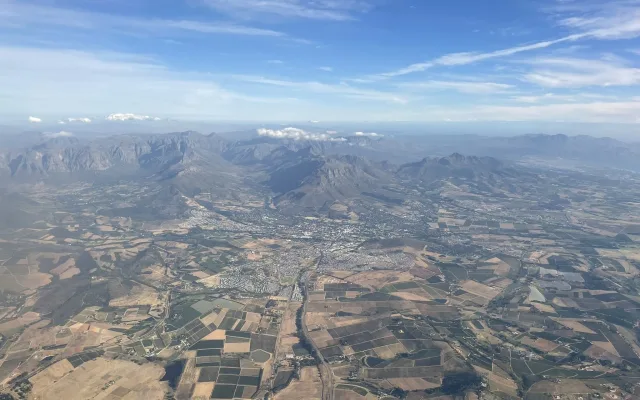
The wine capital of Africa and the second-oldest European settlement in South Africa, with around 200,000 people including the student population, an hour from Cape Town. It was founded by Simon van der Stel in 1679 as a Dutch outpost. This is the country's great campus town, home to Stellenbosch University. More than 200 wineries lie around it, and the wider Cape winelands take in Franschhoek, Paarl, Constantia and Hemel-en-Aarde. The Mediterranean climate is ideal for shiraz, chenin blanc and pinotage.
Main sights
- Dorp Street — the longest surviving street of Cape Dutch architecture, with the oldest houses dating from 1693.
- The Stellenbosch Village Museum — a complex of four Cape Dutch houses from different periods (1690, 1750, 1800, 1850).
- The great Stellenbosch estates: Spier (one of the largest in the country), Tokara (a modern winery with a viewpoint), Delaire Graff, Rust en Vrede, Kanonkop (the pinotage benchmark), Meerlust, Vergelegen.
- Lanzerac Estate — the historic hotel and winery of Stellenbosch, and the birthplace of pinotage, a cross of pinot noir and cinsaut created here in 1925.
- The Stellenbosch University Botanical Garden — the oldest in South Africa (1922).
- The Stellenbosch Wine Route — the main touring route, with more than 200 wineries. Day tours cost R970-1,600 ($60-100).
- Franschhoek — the neighbouring wine town 20 km away and the country's leading food destination, with its Wine Tram.
- Wellington and Paarl — further wine districts an hour from Stellenbosch.
- Helderberg — the mountain viewpoint above the town.
- Boulders Beach — the penguin beach, an hour away.
Food and prices
The cooking is Cape and South African: braai, bobotie, koeksisters and boerewors, with strong French and Dutch inheritance. Lunch in a café is R190-360 ($12-22), dinner in a restaurant R490-1,050 ($30-65). A tasting of five or six wines at an estate costs R130-240 ($8-15), and a bottle of pinotage R130-400 ($8-25). A litre of petrol is R21 ($1.30), a taxi or Uber R130-320 ($8-20), and car hire R400-730 ($25-45) a day. Prices are as of 2026.
Getting there and getting around
The nearest international airport is Cape Town (CPT), 50 km away. From Cape Town there is the Metrorail train, an hour and R50-80 ($3-5), though it is not recommended on safety grounds; a taxi or Uber costs R970-1,300 ($60-80), and car hire R490-810 ($30-50) a day. For the wineries, take a guide or a tour — you cannot drive yourself where alcohol is involved. Around town, walk or take a taxi.
When to go
November to April, the southern summer, runs 18-30°C. December to March is peak season and the estates are full. May to September, the winter, is 8-18°C and rainy, but the wineries stay open and prices are lower. The grape harvest falls in February and March. The main event is the Stellenbosch Wine Festival in February.