Description
The capital of Alsace, with a fairytale old town at Petite France, a Gothic cathedral, and the best Christmas markets in Europe.
Wiki
The capital of Alsace and the seat of the European Parliament (alongside Brussels and Luxembourg) — around 290,000 people on the Ill River at the border with Germany. The Grande Île (historic island centre) is a UNESCO World Heritage Site. The city has a unique Franco-German identity, having changed nationality four times between 1871 and 1945. The Alsatian language is a dialect of German, and Alsatian cuisine is half German. It is also home to France's oldest Christmas market, held since 1570.
Top sights
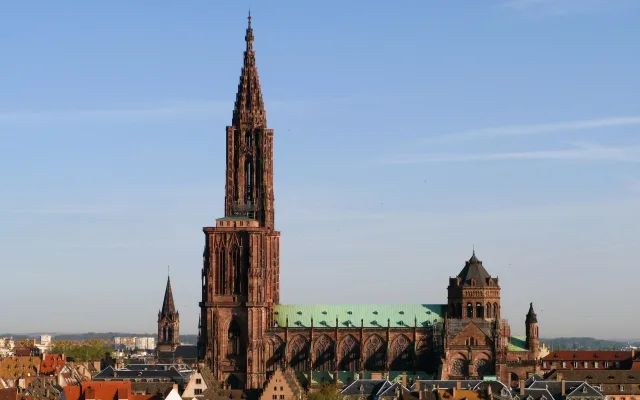
- Strasbourg Cathedral (Cathédrale Notre-Dame) — the tallest church in Europe from 1647 to 1874 (142 m), built in pink sandstone in the Gothic style from the 12th to 15th centuries. The 19th-century astronomical clock features a mechanical procession of the Apostles at 12:30.
- Petite France — the main historic quarter on the island, a medieval tanners' district with half-timbered houses dating from the 16th and 17th centuries.
- Ponts Couverts — a 13th-century defensive work of three bridges across the channels of the Ill and four watchtowers. The wooden roofs were removed in 1784, but the name stuck.
- Barrage Vauban — a fortress-dam built in 1690 with a panoramic terrace.
- Palais Rohan — the city's main museum complex housing three collections under one roof: Archaeological, Decorative Arts, and Fine Arts.
- Alsatian Museum — ethnography of the Alsace region.
- European Quarter — the European Parliament (open during sessions), the European Court of Human Rights, and the Council of Europe.
- Place Kléber — the main city square, with a statue of General Kléber.
- Place Gutenberg — Gutenberg lived in Strasbourg from 1434 to 1444 and ran his first printing experiments here, though he perfected the press in Mainz. A statue of him stands on the square.
- Marché de Noël (Christmas Market) — the oldest in France, running since 1570; around a dozen markets across the city from late November to 24 December.
- Alsace Wine Route (Route des Vins d'Alsace) — a 170 km route through wine villages including Riquewihr, Kaysersberg, Eguisheim, and Colmar.
- Colmar — the most picturesque town in Alsace, 70 km away, with its own Petite Venise quarter.
Food and prices
Alsatian cuisine is the heart of the Franco-German culinary heritage here: choucroute alsacienne (sauerkraut with sausages and pork), tarte flambée (flammekueche), baeckeoffe (slow-braised meat in a pot), kougelhopf, and pretzel. Lunch at a winstub runs 16–25 EUR (about $18–29), dinner 30–65 EUR ($35–75). A glass of Alsatian Riesling or Gewurztraminer costs 4–7 EUR ($5–8). A litre of petrol is around 1.80 EUR ($2.10), a CTS public transport ticket 1.70 EUR ($2), bike hire is available through Vélhop, and taxis run 12–25 EUR ($14–29). Prices are as of 2026.
Getting there and around
Strasbourg Entzheim International Airport (SXB), 12 km from the centre, is served by Air France and Volotea. The airport train takes 9 minutes and costs 4 EUR ($5). From Paris by TGV: 1 hour 50 minutes (30–90 EUR / $35–104). From Frankfurt: around two hours by train. Within the city, the tram network (one of the best in Europe), cycling, and walking all work well — the centre is compact.
When to go
April to October brings temperatures of 12–25°C. Late November to 24 December is Christmas market season — the city's defining event, with peak prices and demand; book accommodation 4–6 months ahead. Winter is cold (−2 to +5°C) but the markets are magical. September and October are the Alsatian grape harvest season.