Description
The best-preserved medieval city in Northern Europe, with Hanseatic towers, the Toompea citadel, and a thriving digital startup scene.
Wiki
Tallinn is the capital of Estonia and one of the most completely preserved medieval cities in Northern Europe. Sitting on the southern shore of the Gulf of Finland, just 80 kilometres from Helsinki, it combines a Hanseatic heritage spanning the 13th to 16th centuries with a reputation as a global digital laboratory: Skype, Wise and Bolt were all founded here, and Estonia runs the world's first nationwide systems of e-residency and online voting. The historic city centre has been a UNESCO World Heritage Site since 1997.
History and character
The first urban settlement on the site of present-day Tallinn emerged in the 13th century, when the Danes built a fortress on Toompea hill — the city's name is thought by some to derive from Taani linn, meaning "Danish town." In 1248 the settlement received Lübeck city rights and soon joined the Hanseatic League, becoming a key transit point for trade between Western Europe and Novgorod. Over the centuries Tallinn passed to the Teutonic Order, Sweden and the Russian Empire, yet its merchant street plan, narrow cobbled lanes and ring of defensive walls survived almost intact. During the Soviet era the city served as the capital of the Estonian SSR; the country restored its independence in 1991.
The metropolitan population approaches half a million, making Tallinn the largest city in the country. The historic core is divided into the aristocratic Upper Town (Toompea) and the merchant Lower Town (All-linn), which for centuries existed as entirely separate administrative units.
What to see in the Old Town
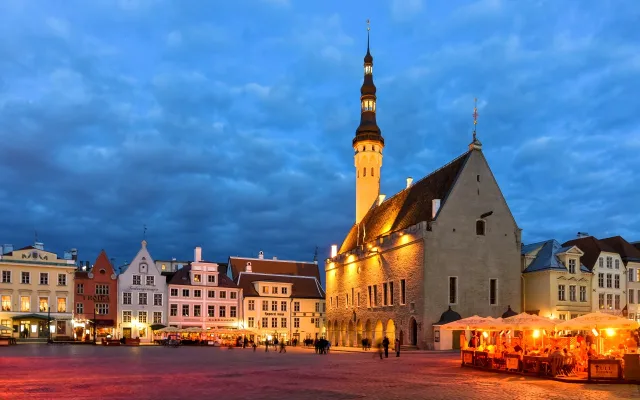
- Town Hall Square (Raekoja plats) — the heart of the Lower Town, dominated by a Gothic town hall dating from 1404, the oldest still in use in the region. The weathervane known as "Old Thomas" on its spire has become Tallinn's unofficial symbol.
- Old Pharmacy (Raeapteek) — in operation since 1422, it is considered one of the longest continuously trading pharmacies in Europe; a small museum is attached.
- Toompea — the castle hill and fortress where the Estonian parliament (Riigikogu) sits today. The Tall Hermann tower, roughly 46 metres high, raises the national flag every day.
- Dome Church (Toomkirik) — a Lutheran cathedral dating from the 13th century, the oldest church on the Estonian mainland, housing the tombs of noble families.
- Alexander Nevsky Cathedral — a Russian Orthodox cathedral in the Neo-Byzantine style, completed in 1900; its onion domes create a striking contrast with the medieval surroundings.
- City walls and towers — of an original ring nearly four kilometres long, about 1.9 km of fortifications and more than two dozen towers survive. The artillery bastion Kiek in de Kök ("Peep into the Kitchen") has been converted into a museum of fortification.
- Kohtuotsa and Patkuli viewing platforms offer classic panoramas of terracotta rooftops, spires and the bay.
Kadriorg and surroundings
To the east of the centre lies Kadriorg Park, with its Baroque palace begun by Peter the Great in 1718–1725 for Catherine I. The palace now houses a collection of foreign art, while the park is home to KUMU, Estonia's main art museum, with an extensive collection of national painting. On the waterfront, the former seaplane hangar now serves as the Lennusadam maritime museum, displaying the submarine Lembit, icebreakers and historic vessels.
Food and atmosphere
Estonian cuisine is restrained and hearty: dark rye bread, smoked and pickled fish, barley soup, blood sausage, and in winter a spiced mulled wine. In the Old Town, atmospheric venues such as the Olde Hansa tavern recreate medieval recipes and décor. Marzipan — said by local legend to have been invented in Tallinn's own pharmacy — is sold in the form of hand-painted figurines. The contemporary food scene is centred on the Rotermann Quarter and the Telliskivi creative district, which grew up on the site of a former industrial complex.
Practical information
The official language is Estonian; Russian and English are both widely spoken. The currency is the euro. The climate is temperate maritime: summers are cool, around 18–22 °C, and winters mild by northern standards, with frequent snowfall and short days. The most comfortable season for sightseeing is May to September; in December the main square hosts a Christmas market.
Lennart Meri Airport is a few kilometres from the centre and is connected to it by tram. The port runs regular ferry services to Helsinki and Stockholm. City public transport is free for registered residents; visitors can use travel passes or a tourist card.
Allow around three days for Tallinn: the first for the Old Town and its fortifications, the second for Kadriorg, the museums and the waterfront, and the third for the modern districts, design studios and short trips beyond the centre.